
Datos técnicos
| Fórmula | C28H24FN3O5 |
||||||
| Peso molecular | 501.51 | Número CAS | 849217-68-1 | ||||
| Solubilidad (25°C)* | In vitro | DMSO | 100 mg/mL (199.39 mM) | ||||
| Water | Insoluble | ||||||
| Ethanol | Insoluble | ||||||
| In vivo (Agregue los solventes al producto individualmente y en orden.) |
|
||||||
|
* <1 mg/ml significa ligeramente soluble o insoluble. * Tenga en cuenta que Selleck prueba la solubilidad de todos los compuestos internamente, y la solubilidad real puede diferir ligeramente de los valores publicados. Esto es normal y se debe a ligeras variaciones entre lotes. * Envío a temperatura ambiente (Las pruebas de estabilidad demuestran que este producto se puede enviar sin medidas de refrigeración.) |
|||||||
Preparación de soluciones madre
Actividad biológica
| Descripción | Un potente inhibidor de VEGFR2 con una IC50 de 0,035 nM, Cabozantinib (XL184) también inhibe c-Met, Ret, Kit, Flt-1/3/4, Tie2 y AXL con una IC50 de 1,3 nM, 4 nM, 4,6 nM, 12 nM/11,3 nM/6 nM, 14,3 nM y 7 nM en ensayos sin células, respectivamente. Induce apoptosis dependiente de PUMA en células de cáncer de colon a través de la vía de señalización AKT/GSK-3β/NF-κB. | ||||||
|---|---|---|---|---|---|---|---|
| Objetivos |
|
||||||
| In vitro | Cabozantinib (XL184) tiene una débil actividad inhibidora contra RON y PDGFRβ con una IC50 de 124 nM y 234 nM, respectivamente, y tiene baja actividad contra FGFR1 con una IC50 de 5,294 μM. A baja concentración (0,1-0,5 μM), es suficiente para inducir una marcada inhibición de la fosforilación constitutiva e inducible de Met y su señalización posterior resultante en células MPNST, e inhibir la migración e invasión de células MPNST inducidas por HGF. Este compuesto también induce una marcada inhibición de la fosforilación de Met y VEGFR2 en células endoteliales de vena umbilical humana (HUVECs) estimuladas por citocinas. Aunque no tiene un efecto significativo sobre el crecimiento de células MPNST a 0,1 μM, XL184 a 5-10 μM inhibe significativamente el crecimiento de células MPNST. | ||||||
| In vivo | El tratamiento con Cabozantinib (XL184) a 30 mg/kg en ratones RIP-Tag2 con tumores espontáneos de islotes pancreáticos interrumpe el 83% de la vasculatura tumoral, reduce los pericitos y los manguitos de membrana basal vacíos, causa hipoxia intratumoral generalizada y una extensa apoptosis de las células tumorales, y ralentiza el rebrote de la vasculatura tumoral después de la retirada del fármaco, de manera más significativa en comparación con XL999, que bloquea VEGFR pero no c-Met, lo que lleva a una reducción de solo el 43% en la vascularización, lo que sugiere que la inhibición concurrente de VEGFR y otras tirosina quinasas receptoras (RTK) funcionalmente relevantes amplifica la inhibición de la angiogénesis. Este compuesto también disminuye la invasividad de los tumores primarios y reduce la metástasis. A 30 mg/kg/día, abroga significativamente el crecimiento y la metástasis de xenoinjertos de MPNST humanos en ratones SCID. La administración de XL184 induce una inhibición dosis-dependiente del crecimiento tumoral en modelos de tumores de mama, pulmón y glioma, en asociación con una disminución de la proliferación de células tumorales y endoteliales, así como un aumento de la apoptosis. Una dosis oral única es suficiente para inducir una inhibición sostenida del crecimiento tumoral en ratones portadores de tumores MDA-MB-231 y ratas portadoras de tumores C6 a 100 mg/kg y 10 mg/kg, respectivamente. |
Protocolo (de referencia)
| Ensayo celular: |
|
|---|---|
| Estudio en animales: |
|
Referencias
|
Validación de productos por parte del cliente
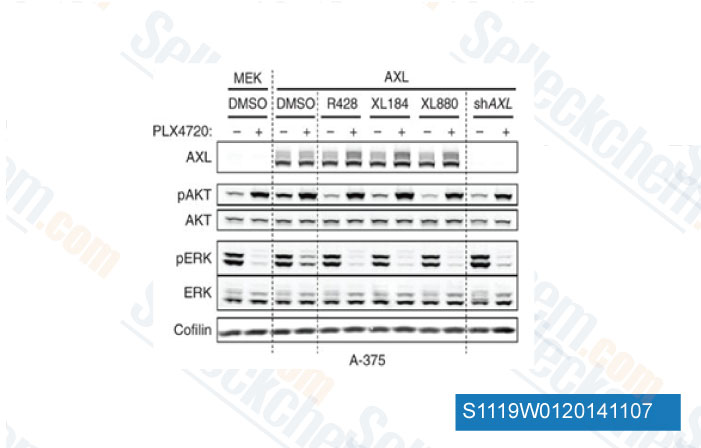
-
Datos de [ Cancer Discov , 2014 , 4(7), 816-27 ]
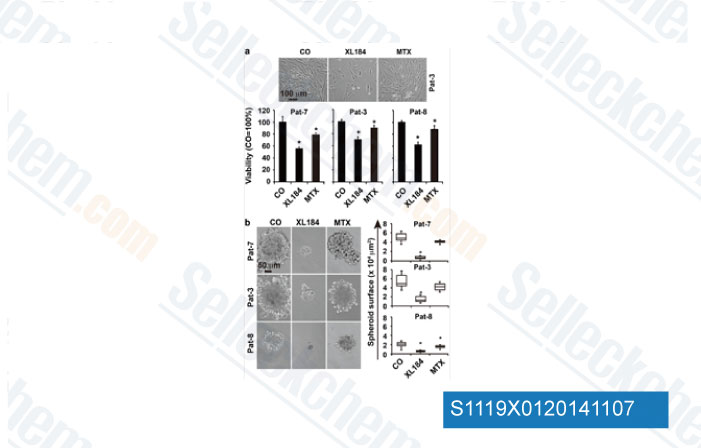
-
Datos de [ Cell Death Dis , 2014 , 5, e1471 ]
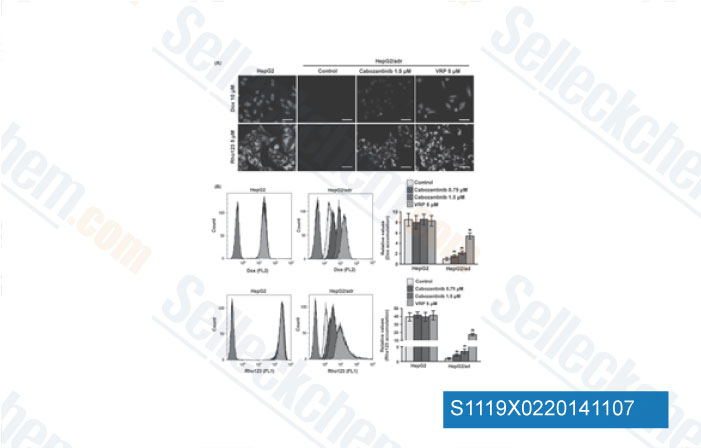
-
Datos de [ Liver Int , 2014 , 10.1111/liv.12524 ]

-
, , Christina W Yde/CDM Danish Cancer Society Research Center Denmark
Sellecks Cabozantinib (XL184) Ha sido citado por 169 Publicaciones
| S100P is a ferroptosis suppressor to facilitate hepatocellular carcinoma development by rewiring lipid metabolism [ Nat Commun, 2025, 16(1):509] | PubMed: 39779666 |
| ARID1A loss enhances sensitivity to c-MET inhibition by dual targeting of GPX4 and iron homeostasis, inducing ferroptosis [ Cell Death Differ, 2025, 10.1038/s41418-025-01510-x] | PubMed: 40369167 |
| Inhibition of TFF3 synergizes with c-MET inhibitors to decrease the CSC-like phenotype and metastatic burden in ER+HER2+ mammary carcinoma [ Cell Death Dis, 2025, 16(1):76] | PubMed: 39920140 |
| Relevance of transportome among the mechanisms of chemoresistance in hepatoblastoma [ Biochem Pharmacol, 2025, 237:116914] | PubMed: 40185314 |
| A Robust Marine Collagen Peptide-Agarose 3D Culture System for In Vitro Modeling of Hepatocellular Carcinoma and Anti-Cancer Therapeutic Development [ Mar Drugs, 2025, 23(10)386] | PubMed: 41149589 |
| Characterisation of an autochthonous mouse ccRCC model of immune checkpoint inhibitor therapy resistance [ Sci Rep, 2025, 15(1):19818] | PubMed: 40473819 |
| Sensitizing cholangiocarcinoma to chemotherapy by inhibition of the drug-export pump MRP3 [ Biomed Pharmacother, 2024, 180:117533] | PubMed: 39405909 |
| Construction of disulfidptosis-based immune response prediction model with artificial intelligence and validation of the pivotal grouping oncogene c-MET in regulating T cell exhaustion [ Front Immunol, 2024, 15:1258475] | PubMed: 38352883 |
| Novel therapeutic strategies targeting bypass pathways and mitochondrial dysfunction to combat resistance to RET inhibitors in NSCLC [ Biochim Biophys Acta Mol Basis Dis, 2024, 1870(6):167249] | PubMed: 38768929 |
| Patient-derived rhabdomyosarcoma cells recapitulate the genetic and transcriptomic landscapes of primary tumors [ iScience, 2024, 27(10):110862] | PubMed: 39319271 |
POLÍTICA DE DEVOLUCIÓN
La Política de Devolución Incondicional de Selleck Chemical garantiza una experiencia de compra en línea fluida para nuestros clientes. Si no está satisfecho con su compra de alguna manera, puede devolver cualquier artículo(s) dentro de los 7 días posteriores a su recepción. En caso de problemas de calidad del producto, ya sean problemas relacionados con el protocolo o con el producto, puede devolver cualquier artículo(s) dentro de los 365 días a partir de la fecha de compra original. Siga las instrucciones a continuación al devolver productos.
ENVÍO Y ALMACENAMIENTO
Los productos Selleck se transportan a temperatura ambiente. Si recibe el producto a temperatura ambiente, tenga la seguridad de que el Departamento de Inspección de Calidad de Selleck ha realizado experimentos para verificar que la colocación a temperatura normal durante un mes no afectará la actividad biológica de los productos en polvo. Después de la recogida, guarde el producto de acuerdo con los requisitos descritos en la hoja de datos. La mayoría de los productos Selleck son estables en las condiciones recomendadas.
NO PARA USO HUMANO, DIAGNÓSTICO VETERINARIO O TERAPÉUTICO.