
Datos técnicos
| Fórmula | C28H24FN3O5.C4H6O5 |
||||||
| Peso molecular | 635.59 | Número CAS | 1140909-48-3 | ||||
| Solubilidad (25°C)* | In vitro | DMSO | 100 mg/mL (157.33 mM) | ||||
| Water | Insoluble | ||||||
| Ethanol | Insoluble | ||||||
| In vivo (Agregue los solventes al producto individualmente y en orden.) |
|
||||||
|
* <1 mg/ml significa ligeramente soluble o insoluble. * Tenga en cuenta que Selleck prueba la solubilidad de todos los compuestos internamente, y la solubilidad real puede diferir ligeramente de los valores publicados. Esto es normal y se debe a ligeras variaciones entre lotes. * Envío a temperatura ambiente (Las pruebas de estabilidad demuestran que este producto se puede enviar sin medidas de refrigeración.) |
|||||||
Preparación de soluciones madre
Actividad biológica
| Descripción | Cabozantinib malate (XL184) es el malato de Cabozantinib, un potente inhibidor de VEGFR2 con una IC50 de 0,035 nM y que también inhibe c-Met, Ret (c-Ret), Kit (c-Kit), Flt-1/3/4, Tie2 y AXL con una IC50 de 1,3 nM, 4 nM, 4,6 nM, 12 nM/11,3 nM/6 nM, 14,3 nM y 7 nM en ensayos sin células, respectivamente. Este compuesto induce apoptosis. | |||||||||||
|---|---|---|---|---|---|---|---|---|---|---|---|---|
| Objetivos |
|
|||||||||||
| In vitro | Cabozantinib malate tiene una actividad inhibidora débil contra RON y PDGFRβ con una IC50 de 124 nM y 234 nM, respectivamente, y tiene una baja actividad contra FGFR1 con una IC50 de 5,294 μM. Este compuesto a baja concentración (0,1-0,5 μM) es suficiente para inducir una marcada inhibición de la fosforilación constitutiva e inducible de Met y su señalización descendente resultante en células MPNST, e inhibir la migración e invasión de células MPNST inducida por HGF. También induce una marcada inhibición de la fosforilación de Met y VEGFR2 en células endoteliales de vena umbilical humana (HUVEC) estimuladas por citocinas. Aunque esta sustancia química no tiene un efecto significativo sobre el crecimiento de células MPNST a 0,1 μM, a 5-10 μM inhibe significativamente el crecimiento de células MPNST. | |||||||||||
| In vivo | El tratamiento con Cabozantinib malate a 30 mg/kg en ratones RIP-Tag2 con tumores espontáneos de los islotes pancreáticos interrumpe el 83% de la vasculatura tumoral, reduce los pericitos y las vainas de membrana basal vacías, provoca hipoxia intratumoral generalizada y apoptosis extensiva de las células tumorales, y ralentiza el recrecimiento de la vasculatura tumoral después de la retirada del fármaco, de forma más significativa en comparación con XL999 que bloquea VEGFR pero no c-Met, lo que lleva a solo una reducción del 43% en la vascularización, lo que sugiere que la inhibición concurrente de VEGFR y otras tirosina quinasas receptoras (RTK) funcionalmente relevantes amplifica la inhibición de la angiogénesis. Este compuesto también disminuye la invasividad de los tumores primarios y reduce la metástasis. Este producto químico a 30 mg/kg/día anula significativamente el crecimiento de xenoinjertos de MPNST humanos y la metástasis en ratones SCID. La administración de este compuesto induce una inhibición dosis-dependiente del crecimiento tumoral en modelos de tumores de mama, pulmón y glioma, en asociación con una disminución de la proliferación de células tumorales y endoteliales, así como un aumento de la apoptosis. Una única dosis oral de este producto químico es suficiente para inducir una inhibición sostenida del crecimiento tumoral en ratones portadores de tumores MDA-MB-231 y ratas portadoras de tumores C6 a 100 mg/kg y 10 mg/kg, respectivamente. |
Protocolo (de referencia)
| Ensayo celular: |
|
|---|---|
| Estudio en animales: |
|
Referencias
|
Validación de productos por parte del cliente
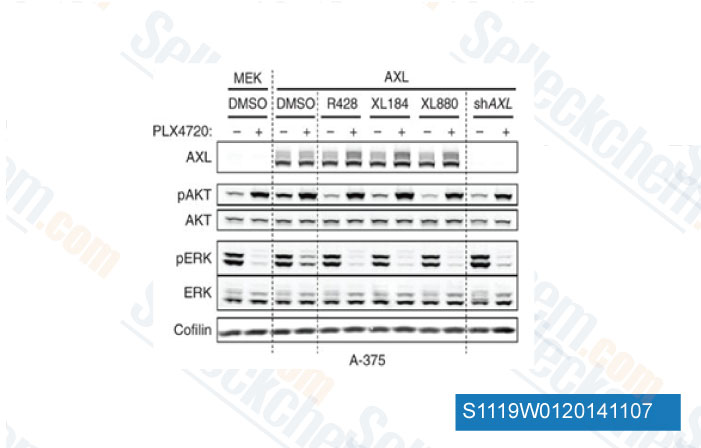
-
Datos de [ Cancer Discov , 2014 , 4(7), 816-27 ]
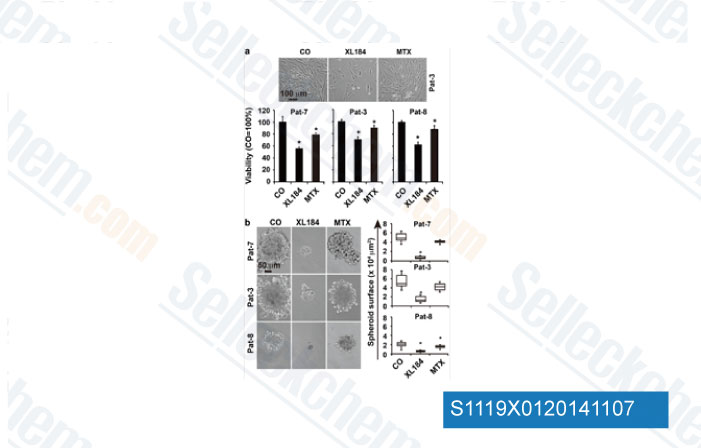
-
Datos de [ Cell Death Dis , 2014 , 5, e1471 ]
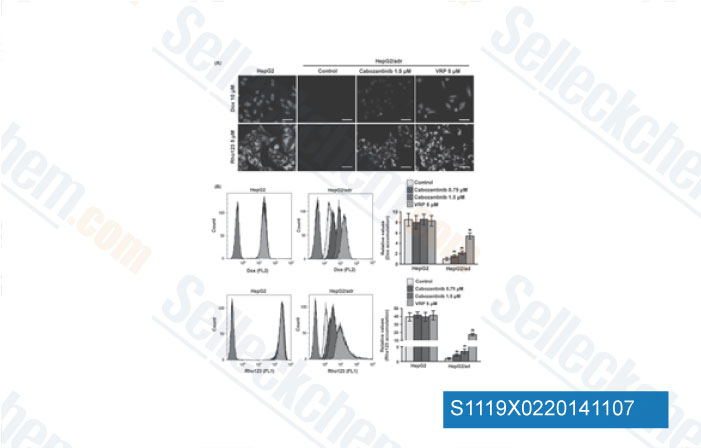
-
Datos de [ Liver Int , 2014 , 10.1111/liv.12524 ]
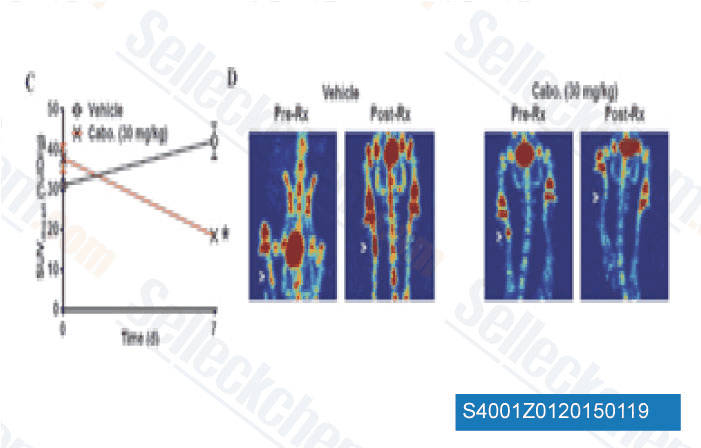
-
Datos de [ Mol Imaging , 2014 , 10.2310/7290.2014.00026 ]
Sellecks Cabozantinib malate Ha sido citado por 110 Publicaciones
| Biofabrication of pheochromocytoma and paraganglioma tumor organoids and assessment of response to systemic therapy [ Sci Rep, 2025, 15(1):35889] | PubMed: 41087622 |
| Tyrosine kinase inhibitors affect sweet taste and dysregulate fate selection of specific taste cell subtypes via KIT inhibition [ bioRxiv, 2025, 2025.08.15.670608] | PubMed: 40894646 |
| Piezo1 regulates meningeal lymphatic vessel drainage and alleviates excessive CSF accumulation [ Nat Neurosci, 2024, 10.1038/s41593-024-01604-8] | PubMed: 38528202 |
| Patient-derived rhabdomyosarcoma cells recapitulate the genetic and transcriptomic landscapes of primary tumors [ iScience, 2024, 27(10):110862] | PubMed: 39319271 |
| A subset of VEGFR-TKIs activates AMPK in LKB1-mutant lung cancer [ Cancer Sci, 2023, 114(4):1651-1662] | PubMed: 36459496 |
| Identification of therapeutic sensitivities in a spheroid drug combination screen of Neurofibromatosis Type I associated High Grade Gliomas [ PLoS One, 2023, 18(2):e0277306] | PubMed: 36730269 |
| Rapid Profiling of Tumor-Immune Interaction Using Acoustically Assembled Patient-Derived Cell Clusters [ Adv Sci (Weinh), 2022, e2201478] | PubMed: 35611994 |
| CIC-mediated modulation of MAPK signaling opposes receptor tyrosine kinase inhibitor response in kinase-addicted sarcoma [ Cancer Res, 2022, canres.1397.2021] | PubMed: 35074756 |
| Targeting PEA3 transcription factors to mitigate small cell lung cancer progression [ Oncogene, 2022, 10.1038/s41388-022-02558-6] | PubMed: 36509998 |
| Plasma extracellular vesicle long RNA profiles in the diagnosis and prediction of treatment response for breast cancer [ Cancers (Basel), 2022, 14(7)1683] | PubMed: 35406455 |
POLÍTICA DE DEVOLUCIÓN
La Política de Devolución Incondicional de Selleck Chemical garantiza una experiencia de compra en línea fluida para nuestros clientes. Si no está satisfecho con su compra de alguna manera, puede devolver cualquier artículo(s) dentro de los 7 días posteriores a su recepción. En caso de problemas de calidad del producto, ya sean problemas relacionados con el protocolo o con el producto, puede devolver cualquier artículo(s) dentro de los 365 días a partir de la fecha de compra original. Siga las instrucciones a continuación al devolver productos.
ENVÍO Y ALMACENAMIENTO
Los productos Selleck se transportan a temperatura ambiente. Si recibe el producto a temperatura ambiente, tenga la seguridad de que el Departamento de Inspección de Calidad de Selleck ha realizado experimentos para verificar que la colocación a temperatura normal durante un mes no afectará la actividad biológica de los productos en polvo. Después de la recogida, guarde el producto de acuerdo con los requisitos descritos en la hoja de datos. La mayoría de los productos Selleck son estables en las condiciones recomendadas.
NO PARA USO HUMANO, DIAGNÓSTICO VETERINARIO O TERAPÉUTICO.