
Datos técnicos
| Fórmula | C22H24N4O4 |
||||||||||
| Peso molecular | 408.45 | Número CAS | 1173900-33-8 | ||||||||
| Solubilidad (25°C)* | In vitro | DMSO | 82 mg/mL (200.75 mM) | ||||||||
| Ethanol | 10 mg/mL (24.48 mM) | ||||||||||
| Water | Insoluble | ||||||||||
| In vivo (Agregue los solventes al producto individualmente y en orden.) |
|
||||||||||
|
* <1 mg/ml significa ligeramente soluble o insoluble. * Tenga en cuenta que Selleck prueba la solubilidad de todos los compuestos internamente, y la solubilidad real puede diferir ligeramente de los valores publicados. Esto es normal y se debe a ligeras variaciones entre lotes. * Envío a temperatura ambiente (Las pruebas de estabilidad demuestran que este producto se puede enviar sin medidas de refrigeración.) |
|||||||||||
Preparación de soluciones madre
Actividad biológica
| Descripción | AZD6482 (KIN-193) es un inhibidor de PI3Kβ con un IC50 de 10 nM, 8, 87 y 109 veces más selectivo para PI3Kβ que para PI3Kδ, PI3Kα y PI3Kγ en ensayos sin células. Fase 1. | ||||||||
|---|---|---|---|---|---|---|---|---|---|
| Objetivos |
|
||||||||
| In vitro | AZD6482 también inhibe PI3Kα, γ y δ, con un IC50 de 80 nM a 1,09 μM, que son significativamente más bajos que su (+)-enantiómero (forma S). Este compuesto es un agente antiplaquetario; bloquea la activación/agregación plaquetaria y promueve la desagregación plaquetaria en el ensayo de agregación plaquetaria lavada (WPA), con un valor de IC50 de 6 nM. Además, al dirigirse a PI3Kβ, este químico inhibe específicamente la trombosis sin interferir con la hemostasia normal. Por lo tanto, se utiliza como un fármaco antitrombótico para la profilaxis de trastornos trombóticos. |
Protocolo (de referencia)
| Ensayo de quinasa:[1] |
|
|---|---|
| Ensayo celular:[1] |
|
Referencias
|
Validación de productos por parte del cliente
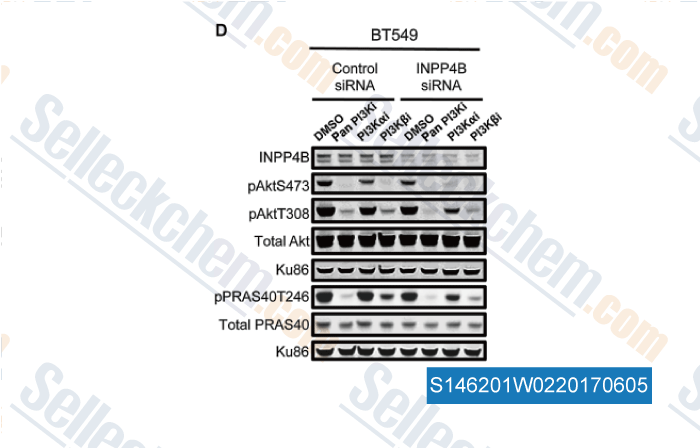
-
, , Mol Cancer Res, 2017, 15(6):765-775

-
, , One customer
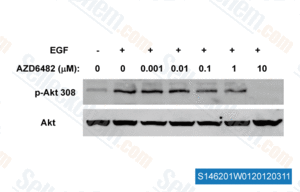
-
, , Dr. Zhang of Tianjin Medical University
![Collagen-embedded melanoma spheroids were treated for 72 h with SGI-1776 [5 μM] or AZD6482 [10 μM] as single agents or in combination before staining for live (green) and dead (red) cells. Experiments were conducted in triplicate and representative images are shown. Scale bar represents 150 microns.](https://file.selleckchem.com/downloads/review/700px/AZD6482-S146201Y0320170605.gif)
-
Datos de [ , , Oncotarget, 2016, 7(34):54897-54912 ]
Sellecks AZD6482 Ha sido citado por 27 Publicaciones
| Human colonic organoids for understanding early events of familial adenomatous polyposis pathogenesis [ J Pathol, 2025, 265(1):26-40] | PubMed: 39641466 |
| Longitudinal phosphoproteomics reveals the PI3K-PAK1 axis as a potential target for recurrent colorectal liver metastases [ Cell Rep, 2024, 43(12):115061] | PubMed: 39689713 |
| Molecular mechanisms of PI3K isoform dependence in embryonic growth [ J Turk Ger Gynecol Assoc, 2024, 25(3):159-166] | PubMed: 39219229 |
| A Gene Co-Expression Network-Based Drug Repositioning Approach Identifies Candidates for Treatment of Hepatocellular Carcinoma [ Cancers (Basel), 2022, 14(6)1573] | PubMed: 35326724 |
| ZAP70 Activation Compensates for Loss of Class IA PI3K Isoforms Through Activation of the JAK-STAT3 Pathway [ Cancer Diagn Progn, 2022, 2(3):391-404] | PubMed: 35530641 |
| Synergism between the phosphatidylinositol 3-kinase p110β isoform inhibitor AZD6482 and the mixed lineage kinase 3 inhibitor URMC-099 on the blockade of glioblastoma cell motility and focal adhesion formation [ Cancer Cell Int, 2021, 21(1):24] | PubMed: 33407478 |
| Metabolic Imaging Detects Resistance to PI3Kα Inhibition Mediated by Persistent FOXM1 Expression in ER+ Breast Cancer [ Cancer Cell, 2020, S1535-6108(20)30427-X] | PubMed: 32976773 |
| PIK3CA C-terminal frameshift mutations are novel oncogenic events that sensitize tumors to PI3K-α inhibition [ Proc Natl Acad Sci U S A, 2020, 117(39):24427-24433] | PubMed: 32929011 |
| Targeting phosphatidylinositol 3 kinase-β and -δ for Bruton tyrosine kinase resistance in diffuse large B-cell lymphoma [ Blood Adv, 2020, 4(18):4382-4392] | PubMed: 32926124 |
| Application of a Biphasic Mathematical Model of Cancer Cell Drug Response for Formulating Potent and Synergistic Targeted Drug Combinations to Triple Negative Breast Cancer Cells. [ Cancers (Basel), 2020, 27;12(5)pii: E1087] | PubMed: 32349331 |
POLÍTICA DE DEVOLUCIÓN
La Política de Devolución Incondicional de Selleck Chemical garantiza una experiencia de compra en línea fluida para nuestros clientes. Si no está satisfecho con su compra de alguna manera, puede devolver cualquier artículo(s) dentro de los 7 días posteriores a su recepción. En caso de problemas de calidad del producto, ya sean problemas relacionados con el protocolo o con el producto, puede devolver cualquier artículo(s) dentro de los 365 días a partir de la fecha de compra original. Siga las instrucciones a continuación al devolver productos.
ENVÍO Y ALMACENAMIENTO
Los productos Selleck se transportan a temperatura ambiente. Si recibe el producto a temperatura ambiente, tenga la seguridad de que el Departamento de Inspección de Calidad de Selleck ha realizado experimentos para verificar que la colocación a temperatura normal durante un mes no afectará la actividad biológica de los productos en polvo. Después de la recogida, guarde el producto de acuerdo con los requisitos descritos en la hoja de datos. La mayoría de los productos Selleck son estables en las condiciones recomendadas.
NO PARA USO HUMANO, DIAGNÓSTICO VETERINARIO O TERAPÉUTICO.