
Datos técnicos
| Fórmula | C14H13BrN2O |
||||||||||
| Peso molecular | 305.17 | Número CAS | 65678-07-1 | ||||||||
| Solubilidad (25°C)* | In vitro | DMSO | 61 mg/mL (199.88 mM) | ||||||||
| Water | Insoluble | ||||||||||
| Ethanol | Insoluble | ||||||||||
| In vivo (Agregue los solventes al producto individualmente y en orden.) |
|
||||||||||
|
* <1 mg/ml significa ligeramente soluble o insoluble. * Tenga en cuenta que Selleck prueba la solubilidad de todos los compuestos internamente, y la solubilidad real puede diferir ligeramente de los valores publicados. Esto es normal y se debe a ligeras variaciones entre lotes. * Envío a temperatura ambiente (Las pruebas de estabilidad demuestran que este producto se puede enviar sin medidas de refrigeración.) |
|||||||||||
Preparación de soluciones madre
Actividad biológica
| Descripción | AG-1024 (Tyrphostin, AGS 200) inhibe la autofosforilación de IGF-1R con una IC50 de 7 μM, es menos potente para IR con una IC50 de 57 μM y distingue específicamente entre InsR e IGF-1R (en comparación con otras tirfostinas). | ||||
|---|---|---|---|---|---|
| Objetivos |
|
||||
| In vitro | AG-1024 bloquea la autofosforilación del receptor IGF-1 e IR con IC50 de 7 μM y 57 μM, respectivamente. Este compuesto también inhibe la actividad de la receptor tyrosine kinase hacia sustratos exógenos (TKA) con valores de IC50 de 18 μM y 80 μM, respectivamente. Este químico (10 μM) inhibe la proliferación celular de manera dependiente del tiempo, e induce apoptosis en células MCF-7 a las 48 horas en un 20.1% y >40% cuando se combina con irradiación (10 Gy), más potente que la irradiación (10 Gy) sola en un 11.8%, lo cual está asociado con una regulación a la baja de phospho-Akt1 y bcl-2, y una regulación al alza de Bax, p53 y p21. Inhibe significativamente la proliferación de células de melanoma con una IC50 de <50 nM en ausencia de suero, bloqueando la señalización MAPK/ERK2, induciendo posteriormente rápidamente la desfosforilación y activación de pRb, y finalmente la formación de complejos pRb-E2F supresores del crecimiento. El tratamiento con este compuesto regula a la baja la expresión de Bcr-Abl y P-Akt, y regula al alza la expresión de DNA-PKcs en células UT7-9 y Ba/F3-p210, lo que lleva a una disminución de la supervivencia clonogénica y la proliferación. También inhibe significativamente la proliferación de células resistentes al inhibidor de BCR-ABL STI571, lo que se correlaciona con una disminución dependiente de la dosis en la expresión de la proteína Bcr-Abl. | ||||
| In vivo | La administración de AG-1024 a una dosis de 30 μg durante 10 días inhibe significativamente el crecimiento tumoral del xenoinjerto Ba/F3-p210 en ratones. |
Protocolo (de referencia)
| Ensayo de quinasa:[1] |
|
|---|---|
| Ensayo celular:[2] |
|
| Estudio en animales:[4] |
|
Referencias
|
Validación de productos por parte del cliente
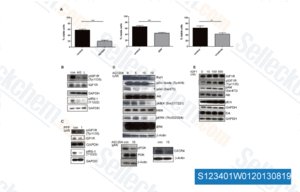
-
Datos de [ Blood , 2013 , 122(9), 1621-33 ]
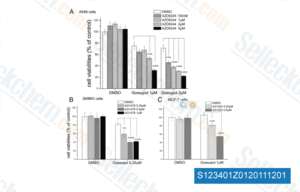
-
Datos de [ Mol Endocrinol , 2011 , 25, 2041-53 ]
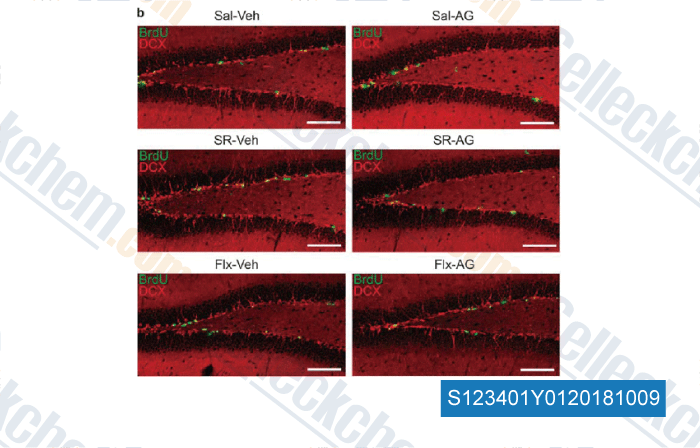
-
Datos de [ , , Mol Psychiatry, 2018, 23(4):833-842 ]
Sellecks AG-1024 Ha sido citado por 27 Publicaciones
| A Transcriptomics Analysis of the Regulation of Lens Fiber Cell Differentiation in the Absence of FGFRs and PTEN [ Cells, 2024, 13(14)1222] | PubMed: 39056803 |
| LTK and ALK promote neuronal polarity and cortical migration by inhibiting IGF1R activity [ EMBO Rep, 2023, 24(7):e56937] | PubMed: 37291945 |
| Ras-mutant cancers are sensitive to small molecule inhibition of V-type ATPases in mice [ Nat Biotechnol, 2022, 10.1038/s41587-022-01386-z] | PubMed: 35879364 |
| Tyrphostin AG1024 Suppresses Coronaviral Replication by Downregulating JAK1 via an IR/IGF-1R Independent Proteolysis Mediated by Ndfip1/2_NEDD4-like E3 Ligase Itch [ Pharmaceuticals (Basel), 2022, 15(2)241] | PubMed: 35215353 |
| Targeting oncogenic mutations in colorectal cancer using cryptotanshinone [ PLoS One, 2021, 16(2):e0247190] | PubMed: 33596259 |
| Regulation of Hippo-YAP Signaling by Insulin-Like Growth factor-1 Receptor in the Tumorigenesis of Diffuse Large B-cell Lymphoma [ J Hematol Oncol, 2020, 13(1):77] | PubMed: 32546241 |
| Myeloid cells provide critical support for T-ALL in vivo [ The University of Texas at Austin, 2020, ] | PubMed: None |
| An Autocrine IL-6/IGF-1R Loop Mediates EMT and Promotes Tumor Growth in Non-small Cell Lung Cancer. [ Int J Biol Sci, 2019, 15(9):1882-1891] | PubMed: 31523190 |
| mTORC2-mediated PDHE1α nuclear translocation links EBV-LMP1 reprogrammed glucose metabolism to cancer metastasis in nasopharyngeal carcinoma. [ Oncogene, 2019, 38(24):4669-4684] | PubMed: 30745576 |
| A novel 5HT3 receptor–IGF1 mechanism distinct from SSRI-induced antidepressant effects [Kondo M, et al. Mol Psychiatry, 2018, 23(4):833-842] | PubMed: 28439104 |
POLÍTICA DE DEVOLUCIÓN
La Política de Devolución Incondicional de Selleck Chemical garantiza una experiencia de compra en línea fluida para nuestros clientes. Si no está satisfecho con su compra de alguna manera, puede devolver cualquier artículo(s) dentro de los 7 días posteriores a su recepción. En caso de problemas de calidad del producto, ya sean problemas relacionados con el protocolo o con el producto, puede devolver cualquier artículo(s) dentro de los 365 días a partir de la fecha de compra original. Siga las instrucciones a continuación al devolver productos.
ENVÍO Y ALMACENAMIENTO
Los productos Selleck se transportan a temperatura ambiente. Si recibe el producto a temperatura ambiente, tenga la seguridad de que el Departamento de Inspección de Calidad de Selleck ha realizado experimentos para verificar que la colocación a temperatura normal durante un mes no afectará la actividad biológica de los productos en polvo. Después de la recogida, guarde el producto de acuerdo con los requisitos descritos en la hoja de datos. La mayoría de los productos Selleck son estables en las condiciones recomendadas.
NO PARA USO HUMANO, DIAGNÓSTICO VETERINARIO O TERAPÉUTICO.