
Datos técnicos
| Fórmula | C24H25ClFN5O3 |
||||||
| Peso molecular | 485.94 | Número CAS | 850140-72-6 | ||||
| Solubilidad (25°C)* | In vitro | DMSO | 97 mg/mL (199.61 mM) | ||||
| Ethanol | 97 mg/mL (199.61 mM) | ||||||
| Water | Insoluble | ||||||
| In vivo (Agregue los solventes al producto individualmente y en orden.) |
|
||||||
|
* <1 mg/ml significa ligeramente soluble o insoluble. * Tenga en cuenta que Selleck prueba la solubilidad de todos los compuestos internamente, y la solubilidad real puede diferir ligeramente de los valores publicados. Esto es normal y se debe a ligeras variaciones entre lotes. * Envío a temperatura ambiente (Las pruebas de estabilidad demuestran que este producto se puede enviar sin medidas de refrigeración.) |
|||||||
Preparación de soluciones madre
Actividad biológica
| Descripción | Afatinib inhibe EGFR/ErbB irreversiblemente in vitro con IC50 de 0,5, 0,4, 10, 14, 1 nM para EGFRwt, EGFR L858R , EGFR L858R/T790M ErbB2 (HER2) y ErbB4 (HER4), respectivamente. Este compuesto induce la autofagia. | ||||||||||
|---|---|---|---|---|---|---|---|---|---|---|---|
| Objetivos |
|
||||||||||
| In vitro | BIBW2992 muestra una potente actividad contra las formas tanto salvajes como mutantes de EGFR y HER2. Es similar a Gefitinib en potencia contra EGFR L858R, pero aproximadamente 100 veces más activo contra el doble mutante EGFR L858R-T790M resistente a Gefitinib. Este compuesto exhibe potentes efectos sobre la fosforilación de EGFR y HER2 in vivo. Se compara favorablemente con compuestos de referencia (como Lapatinib et al.) en todos los tipos de células probados, como la línea celular de carcinoma epidermoide humano A431 que expresa EGFR wt, células murinas NIH-3T3 transfectadas con HER2 wt, así como la línea celular de cáncer de mama BT-474 y la línea celular de cáncer gástrico NCI-N87, que expresan HER2 endógeno. | ||||||||||
| In vivo | La administración oral diaria de BIBW2992 a 20 mg/kg durante 25 días resulta en una dramática regresión tumoral con una relación acumulada de volumen tumoral tratado/control (relación T/C) del 2%. La fosforilación reducida de EGFR y AKT se confirma mediante tinción inmunohistoquímica de las secciones de tejido. Por lo tanto, al igual que el lapatinib y el neratinib, este compuesto es un inhibidor de la Protein Tyrosine Kinase (TKI) de próxima generación que inhibe irreversiblemente las quinasas del receptor 2 del factor de crecimiento epidérmico humano (Her2) y del receptor del factor de crecimiento epidérmico (EGFR). No solo es activo contra mutaciones de EGFR dirigidas por TKI de primera generación como Erlotinib o Gefitinib, sino también contra aquellas insensibles a estas terapias estándar. |
Protocolo (de referencia)
| Ensayo de quinasa: |
|
|---|---|
| Ensayo celular: |
|
| Estudio en animales: |
|
Referencias
|
Validación de productos por parte del cliente
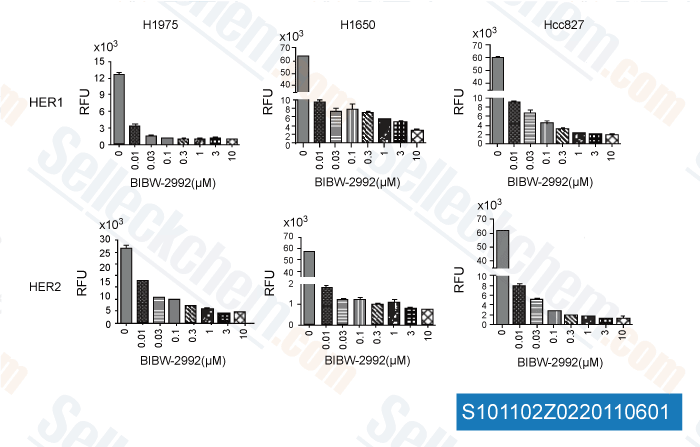
-
Datos de [ Int J Proteomics , 2011 , 2011, 215496 ]
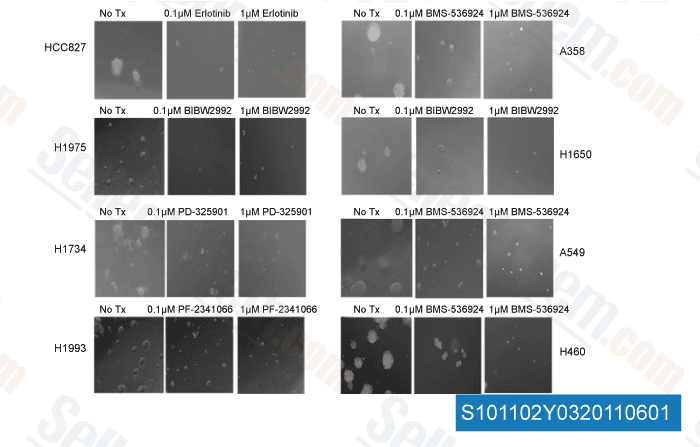
-
Datos de [ Int J Proteomics , 2011 , 2011, 215496 ]
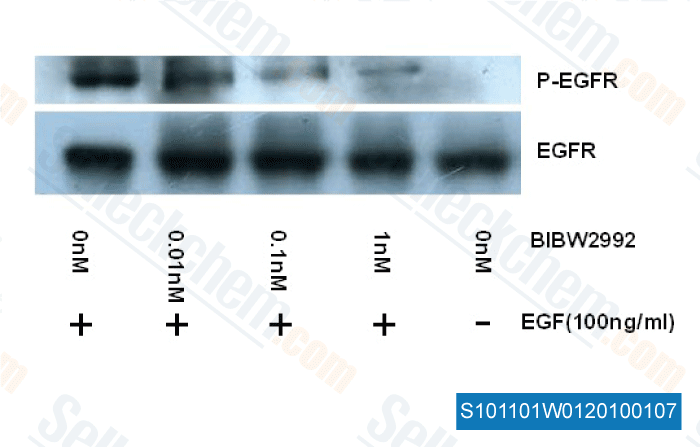
-
, , Dr. Zhang of Tianjin Medical University
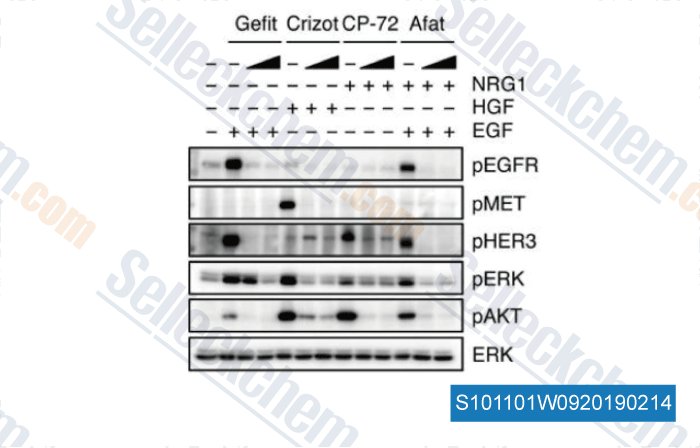
-
Datos de [ , , Nature, 2016, 534(7609):647-51 ]
Sellecks Afatinib (BIBW2992) Ha sido citado por 453 Publicaciones
| Lysosomal EGFR acts as a Rheb-GEF independent of its kinase activity to activate mTORC1 [ Cell Res, 2025, 10.1038/s41422-025-01110-x] | PubMed: 40259053 |
| Longitudinal single-cell multiomic atlas of high-risk neuroblastoma reveals chemotherapy-induced tumor microenvironment rewiring [ Nat Genet, 2025, 10.1038/s41588-025-02158-6] | PubMed: 40229600 |
| The potential of lazertinib and amivantamab combination therapy as a treatment strategy for uncommon EGFR-mutated NSCLC [ Cell Rep Med, 2025, 6(2):101929] | PubMed: 39874964 |
| AP1-mediated reprogramming of EGFR expression triggers resistance to BLU-667 and LOXO-292 in RET-rearranged tumors [ J Exp Clin Cancer Res, 2025, 44(1):154] | PubMed: 40405293 |
| Anti-galectin-9 therapy synergizes with EGFR inhibition to reprogram the tumor microenvironment and overcome immune evasion [ J Immunother Cancer, 2025, 13(7)e010926] | PubMed: 40664443 |
| Blocking cancer-fibroblast mutualism inhibits proliferation of endocrine therapy resistant breast cancer [ Mol Syst Biol, 2025, 10.1038/s44320-025-00104-6] | PubMed: 40341770 |
| PI3K-dependent GAB1/Erk phosphorylation renders head and neck squamous cell carcinoma sensitive to PI3Kα inhibitors [ Cell Death Dis, 2025, 16(1):457] | PubMed: 40533463 |
| Exercise-induced adipokine Nrg4 alleviates MASLD by disrupting hepatic cGAS-STING signaling [ Cell Rep, 2025, 44(2):115251] | PubMed: 39891907 |
| Rare mutations at EGFR L747 position: molecular characteristics and superior response to afatinib in NSCLC patients [ ESMO Open, 2025, 10(9):105558] | PubMed: 40834500 |
| PTEN loss and ERBB2/ERBB3-mediated AKT reactivation drive resistance to MET inhibition in MET-amplified hepatocellular carcinoma [ Cell Oncol (Dordr), 2025, 10.1007/s13402-025-01097-y] | PubMed: 40991144 |
POLÍTICA DE DEVOLUCIÓN
La Política de Devolución Incondicional de Selleck Chemical garantiza una experiencia de compra en línea fluida para nuestros clientes. Si no está satisfecho con su compra de alguna manera, puede devolver cualquier artículo(s) dentro de los 7 días posteriores a su recepción. En caso de problemas de calidad del producto, ya sean problemas relacionados con el protocolo o con el producto, puede devolver cualquier artículo(s) dentro de los 365 días a partir de la fecha de compra original. Siga las instrucciones a continuación al devolver productos.
ENVÍO Y ALMACENAMIENTO
Los productos Selleck se transportan a temperatura ambiente. Si recibe el producto a temperatura ambiente, tenga la seguridad de que el Departamento de Inspección de Calidad de Selleck ha realizado experimentos para verificar que la colocación a temperatura normal durante un mes no afectará la actividad biológica de los productos en polvo. Después de la recogida, guarde el producto de acuerdo con los requisitos descritos en la hoja de datos. La mayoría de los productos Selleck son estables en las condiciones recomendadas.
NO PARA USO HUMANO, DIAGNÓSTICO VETERINARIO O TERAPÉUTICO.