
SB203580 (Adezmapimod)

N.º de catálogoS1076 Lote:S107612

Imprimir

Datos técnicos

Fórmula

C21H16FN3OS

Peso molecular 377.43 Número CAS 152121-47-6
Solubilidad (25°C)* In vitro DMSO 96 mg/mL (254.35 mM)
Ethanol 28 mg/mL (74.18 mM)
Water Insoluble
In vivo (Agregue los solventes al producto individualmente y en orden.)
Homogeneous suspension
CMC-NA
≥5mg/ml Taking the 1 mL working solution as an example, add 5 mg of this product to 1 ml of CMC-Na solution, mix evenly to obtain a homogeneous suspension with a final concentration of 5 mg/ml.
Clear solution
5% DMSO 40% PEG 300 5%Tween80 50%ddH2O

Validado por los laboratorios Selleck. Si necesita ajustes en esta formulación, póngase en contacto con nuestro equipo de ventas para pruebas personalizadas.

5.000mg/ml (13.25mM) Taking the 1 mL working solution as an example, add 50 μL of 100 mg/ml clarified DMSO stock solution to 400 μL of PEG300, mix evenly to clarify it; add 50 μL of Tween80 to the above system, mix evenly to clarify; then continue to add 500 μL of ddH2O to adjust the volume to 1 mL. The mixed solution should be used immediately for optimal results. 
* <1 mg/ml significa ligeramente soluble o insoluble.
* Tenga en cuenta que Selleck prueba la solubilidad de todos los compuestos internamente, y la solubilidad real puede diferir ligeramente de los valores publicados. Esto es normal y se debe a ligeras variaciones entre lotes.
* Envío a temperatura ambiente (Las pruebas de estabilidad demuestran que este producto se puede enviar sin medidas de refrigeración.)

Preparación de soluciones madre

Actividad biológica

Descripción Adezmapimod (SB203580, RWJ 64809, PB 203580) es un inhibidor de la p38 MAPK con una IC50 de 0,3-0,5 μM en células THP-1, 10 veces menos sensible a SAPK3(106T) y SAPK4(106T) y bloquea la fosforilación de PKB con una IC50 de 3-5 μM. SB203580 induce la mitophagy y la autophagy.
Objetivos
p38 MAPK
(THP-1 cells)
PKB
(THP-1 cells)
0.3 μM-0.5 μM 3 μM-5 μM
In vitro

Adezmapimod (SB203580) inhibe la proliferación de células T humanas primarias, células T murinas CT6 o células B BAF F7 inducida por IL-2 con una IC50 de 3-5 μm. También inhibe la activación de p70S6 quinasa inducida por IL-2, aunque la concentración requerida es ligeramente superior con una IC50 superior a 10 μm. Este compuesto inhibe la actividad de PDK1 de forma dosis-dependiente con una IC50 en el rango de 3-10 μm. Inhibe la estimulación de MAPKAPK2 por p38-MAPK con una IC50 de aproximadamente 0,07 μM, mientras que la actividad total de SAPK/JNK se inhibe con una IC50 de 3-10 μM. A concentraciones más altas, activa la vía ERK, lo que posteriormente mejora la actividad transcripcional de NF-κB. También induce autofagia en células de carcinoma hepatocelular (CHC) humano.

In vivo

Adezmapimod (SB203580) protege el miocardio porcino contra la lesión isquémica en un modelo in vivo. También es eficaz en la prevención y el tratamiento de la enfermedad en el modelo de ratones MRL/lpr de lupus eritematoso sistémico (LES).

Características Primer inhibidor de p38 reportado.

Protocolo (de referencia)

Ensayo de quinasa:

[1]

  • Ensayo de fosforilación de quinasa de receptores celulares

    4 μg de anti-PKBα de oveja se inmovilizan en 25 μL de proteína G-Sepharose durante la noche (o 1,5 horas) y se lavan en tampón A (50 mm Tris, pH 7,5, 1 mm EDTA, 1 mm EGTA, 0,5 mm Na3VO4, 0,1 % β-mercaptoetanol, 1 % Triton X-100, 50 mm fluoruro de sodio, 5 mm pirofosfato de sodio, 0,1 mm fluoruro de fenilmetilsulfonilo, 1 μg/mL de pepstatina, leupeptina y 1 μm de microcistina). El anti-PKB inmovilizado se incuba luego con 0,5 mL de lisado (de 5 × 10⁶ células) durante 1,5 horas y se lava tres veces en 0,5 mL de tampón A suplementado con 0,5 m NaCl, dos veces en 0,5 mL de tampón B (50 mm Tris-HCl, pH 7,5, 0,03 % (p/v) Brij-35, 0,1 mm EGTA y 0,1 % β-mercaptoetanol), y dos veces con 100 μL de tampón de dilución para ensayo; el tampón de dilución 5× para ensayo es 100 mm MOPS, pH 7,2, 125 mm β-glicerofosfato, 25 mm EGTA, 5 mm ortovanadato de sodio, 5 mm DTT. Al complejo inmune de la enzima PKB se añaden 10 μL de tampón de dilución para ensayo, 40 μm de péptido inhibidor de proteína quinasa A, 100 μm de péptido sustrato específico de PKB y 10 μCi de [γ-32P]ATP, todos preparados en tampón de dilución para ensayo. La reacción se incuba durante 20 minutos a temperatura ambiente con agitación, luego las muestras se centrifugan brevemente y se retiran 40 μL del volumen de reacción a otro tubo al que se añaden 20 μL de ácido tricloroacético al 40 % para detener la reacción. Esto se mezcla y se incuba durante 5 minutos a temperatura ambiente, y 40 μL se transfieren a papel de fosfocelulosa P81 y se dejan unir durante 30 segundos. La pieza de P81 se lava tres veces en ácido fosfórico al 0,75 % y luego en acetona a temperatura ambiente. La incorporación de γ-32P se mide luego mediante recuento por centelleo.

Ensayo celular:

[1]

  • Líneas celulares

    CT6 cell , BA/F3 F7 cell

  • Concentraciones

    0–30 μM

  • Tiempo de incubación

    1 hour

  • Método

    CT6 cell and BA/F3 F7 cell are rested by washing three times in RPMI and culturing overnight in RPMI, 5% fetal calf serum in the absence of growth factor, antibiotics, or β-mercaptoethanol supplements. 2–5 × 10⁶ rested CT6 cells are resuspended in 2 mL of RPMI, 5% fetal calf serum and preincubated with Adezmapimod (SB203580) or vehicle control as indicated in figure legends. Cells are then stimulated with 20 ng/ml recombinant human IL-2 for 5 minutes at 37  °C and pelleted in a minifuge for 30 seconds, medium is aspirated, and the pellet is lysed in the appropriate buffer. BA/F3 cells stably expressing deletion mutants of IL-2 receptor β chain are maintained in glutamine containing RPMI further supplemented with 5% fetal calf serum and 0.2 μg/mL G418. The cells are then washed extensively, rested overnight, and washed again before activating with IL-2; such cell preparations are >90% T cells. Cellular proliferation assays are performed by measurement of [3H]thymidine incorporation.

Estudio en animales:

[5]

  • Modelos animales

    Systemic lupus erythematosus (SLE) are established in female MRL/lpr mice and female C57BL/6 mice

  • Dosificaciones

    0.1 M/day

  • Administración

    Orally administered

Referencias

  • https://pubmed.ncbi.nlm.nih.gov/10702313/
  • https://pubmed.ncbi.nlm.nih.gov/10960075/
  • https://pubmed.ncbi.nlm.nih.gov/22170404/
  • https://pubmed.ncbi.nlm.nih.gov/10710135/
  • https://pubmed.ncbi.nlm.nih.gov/21549858/

Validación de productos por parte del cliente
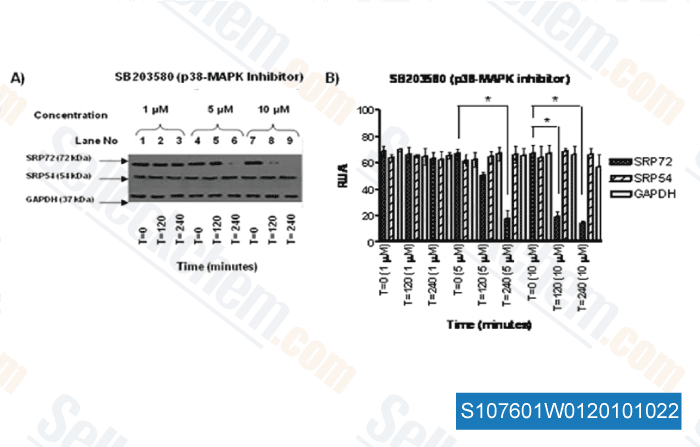
<p>A, effects of p38 inhibitor SB203580 (1, 5, and 10 μM) on SRP72 protein expression was evaluated by WB using antibodies against human SRP72,SRP54, and GAPDH. A decreased intensity of SRP72 bands was noted when using the inhibitor at 5 μM concentration at 240 min (lane 6) and 10 μM at 120 and 240 min (lanes 8 and 9). B, results were analyzed and RUA illustrated, finding significant results at 5 μM, 240 versus 0 min, and 10 μM, 240 versus 0 and 120 versus 0 min, respectively, (p<0.05).</p><div><div> </div></div><p> </p>

Datos de [ J Biol Chem , 2010 , 285, 32824-32833 ]
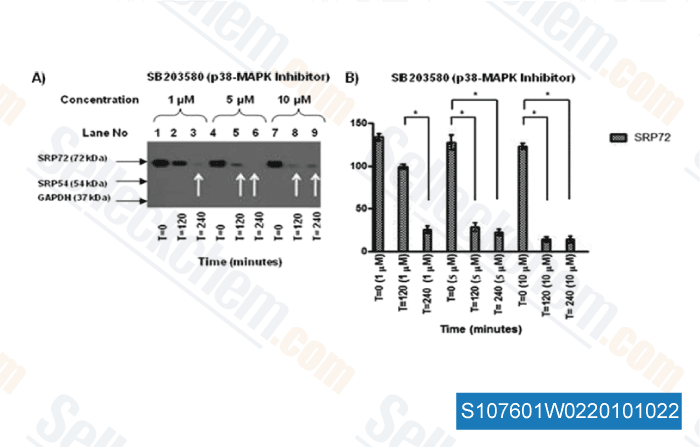
<p>A, effect of p38 MAPK inhibitor SB203580 (1, 5, and 10 μM) on SRP72 phosphorylation was evaluated. Jurkat cells were stimulated with rhIL-1, harvested at 0, 120, and 240 min, lysed, and immunoprecipitated using anti-human SRP19 andWBusing anti-phosphoserine antibodies. A decreased intensity of SRP72 band was found when using the inhibitor at concentration of 1μM at 240 min and 5 and 10 μM at 120 and 240 min. B, results were analyzed and RUA illustrated, finding significant results at 1 μM 240 versus 120, 5, and 10 μM at 120 versus 0 and 240 versus 0 min *, p<0.05.</p>

Datos de [ J Biol Chem , 2010 , 285, 32824–32833 ]

<p>We used real time RT-PCR to investigate the effects of SB203580 on SRP72 mRNA expression. All the samples were treated under the same experimental conditions used in protein tests done by WB, and phosphorylation was measured indirectly by IP-WB. The results did not show significant changes on the mRNA expression of SRP72 after the treatment with these inhibitors.</p>

Datos de [ J Biol Chem , 2010 , 285, 32824–32833 ]
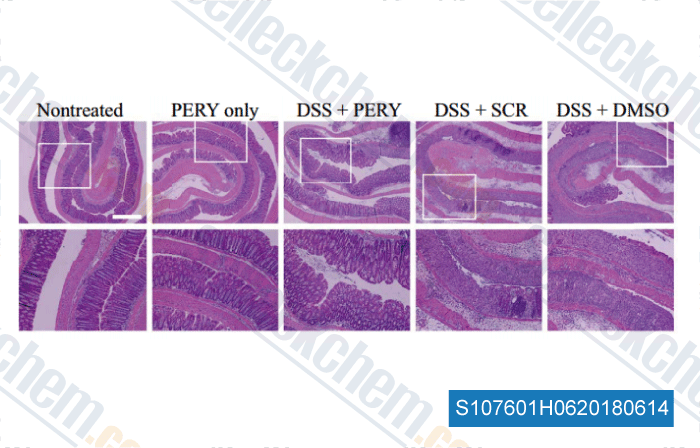
C57BL/6 male mice (8 weeks, Harlan) were pretreated with by intravenous injections with PERY or SCR peptides (15 mg/kg) or DMSO. The following day, mice were treated with 1.5% dextran sodium sulfate (DSS) in drinking water for 7 days followed by 3 days of normal drinking water. During DSS administration, mice were treated every other day (total of five intravenous injections). Control groups included nontreated mice (no DSS, no treatment) and mice receiving PERY peptide with normal drinking water (PERY only, no DSS). Mice were then euthanized and analyzed. Colitis was evaluated using (C) hematoxylin and eosin (H&E) histological sections of the colons (top) and their magnifications (bottom). Scale bar, 2 mm.

Datos de [ , , Science, 2018, 11(525), doi: 10.1126/scisignal.aao3428 ]

Sellecks SB203580 (Adezmapimod) Ha sido citado por 1012 Publicaciones

Oncogenic RAS induces a distinctive form of non-canonical autophagy mediated by the P38-ULK1-PI4KB axis [ Cell Res, 2025, 10.1038/s41422-025-01085-9] PubMed: 40055523
The intrinsic expression of NLRP3 in Th17 cells promotes their protumor activity and conversion into Tregs [ Cell Mol Immunol, 2025, 22(5):541-556] PubMed: 40195474
First-in-class ultralong-target-residence-time p38α inhibitors as a mitosis-targeted therapy for colorectal cancer [ Nat Cancer, 2025, 6(2):259-277] PubMed: 39820127
Gut Microbiota Modulates Obesity-Associated Skeletal Deterioration Through Macrophage Aging and Grancalcin Secretion [ Adv Sci (Weinh), 2025, 12(28):e2502634] PubMed: 40349163
Orosomucoid 1 Ameliorates Temporomandibular Joint Osteoarthritis by Maintaining Cartilage Homeostasis [ Adv Sci (Weinh), 2025, 12(36):e00028] PubMed: 40583170
A novel human specific lncRNA MEK6-AS1 regulates adipogenesis and fatty acid biosynthesis by stabilizing MEK6 mRNA [ J Biomed Sci, 2025, 32(1):6] PubMed: 39773638
Targeting Matrix Metalloproteinase-9 to Alleviate T Cell Exhaustion and Improve Sepsis Prognosis [ Research (Wash D C), 2025, 8:0996] PubMed: 41306770
Inhalable targeted CD8 + T cell nanoparticles loaded ferroptosis inhibitor ferrostatin-1 alleviate acute lung injury [ J Nanobiotechnology, 2025, 23(1):723] PubMed: 41261431
FNDC5/irisin-enriched sEVs conjugated with bone-targeting aptamer alleviate osteoporosis: a potential alternative to exercise [ J Nanobiotechnology, 2025, 23(1):504] PubMed: 40652239
LL37 complexed to double-stranded RNA induces RIG-I-like receptor signalling and Gasdermin E activation facilitating IL-36γ release from keratinocytes [ Cell Death Dis, 2025, 16(1):198] PubMed: 40121229

POLÍTICA DE DEVOLUCIÓN
La Política de Devolución Incondicional de Selleck Chemical garantiza una experiencia de compra en línea fluida para nuestros clientes. Si no está satisfecho con su compra de alguna manera, puede devolver cualquier artículo(s) dentro de los 7 días posteriores a su recepción. En caso de problemas de calidad del producto, ya sean problemas relacionados con el protocolo o con el producto, puede devolver cualquier artículo(s) dentro de los 365 días a partir de la fecha de compra original. Siga las instrucciones a continuación al devolver productos.

ENVÍO Y ALMACENAMIENTO
Los productos Selleck se transportan a temperatura ambiente. Si recibe el producto a temperatura ambiente, tenga la seguridad de que el Departamento de Inspección de Calidad de Selleck ha realizado experimentos para verificar que la colocación a temperatura normal durante un mes no afectará la actividad biológica de los productos en polvo. Después de la recogida, guarde el producto de acuerdo con los requisitos descritos en la hoja de datos. La mayoría de los productos Selleck son estables en las condiciones recomendadas.

NO PARA USO HUMANO, DIAGNÓSTICO VETERINARIO O TERAPÉUTICO.