
Datos técnicos
| Fórmula | C20H15ClN4.2HCl |
||||||
| Peso molecular | 419.73 | Número CAS | 212141-51-0 | ||||
| Solubilidad (25°C)* | In vitro | DMSO | 21.25 mg/mL (50.62 mM) | ||||
| Water | 10 mg/mL (23.82 mM) | ||||||
| Ethanol | 6 mg/mL (14.29 mM) | ||||||
| In vivo (Agregue los solventes al producto individualmente y en orden.) |
|
||||||
|
* <1 mg/ml significa ligeramente soluble o insoluble. * Tenga en cuenta que Selleck prueba la solubilidad de todos los compuestos internamente, y la solubilidad real puede diferir ligeramente de los valores publicados. Esto es normal y se debe a ligeras variaciones entre lotes. * Envío a temperatura ambiente (Las pruebas de estabilidad demuestran que este producto se puede enviar sin medidas de refrigeración.) |
|||||||
Preparación de soluciones madre
Actividad biológica
| Descripción | Vatalanib 2HCl (PTK787, ZK 222584, cpg-79787) es un inhibidor de VEGFR2/KDR con una IC50 de 37 nM en un ensayo sin células, menos potente contra VEGFR1/Flt-1, 18 veces contra VEGFR3/Flt-4. Fase 3. | |||||||||||
|---|---|---|---|---|---|---|---|---|---|---|---|---|
| Objetivos |
|
|||||||||||
| In vitro | Vatalanib también inhibe Flk, c-Kit y PDGFRβ con IC50 de 270 nM, 730 nM y 580 nM, respectivamente. Además, Vatalanib muestra el efecto antiproliferativo al inhibir la incorporación de timidina inducida por VEGF en HUVEC con un IC50 de 7,1 nM, y suprime de forma dosis-dependiente la supervivencia y migración de células endoteliales inducidas por VEGF en el mismo rango de dosis sin efecto citotóxico o antiproliferativo en células que no expresan receptores de VEGF. Un estudio reciente muestra que Vatalanib inhibe significativamente el crecimiento de células de carcinoma hepatocelular y mejora la apoptosis inducida por IFN/5-FU al aumentar los niveles de proteínas de Bax y reducir Bcl-xL y Bcl-2. | |||||||||||
| In vivo | Vatalanib induce una inhibición dosis-dependiente de la respuesta angiogénica a VEGF y PDGF tanto en un modelo de implante de factor de crecimiento como en un modelo de angiogénesis impulsada por células tumorales después de una dosificación oral una vez al día (25-100 mg/kg). En el mismo rango de dosis, Vatalanib también inhibe el crecimiento y las metástasis de varios carcinomas humanos en ratones nude sin un efecto significativo en las células sanguíneas circulantes o los leucocitos de la médula ósea. |
Protocolo (de referencia)
| Ensayo de quinasa:[1] |
|
|---|---|
| Ensayo celular:[1] |
|
| Estudio en animales:[1] |
|
Referencias
|
Validación de productos por parte del cliente
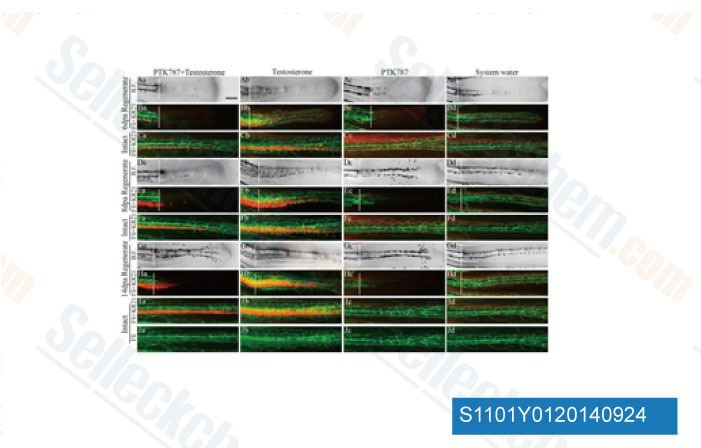
-
Datos de [ Development , 2013 , 140, 4323-34 ]
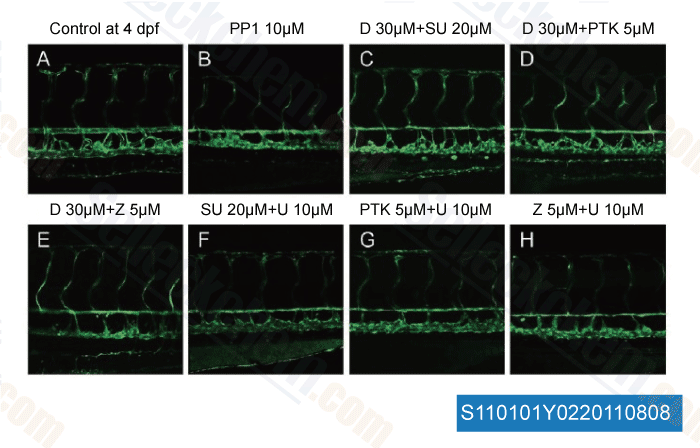
-
Datos de [ Cell Res , 2011 , 21, 1080-1087 ]
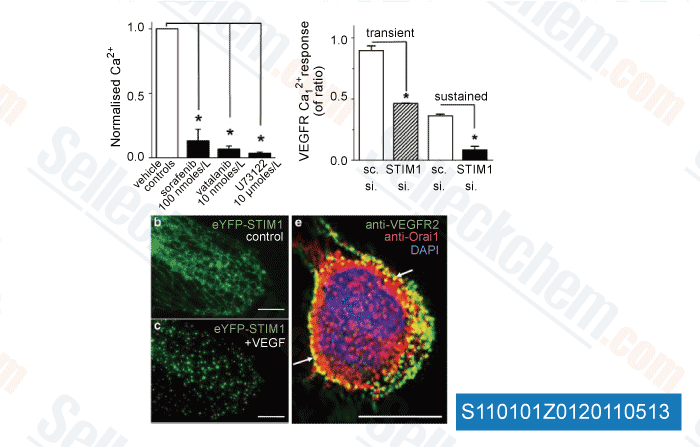
-
Datos de [ Circ Res , 2011 , 108, 1190-1198 ]
Sellecks Vatalanib (PTK787) 2HCl Ha sido citado por 55 Publicaciones
| Galectin-3-integrin α5β1 phase separation disrupted by advanced glycation end-products impairs diabetic wound healing in rodents [ Nat Commun, 2025, 16(1):7287] | PubMed: 40775187 |
| Development of an Automated Morphometric Approach to Assess Vascular Outcomes following Exposure to Environmental Chemicals in Zebrafish [ Environ Health Perspect, 2024, 132(5):57001] | PubMed: 38701112 |
| Nudifloside, a Secoiridoid Glucoside Derived from Callicarpa nudiflora, Inhibits Endothelial-to-Mesenchymal Transition and Angiogenesis in Endothelial Cells by Suppressing Ezrin Phosphorylation [ J Cancer, 2024, 15(9):2448-2459] | PubMed: 38577590 |
| Platform combining statistical modeling and patient-derived organoids to facilitate personalized treatment of colorectal carcinoma [ J Exp Clin Cancer Res, 2023, 42(1):79] | PubMed: 37013646 |
| Inhibition of VEGFR2 and EGFR signaling cooperatively suppresses the proliferation of oral squamous cell carcinoma [ Cancer Med, 2023, 12(15):16416-16430] | PubMed: 37341071 |
| Temporal mapping and pharmacological manipulation of signaling architecture of Tyrosine kinases in Traumatic Brain Injury (TBI) [ oparu, 2023, 10.18725/OPARU-47820] | PubMed: None |
| Investigation of the pharmacological effect and mechanism of mountain-cultivated ginseng and garden ginseng in cardiovascular diseases based on network pharmacology and zebrafish experiments [ Front Pharmacol, 2022, 13:920979] | PubMed: 36120313 |
| In Vitro Angiogenesis Inhibition and Endothelial Cell Growth and Morphology [ Int J Mol Sci, 2022, 23(8)4277] | PubMed: 35457095 |
| Establishment and Characterization of NCC-PMP1-C1: A Novel Patient-Derived Cell Line of Metastatic Pseudomyxoma Peritonei [ J Pers Med, 2022, 12(2)258] | PubMed: 35207746 |
| Establishment and characterization of NCC-UPS4-C1: a novel cell line of undifferentiated pleomorphic sarcoma from a patient with Li-Fraumeni syndrome [ Hum Cell, 2022, 10.1007/s13577-022-00671-y] | PubMed: 35118583 |
POLÍTICA DE DEVOLUCIÓN
La Política de Devolución Incondicional de Selleck Chemical garantiza una experiencia de compra en línea fluida para nuestros clientes. Si no está satisfecho con su compra de alguna manera, puede devolver cualquier artículo(s) dentro de los 7 días posteriores a su recepción. En caso de problemas de calidad del producto, ya sean problemas relacionados con el protocolo o con el producto, puede devolver cualquier artículo(s) dentro de los 365 días a partir de la fecha de compra original. Siga las instrucciones a continuación al devolver productos.
ENVÍO Y ALMACENAMIENTO
Los productos Selleck se transportan a temperatura ambiente. Si recibe el producto a temperatura ambiente, tenga la seguridad de que el Departamento de Inspección de Calidad de Selleck ha realizado experimentos para verificar que la colocación a temperatura normal durante un mes no afectará la actividad biológica de los productos en polvo. Después de la recogida, guarde el producto de acuerdo con los requisitos descritos en la hoja de datos. La mayoría de los productos Selleck son estables en las condiciones recomendadas.
NO PARA USO HUMANO, DIAGNÓSTICO VETERINARIO O TERAPÉUTICO.