
Datos técnicos
| Fórmula | C24H18F2N2O5 |
||||||
| Peso molecular | 452.41 | Número CAS | 936727-05-8 | ||||
| Solubilidad (25°C)* | In vitro | DMSO | 90 mg/mL (198.93 mM) | ||||
| Ethanol | 14 mg/mL (30.94 mM) | ||||||
| Water | Insoluble | ||||||
| In vivo (Agregue los solventes al producto individualmente y en orden.) |
|
||||||
|
* <1 mg/ml significa ligeramente soluble o insoluble. * Tenga en cuenta que Selleck prueba la solubilidad de todos los compuestos internamente, y la solubilidad real puede diferir ligeramente de los valores publicados. Esto es normal y se debe a ligeras variaciones entre lotes. * Envío a temperatura ambiente (Las pruebas de estabilidad demuestran que este producto se puede enviar sin medidas de refrigeración.) |
|||||||
Preparación de soluciones madre
Actividad biológica
| Descripción | Lumacaftor (VX-809, VRT 826809) actúa para corregir las mutaciones de CFTR comunes en la fibrosis quística al aumentar la maduración del CFTR mutante (F508del-CFTR), con una EC50 de 0,1 μM en células tiroideas de rata Fisher. Fase 3. | ||
|---|---|---|---|
| Objetivos |
|
||
| In vitro | Lumacaftor (VX-809) actúa a nivel del RE para permitir que una fracción del F508del-CFTR adopte una forma correctamente plegada, salga del RE y se movilice hacia la superficie celular para un funcionamiento normal. En células tiroideas de rata Fischer (FRT) que expresan F508del-CFTR, el tratamiento con este compuesto mejora significativamente la maduración del F508del-CFTR en 7,1 veces con una EC50 de 0,1 μM, y mejora el transporte de cloruro mediado por F508del-CFTR en aproximadamente 5 veces con una EC50 de 0,5 μM, mientras que VRT-768 tiene valores de EC50 más altos de 7,9 μM y 16 μM, respectivamente. En células HEK-293 que expresan F508del-CFTR, (3 μM) aumenta la salida de F508del-CFTR del RE en 6 veces, alcanzando niveles comparables al 34% de CFTR. En células epiteliales bronquiales humanas primarias (HBE) con mutación F508del-CFTR, el agente aumenta la maduración de CFTR y mejora la secreción de cloruro con EC50 de 350 nM y 81 nM, respectivamente, siendo más eficaz que Corr-4a y VRT-325. El F508del-CFTR corregido por él exhibe una probabilidad de apertura de canal único de 0,39 similar al CFTR normal de 0,40. A diferencia de VX-770, no es un potenciador de CFTR, ya que la adición aguda no tiene efecto sobre la función de F508del-CFTR. A diferencia de VRT-325 y Corr-4a, no mejora el procesamiento de las formas normales o mutantes de hERG o P-gp, así como de otras proteínas mal localizadas causantes de enfermedades, incluyendo el mutante α1-antitripsina Z (E342K-α1-AT) o N370S-β-glucosidasa, lo que sugiere que es específico para CFTR. En combinación con VRT-325 o Corr-4a tiene un efecto aditivo sobre el transporte de cloruro mediado por CFTR en células F508del-HBE cultivadas. |
||
| In vivo | Lumacaftor (VX-809; VRT 826809) es un modulador de CFTR que corrige el plegamiento y el tráfico de la proteína CFTR. |
||
| Características | Mayor especificidad y eficacia en relación con otros fármacos para defectos del CFTR. |
Protocolo (de referencia)
| Ensayo de quinasa: |
|
|---|---|
| Ensayo celular: |
|
| Estudio en animales: |
|
Referencias
|
Validación de productos por parte del cliente
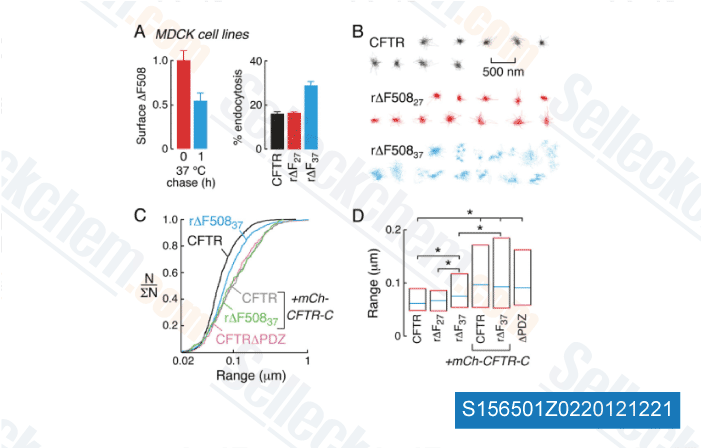
-
Datos de [ J Biol Chem , 2012 , 287, 43630-8 ]
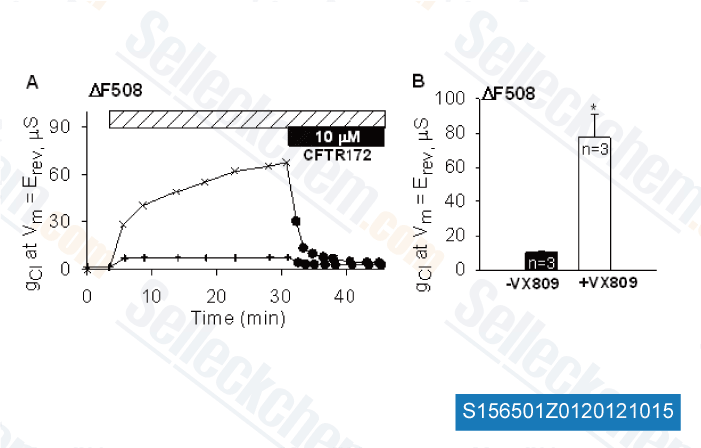
-
, , Xuehong Liu of Oregon Health & Science University
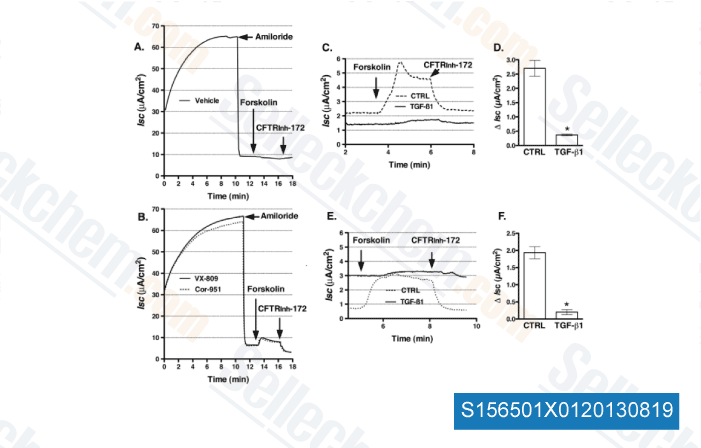
-
,

-
Datos de [ , , Mol Pharm, 2018, 15(3):759-767 ]
Sellecks VX-809 (Lumacaftor) Ha sido citado por 240 Publicaciones
| ACE-tRNAs are a platform technology for suppressing nonsense mutations that cause cystic fibrosis [ Nucleic Acids Res, 2025, 53(13)gkaf675] | PubMed: 40650978 |
| In silico, in vitro and ex vivo characterization of cystic fibrosis transmembrane conductance regulator pathogenic variants localized in the fourth intracellular loop and their rescue by modulators [ Br J Pharmacol, 2025, 10.1111/bph.70176] | PubMed: 40831301 |
| Global functional genomics reveals GRK5 as a cystic fibrosis therapeutic target synergistic with current modulators [ iScience, 2025, 28(3):111942] | PubMed: 40040803 |
| Human Induced Lung Organoids: A Promising Tool for Cystic Fibrosis Drug Screening [ Int J Mol Sci, 2025, 26(2)437] | PubMed: 39859153 |
| Nasal cells as a bronchial cell surrogate for pre-clinical assessment of drug response in cystic fibrosis [ Front Pharmacol, 2025, 16:1651122] | PubMed: 40978488 |
| Inhibitors of the ubiquitin‑proteasome system rescue cellular levels and ion transport function of pathogenic pendrin (SLC26A4) protein variants [ Int J Mol Med, 2025, 55(5)69] | PubMed: 40052591 |
| The Inhibition of the Membrane-Bound Transcription Factor Site-1 Protease (MBTP1) Alleviates the p.Phe508del-Cystic Fibrosis Transmembrane Conductance Regulator (CFTR) Defects in Cystic Fibrosis Cells [ Cells, 2024, 13(2)185] | PubMed: 38247876 |
| Comprehensive Assessment of CFTR Modulators' Therapeutic Efficiency for N1303K Variant [ Int J Mol Sci, 2024, 25(5)2770] | PubMed: 38474016 |
| Estimation of Chloride Channel Residual Function and Assessment of Targeted Drugs Efficiency in the Presence of a Complex Allele [L467F;F508del] in the CFTR Gene [ Int J Mol Sci, 2024, 25(19)10424] | PubMed: 39408749 |
| The F508del-CFTR trafficking correctors elexacaftor and tezacaftor are CFTR-independent Ca2+-mobilizing agonists normalizing abnormal Ca2+ levels in human airway epithelial cells [ Respir Res, 2024, 25(1):436] | PubMed: 39702307 |
POLÍTICA DE DEVOLUCIÓN
La Política de Devolución Incondicional de Selleck Chemical garantiza una experiencia de compra en línea fluida para nuestros clientes. Si no está satisfecho con su compra de alguna manera, puede devolver cualquier artículo(s) dentro de los 7 días posteriores a su recepción. En caso de problemas de calidad del producto, ya sean problemas relacionados con el protocolo o con el producto, puede devolver cualquier artículo(s) dentro de los 365 días a partir de la fecha de compra original. Siga las instrucciones a continuación al devolver productos.
ENVÍO Y ALMACENAMIENTO
Los productos Selleck se transportan a temperatura ambiente. Si recibe el producto a temperatura ambiente, tenga la seguridad de que el Departamento de Inspección de Calidad de Selleck ha realizado experimentos para verificar que la colocación a temperatura normal durante un mes no afectará la actividad biológica de los productos en polvo. Después de la recogida, guarde el producto de acuerdo con los requisitos descritos en la hoja de datos. La mayoría de los productos Selleck son estables en las condiciones recomendadas.
NO PARA USO HUMANO, DIAGNÓSTICO VETERINARIO O TERAPÉUTICO.