
Datos técnicos
| Fórmula | C21H24N4O2 |
||||||
| Peso molecular | 364.44 | Número CAS | 663619-89-4 | ||||
| Solubilidad (25°C)* | In vitro | DMSO | 12 mg/mL (32.92 mM) | ||||
| Water | Insoluble | ||||||
| Ethanol | Insoluble | ||||||
| In vivo (Agregue los solventes al producto individualmente y en orden.) |
|
||||||
|
* <1 mg/ml significa ligeramente soluble o insoluble. * Tenga en cuenta que Selleck prueba la solubilidad de todos los compuestos internamente, y la solubilidad real puede diferir ligeramente de los valores publicados. Esto es normal y se debe a ligeras variaciones entre lotes. * Envío a temperatura ambiente (Las pruebas de estabilidad demuestran que este producto se puede enviar sin medidas de refrigeración.) |
|||||||
Preparación de soluciones madre
Actividad biológica
| Descripción | El TGX-221 es un inhibidor específico de p110β con una IC50 de 5 nM en un ensayo sin células, 1000 veces más selectivo para p110β que para p110α. | ||||
|---|---|---|---|---|---|
| Objetivos |
|
||||
| In vitro | La actividad de TGX-221 contra diferentes isoformas se mide en un ensayo in vitro de PI3K utilizando múltiples preparaciones de p85/p110 recombinante. Este compuesto muestra una potencia lenta hacia p110δ con una IC50 de 211 nM. Además, atenúa parcialmente la fosforilación de Ser473 de PKB inducida por insulina en células de macrófagos J774.2. Este químico inhibe la interacción plaqueta-ECC, la agregación plaquetaria y la unión plaqueta-granulocito en un modelo de circulación extracorpórea (ECC). Un estudio reciente muestra que después del tratamiento con este compuesto (0.2, 2 y 20 μM), las células PC3 muestran inhibición de la proliferación con una reducción significativa de la actividad de la isoforma p110β PI3K. | ||||
| In vivo | Como agente antitrombótico, el TGX-221 en dosis de 1 + 1 (49 %) y 3 + 3 (88 %) mejora el flujo sanguíneo integrado durante 30 minutos en un modelo de ratón. Además, el tiempo de sangrado de la cola (BT) (seg) aumenta con este compuesto en dosis de 3 + 3 (mediana 1560) y 1 + 1 (1305) y el BT renal medio (seg) también aumenta en todos los grupos de TGX-221. |
Protocolo (de referencia)
| Ensayo de quinasa:[1] |
|
|---|---|
| Ensayo celular:[3] |
|
| Estudio en animales:[3] |
|
Referencias
|
Validación de productos por parte del cliente
![<p>(H) 30-min pretreatment of LCLs with 0.5 μmol/L TGX-221 significantly reduces protein synthesis in FXS patient cells [n = 40, 4 independent experiments, 2-way ANOVA: * P (genotype) < 0.001, * P (treatment) = 0.005, * P (interaction) < 0.001, Bon-ferroni post hocanalyses, * P = 0.001, #P = 0.002, ≠P = 0.02]. Example images are shown on the left: upper panel: signal for newly synthesized proteins (red), lower panel: overlay with tubulin staining (green). Scale bar is 20 μm. (I) Increasing concentrations of TGX-221 (5 μmol/L and 10 μmol/L) further reduce protein synthesis rates in FXS LCLs to healthy control levels.</p>](https://file.selleckchem.com/downloads/review/700px/TGX-221-S116901Y0120120509.gif)
-
Datos de [ Mol Med , 2012 , 18, 336-45 ]
![<p>(E) TGX-221 treatment (0.5 μmol/L, 30 min) of control and FXS LCLs reduces PI3K activity as shown by a radioactive PI3K assay of p110β-specific immunoprecipitates from LCL lysates, and decreases PI3K/mTOR down-stream signaling as shown by strongly reduced phosphorylation of S6 independently of the genotype. (F, G) Quantification demonstrates a significant, dose-dependent effect of TGX-221 treatment on PI3K activity [F, competitive ELISA, n = 4, 2-way ANOVA, *P (genotype) = 0.0079, *P (treatment) = 0.0258, P (interaction) = 0.9418], and on S6 phosphorylation[G, ELISA, n = 4, 2-way ANOVA, *P (genotype) = 0.013), *P (treatment) < 0.0001, P (interaction) = 0.195].</p>](https://file.selleckchem.com/downloads/review/700px/TGX-221-S116901Z0220120509.gif)
-
Datos de [ Mol Med , 2012 , 18, 336-45 ]
![<p>A p110β-selective antagonist rescues increased protein synthesis in synaptic fractions from Fmr1 KO mice and in LCLs from a patient with FXS. (A–C) Treatment of synaptoneurosomes with TGX-221 (1 μmol/L, 30 min) reduces p110β-specific PI3K activity and phosphorylation of the downstream target AKT in both WT and Fmr1 KO SNS, shown by a radioactive PI3K assay and phosphoAkt- specific western blot-ting (A). (B) Quantification of PI3K activity using a competitive ELISA showed a significant reduction in PI3K activity in both genotypes after treatment [ n = 4, 2-way ANOVA, *P (genotype) = 0.0086, * P (treatment) = 0.0087, P (interaction) = 0.7154]. (C) Densitometric quantification of phosphoAkt-specific western blots showed a significant effect of treatment (C, n = 4, 2-way ANOVA, *P (treatment) = 0.0005, P (genotype) =0.372, P (interaction) = 0.4894).</p>](https://file.selleckchem.com/downloads/review/700px/TGX-221-S116901Z0120120509.gif)
-
Datos de [ Mol Med , 2012 , 18, 336-45 ]
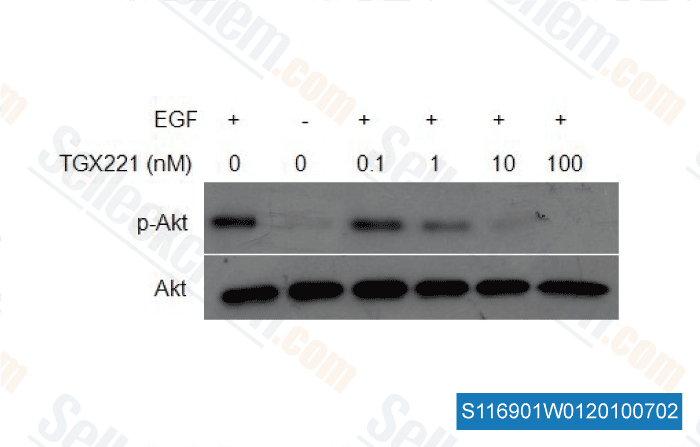
-
, , Dr. Zhang of Tianjin Medical University
Sellecks TGX-221 Ha sido citado por 102 Publicaciones
| hnRNPL phase separation activates PIK3CB transcription and promotes glycolysis in ovarian cancer [ Nat Commun, 2025, 16(1):4828] | PubMed: 40413189 |
| PI3K-dependent GAB1/Erk phosphorylation renders head and neck squamous cell carcinoma sensitive to PI3Kα inhibitors [ Cell Death Dis, 2025, 16(1):457] | PubMed: 40533463 |
| Role and Therapeutic Potential of miR-301b-3p in Regulating the PI3K-AKT Pathway via PIK3CB in Eosinophilic Chronic Rhinosinusitis [ J Inflamm Res, 2025, 18:10235-10251] | PubMed: 40756418 |
| Development of Acquired Resistance in Alpelisib-treated Gastric Cancer Cells With PIK3CA Mutations and Overcoming Strategies [ Anticancer Res, 2025, 45(5):1877-1896] | PubMed: 40295072 |
| Integration of 3D bioprinting and multi-algorithm machine learning identified glioma susceptibilities and microenvironment characteristics [ Cell Discov, 2024, 10(1):39] | PubMed: 38594259 |
| Microglia degrade Alzheimer's amyloid-beta deposits extracellularly via digestive exophagy [ Cell Rep, 2024, 43(12):115052] | PubMed: 39644493 |
| WWP1 inhibition suppresses the proliferation of pancreatic cancer cells by regulating the PI3K-AKT pathway [ J Gastroenterol, 2024, 10.1007/s00535-024-02192-x] | PubMed: 39656237 |
| Machine learning-based identification of lower grade glioma stemness subtypes discriminates patient prognosis and drug response [ Comput Struct Biotechnol J, 2023, 21:3827-3840] | PubMed: 37560125 |
| Pan-PI3K inhibition with copanlisib overcomes Treg- and M2-TAM-mediated immune suppression and promotes anti-tumor immune responses [ Clin Exp Med, 2023, 10.1007/s10238-023-01227-6] | PubMed: 37935952 |
| Overcoming resistance to immune checkpoint therapy in PTEN-null prostate cancer by intermittent anti-PI3Kα/β/δ treatment [ Nat Commun, 2022, 13(1):182] | PubMed: 35013322 |
POLÍTICA DE DEVOLUCIÓN
La Política de Devolución Incondicional de Selleck Chemical garantiza una experiencia de compra en línea fluida para nuestros clientes. Si no está satisfecho con su compra de alguna manera, puede devolver cualquier artículo(s) dentro de los 7 días posteriores a su recepción. En caso de problemas de calidad del producto, ya sean problemas relacionados con el protocolo o con el producto, puede devolver cualquier artículo(s) dentro de los 365 días a partir de la fecha de compra original. Siga las instrucciones a continuación al devolver productos.
ENVÍO Y ALMACENAMIENTO
Los productos Selleck se transportan a temperatura ambiente. Si recibe el producto a temperatura ambiente, tenga la seguridad de que el Departamento de Inspección de Calidad de Selleck ha realizado experimentos para verificar que la colocación a temperatura normal durante un mes no afectará la actividad biológica de los productos en polvo. Después de la recogida, guarde el producto de acuerdo con los requisitos descritos en la hoja de datos. La mayoría de los productos Selleck son estables en las condiciones recomendadas.
NO PARA USO HUMANO, DIAGNÓSTICO VETERINARIO O TERAPÉUTICO.