
Datos técnicos
| Fórmula | C20H22F3N5O |
||||||
| Peso molecular | 405.42 | Número CAS | 1025065-69-3 | ||||
| Solubilidad (25°C)* | In vitro | DMSO | 81 mg/mL (199.79 mM) | ||||
| Ethanol | 81 mg/mL (199.79 mM) | ||||||
| Water | Insoluble | ||||||
| In vivo (Agregue los solventes al producto individualmente y en orden.) |
|
||||||
|
* <1 mg/ml significa ligeramente soluble o insoluble. * Tenga en cuenta que Selleck prueba la solubilidad de todos los compuestos internamente, y la solubilidad real puede diferir ligeramente de los valores publicados. Esto es normal y se debe a ligeras variaciones entre lotes. * Envío a temperatura ambiente (Las pruebas de estabilidad demuestran que este producto se puede enviar sin medidas de refrigeración.) |
|||||||
Preparación de soluciones madre
Actividad biológica
| Descripción | SGI-1776 free base es un novedoso inhibidor competitivo de ATP de Pim1 con una IC50 de 7 nM en un ensayo sin células, 50 y 10 veces más selectivo frente a Pim2 y Pim3, también potente contra Flt3 y Haspin. SGI-1776 induce apoptosis y autophagy. | ||||||||
|---|---|---|---|---|---|---|---|---|---|
| Objetivos |
|
||||||||
| In vitro | In addition to Pim, SGI-1776 also potently targets FLT3 (IC50 = 44nM). Treatment of AML cells with SGI-1776 results in a concentration-dependent induction of apoptosis. Importantly, SGI-1776 is also cytotoxic in AML primary cells, irrespective of FLT3 mutation status and results in Mcl-1 protein decline. Treatment of CLL cells with SGI-1776 results in a concentration-dependent induction of apoptosis. SGI-1776 induces apoptosis in CLL and that the mechanism involves Mcl-1 reduction. Apoptosis induction coupled with the inhibition of RNA synthesis is observed in CLL cells treated with SGI-1776. SGI-1776 exhibites cytotoxic activity in vitro with a median relative IC50 of 3.1 mM. SGI-1776 induces tumor growth inhibition meeting criteria for intermediate EFS T/C activity in 1 of 39 evaluable models. In contrast, SGI-1776 induces complete responses of subcutaneous MV4;11. |
||||||||
| In vivo | Consistent with cell line data, xenograft model studies with mice bearing MV-4-11 tumors shows efficacy with SGI-1776. SGI-1776 has shown preclinical activity against leukemia and solid tumor cell line models with IC50 values of 0.005–11.68 mM. SGI-1776 induces significant differences in EFS distribution in vivo in 9 of 31 solid tumor xenografts and in 1 of 8 of the evaluable ALL xenografts. |
Protocolo (de referencia)
| Ensayo de quinasa: |
|
|---|---|
| Ensayo celular: |
|
| Estudio en animales: |
|
Referencias
|
Validación de productos por parte del cliente
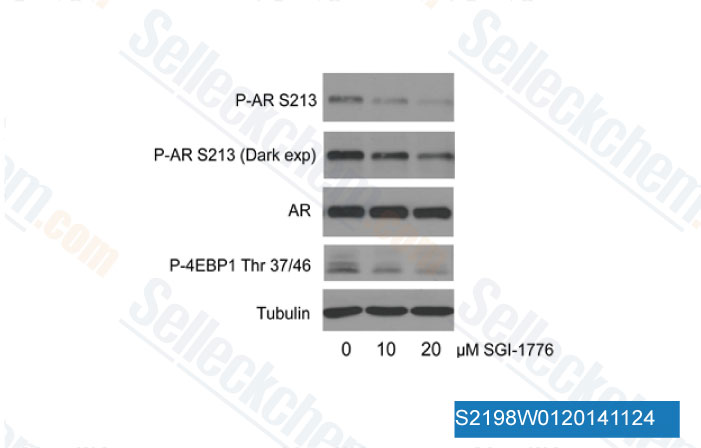
-
Datos de [ Oncogene , 2013 , 32(34), 3992-4000 ]
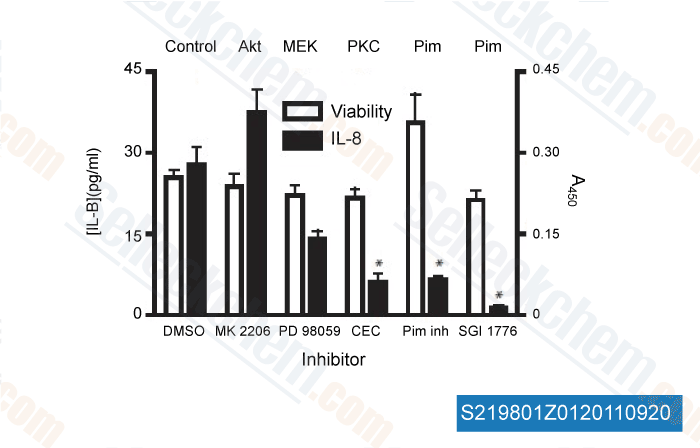
-
Datos de [ Sci Signal , 2011 , 4, rs9 ]
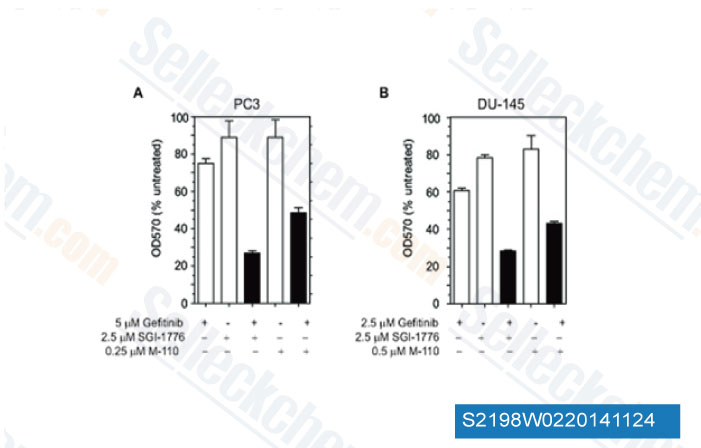
-
Datos de [ Oncotarget , 2011 , 2(12), 1134-44 ]
Selleck's SGI-1776 free base Ha sido citado por 43 Publicaciones
| PIM1 kinase promotes EMT-associated osimertinib resistance via regulating GSK3β signaling pathway in EGFR-mutant non-small cell lung cancer [ Cell Death Dis, 2024, 15(9):644] | PubMed: 39227379 |
| New Fusarochromanone Derivatives from the Marine Fungus Fusarium equiseti UBOCC-A-117302 [ Mar Drugs, 2024, 22(10)444] | PubMed: 39452852 |
| CDK9 inhibition induces epigenetic reprogramming revealing strategies to circumvent resistance in lymphoma [ Mol Cancer, 2023, 22(1):64] | PubMed: 36998071 |
| Neoprzewaquinone A Inhibits Breast Cancer Cell Migration and Promotes Smooth Muscle Relaxation by Targeting PIM1 to Block ROCK2/STAT3 Pathway [ Int J Mol Sci, 2023, 24(6)5464] | PubMed: 36982538 |
| Structure Activity Relationship Studies around DB18, a Potent and Selective Inhibitor of CLK Kinases [ Molecules, 2022, 27(19)6149] | PubMed: 36234686 |
| Targeting Echinococcus multilocularis PIM kinase for improving anti-parasitic chemotherapy [ PLoS Negl Trop Dis, 2022, 16(10):e0010483] | PubMed: 36190997 |
| Preclinical Immunopharmacologic Assessment of KPL-404, a Novel, Humanized, Non-Depleting Antagonistic Anti-CD40 Monoclonal Antibody [ Int J Gynecol Pathol, 2022, 10.1097/PGP.0000000000000882] | PubMed: 35443252 |
| Inhibition of PIM Kinases in DLBCL Targets MYC Transcriptional Program and Augments the Efficacy of Anti-CD20 Antibodies [ Cancer Res, 2021, 81(23):6029-6043] | PubMed: 34625423 |
| Inhibition of PIM Kinases in DLBCL Targets MYC Transcriptional Program and Augments the Efficacy of Anti-CD20 Antibodies [ Cancer Res, 2021, canres.1023.2021] | PubMed: 34625423 |
| PIM1 phosphorylation of the androgen receptor and 14-3-3 ζ regulates gene transcription in prostate cancer [ Commun Biol, 2021, 4(1):1221] | PubMed: 34697370 |
POLÍTICA DE DEVOLUCIÓN
La Política de Devolución Incondicional de Selleck Chemical garantiza una experiencia de compra en línea fluida para nuestros clientes. Si no está satisfecho con su compra de alguna manera, puede devolver cualquier artículo(s) dentro de los 7 días posteriores a su recepción. En caso de problemas de calidad del producto, ya sean problemas relacionados con el protocolo o con el producto, puede devolver cualquier artículo(s) dentro de los 365 días a partir de la fecha de compra original. Siga las instrucciones a continuación al devolver productos.
ENVÍO Y ALMACENAMIENTO
Los productos Selleck se transportan a temperatura ambiente. Si recibe el producto a temperatura ambiente, tenga la seguridad de que el Departamento de Inspección de Calidad de Selleck ha realizado experimentos para verificar que la colocación a temperatura normal durante un mes no afectará la actividad biológica de los productos en polvo. Después de la recogida, guarde el producto de acuerdo con los requisitos descritos en la hoja de datos. La mayoría de los productos Selleck son estables en las condiciones recomendadas.
NO PARA USO HUMANO, DIAGNÓSTICO VETERINARIO O TERAPÉUTICO.