
Datos técnicos
| Fórmula | C16H21NO3 |
||||||||||||||
| Peso molecular | 275.34 | Número CAS | 61413-54-5 | ||||||||||||
| Solubilidad (25°C)* | In vitro | DMSO | 55 mg/mL (199.75 mM) | ||||||||||||
| Ethanol | 55 mg/mL (199.75 mM) | ||||||||||||||
| Water | Insoluble | ||||||||||||||
| In vivo (Agregue los solventes al producto individualmente y en orden.) |
|
||||||||||||||
|
* <1 mg/ml significa ligeramente soluble o insoluble. * Tenga en cuenta que Selleck prueba la solubilidad de todos los compuestos internamente, y la solubilidad real puede diferir ligeramente de los valores publicados. Esto es normal y se debe a ligeras variaciones entre lotes. * Envío a temperatura ambiente (Las pruebas de estabilidad demuestran que este producto se puede enviar sin medidas de refrigeración.) |
|||||||||||||||
Preparación de soluciones madre
Actividad biológica
| Descripción | El inhibidor selectivo de la PDE4, Rolipram, inhibió de forma similar las actividades inmunopurificadas de PDE4B y PDE4D, con valores de IC50 de aprox. 130 nM y 240 nM respectivamente; un agente antiinflamatorio. | ||||
|---|---|---|---|---|---|
| Objetivos |
|
Protocolo (de referencia)
Referencias
|
Validación de productos por parte del cliente

-
Datos de [ , , Mol Cancer Ther, 2014, 13(10):2463-73. ]
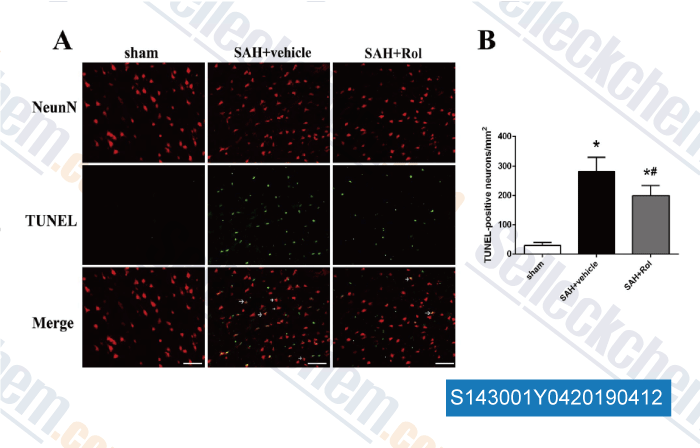
-
Datos de [ , , Biomed Pharmacother, 2018, 99:947-955 ]
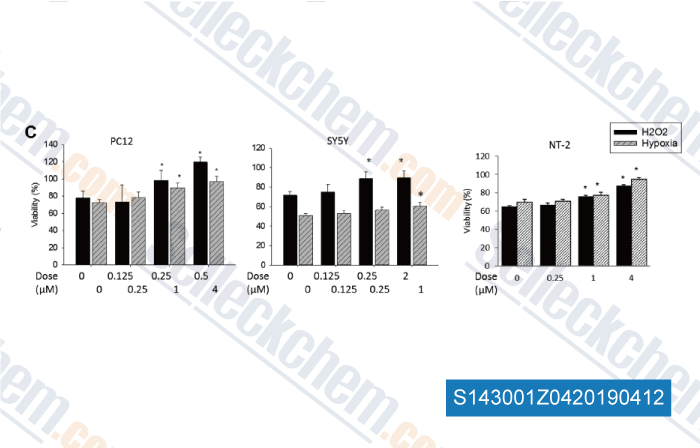
-
Datos de [ , , J Sex Med, 2016, 13(12):1834-1843 ]
-
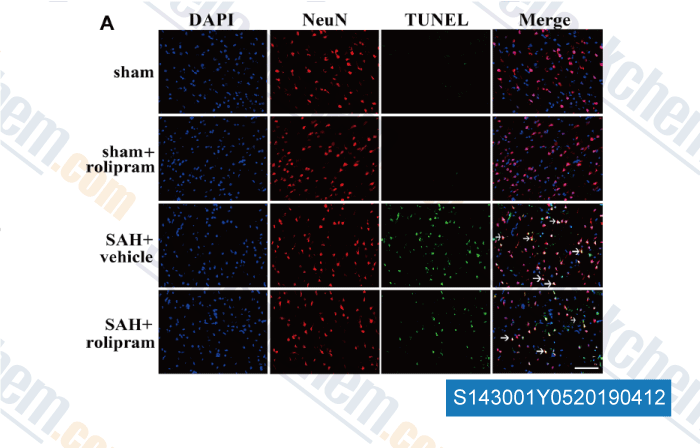
Datos de [ , , Neurochem Res, 2018, 43(4):785-795 ]
Sellecks Rolipram Ha sido citado por 18 Publicaciones
| P2RY14 cAMP signaling regulates Schwann cell precursor self-renewal, proliferation, and nerve tumor initiation in a mouse model of neurofibromatosis [ Elife, 2022, 11e73511] | PubMed: 35311647 |
| Purinergic Signaling in Neurofibromatosis Type 1: Characterizing the Role of P2RY14 in Neurofibroma Development [ ProQuest, 2022, 30509631] | PubMed: None |
| Roflupram protects against rotenone-induced neurotoxicity and facilitates α-synuclein degradation in Parkinson's disease models [ Acta Pharmacol Sin, 2021, 10.1038/s41401-021-00768-4] | PubMed: 34531546 |
| Rolipram Prevents the Formation of Abdominal Aortic Aneurysm (AAA) in Mice: PDE4B as a Target in AAA [ Antioxidants (Basel), 2021, 10(3)460] | PubMed: 33809405 |
| Release of adenosine-induced immunosuppression: Comprehensive characterization of dual A2A/A2B receptor antagonist [ Int Immunopharmacol, 2021, 96:107645] | PubMed: 33894488 |
| The protective effect of the PDE-4 inhibitor rolipram on intracerebral haemorrhage is associated with the cAMP/AMPK/SIRT1 pathway [ Sci Rep, 2021, 11(1):19737] | PubMed: 34611179 |
| MicroRNA-30d-5p ameliorates lipopolysaccharide-induced acute lung injury via activating AMPKα [ Immunopharmacol Immunotoxicol, 2021, 43(4):431-442] | PubMed: 34157933 |
| Roflupram exerts neuroprotection via activation of CREB/PGC-1α signalling in experimental models of Parkinson's disease. [ Br J Pharmacol, 2020, 177(10):2333-2350] | PubMed: 31972868 |
| Roflupram, a novel phosphodiesterase 4 inhibitor, inhibits lipopolysaccharide-induced neuroinflammatory responses through activation of the AMPK/Sirt1 pathway [ Int Immunopharmacol, 2020, S1567-5769(20)33643-2] | PubMed: 33243606 |
| The diacylglycerol kinase α (DGKα)/Akt/NF-κB feedforward loop promotes esophageal squamous cell carcinoma (ESCC) progression via FAK-dependent and FAK-independent manner [ Oncogene, 2019, 38(14):2533-2550] | PubMed: 30532074 |
POLÍTICA DE DEVOLUCIÓN
La Política de Devolución Incondicional de Selleck Chemical garantiza una experiencia de compra en línea fluida para nuestros clientes. Si no está satisfecho con su compra de alguna manera, puede devolver cualquier artículo(s) dentro de los 7 días posteriores a su recepción. En caso de problemas de calidad del producto, ya sean problemas relacionados con el protocolo o con el producto, puede devolver cualquier artículo(s) dentro de los 365 días a partir de la fecha de compra original. Siga las instrucciones a continuación al devolver productos.
ENVÍO Y ALMACENAMIENTO
Los productos Selleck se transportan a temperatura ambiente. Si recibe el producto a temperatura ambiente, tenga la seguridad de que el Departamento de Inspección de Calidad de Selleck ha realizado experimentos para verificar que la colocación a temperatura normal durante un mes no afectará la actividad biológica de los productos en polvo. Después de la recogida, guarde el producto de acuerdo con los requisitos descritos en la hoja de datos. La mayoría de los productos Selleck son estables en las condiciones recomendadas.
NO PARA USO HUMANO, DIAGNÓSTICO VETERINARIO O TERAPÉUTICO.