
Datos técnicos
| Fórmula | C21H23N7O2S.HCl |
||||||||||
| Peso molecular | 473.98 | Número CAS | 635702-64-6 | ||||||||
| Solubilidad (25°C)* | In vitro | DMSO | 32 mg/mL (67.51 mM) | ||||||||
| Water | Insoluble | ||||||||||
| Ethanol | Insoluble | ||||||||||
| In vivo (Agregue los solventes al producto individualmente y en orden.) |
|
||||||||||
|
* <1 mg/ml significa ligeramente soluble o insoluble. * Tenga en cuenta que Selleck prueba la solubilidad de todos los compuestos internamente, y la solubilidad real puede diferir ligeramente de los valores publicados. Esto es normal y se debe a ligeras variaciones entre lotes. * Envío a temperatura ambiente (Las pruebas de estabilidad demuestran que este producto se puede enviar sin medidas de refrigeración.) |
|||||||||||
Preparación de soluciones madre
Actividad biológica
| Descripción | Pazopanib HCl es un novedoso inhibidor multiobjetivo de VEGFR1, VEGFR2, VEGFR3, PDGFR, FGFR, c-Kit y c-Fms con una IC50 de 10 nM, 30 nM, 47 nM, 84 nM, 74 nM, 140 nM y 146 nM en ensayos libres de células, respectivamente. Pazopanib induce la muerte celular autofágica tipo II. | |||||||||||
|---|---|---|---|---|---|---|---|---|---|---|---|---|
| Objetivos |
|
|||||||||||
| In vitro | Pazopanib inhibe potentemente la fosforilación de VEGFR2 inducida por VEGF en células HUVEC con una IC50 de 8 nM. Pazopanib muestra una inhibición del crecimiento dosis-dependiente en todas las líneas celulares de sarcoma sinovial, incluidas las células SYO-1 y HS-SY-II. La proliferación de las células SYO-1 y HS-SY-II se inhibe incluso a 1 µg/mL de Pazopanib y se suprime completamente a 5 µg/mL. Pazopanib induce la detención en G1 y, por lo tanto, suprime el crecimiento de las células de sarcoma sinovial. La fosforilación de Akts, GSK-3β, JNKs, p70 S6 Kinase y mTOR se suprime en las células SYO-1 tratadas con Pazopanib en comparación con las células tratadas con el vehículo. Pazopanib entre 20 m g/mL y 22,5 m g/mL muestra una reducción creciente de la viabilidad de las células RPE. | |||||||||||
| In vivo | Los ratones tratados con 30 mg/kg o 100 mg/kg de Pazopanib revelan una disminución significativa de la carga tumoral en comparación con los ratones tratados con el vehículo o 10 mg/kg de Pazopanib. El tratamiento con Pazopanib es bien tolerado y no hay una diferencia significativa en el peso corporal entre los ratones de cada grupo. | |||||||||||
| Características | Un inhibidor multi-quinasa. |
Protocolo (de referencia)
| Ensayo de quinasa: |
|
|---|---|
| Ensayo celular: |
|
| Estudio en animales: |
|
Referencias
|
Validación de productos por parte del cliente
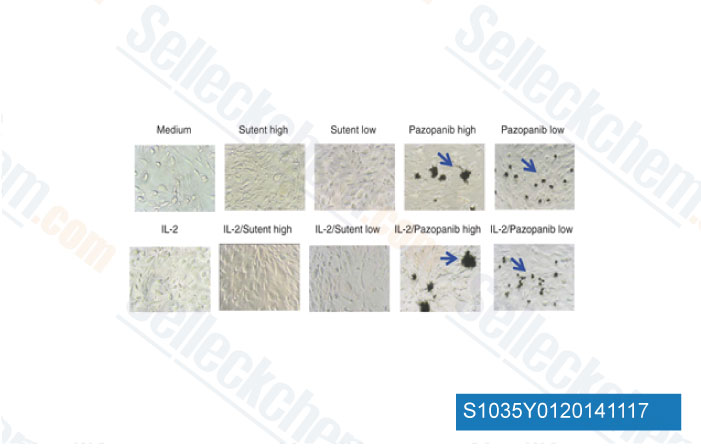
-
Datos de [ Expert Opin Pharmacother , 2014 , 15(11), 1489-99 ]
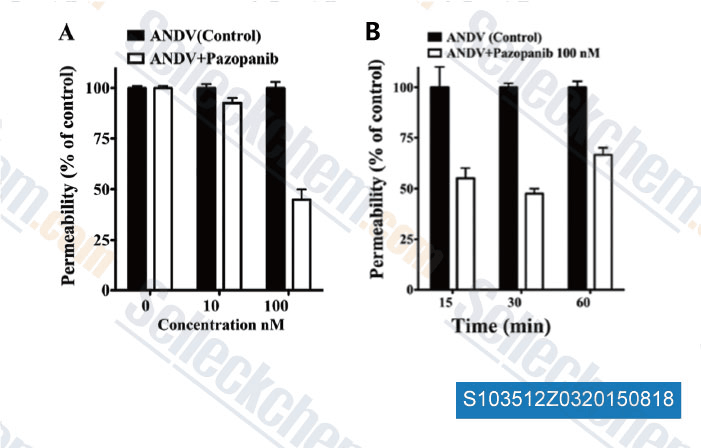
-
Datos de [ , , J Virol, 2011, 85(5): 2296-303 ]
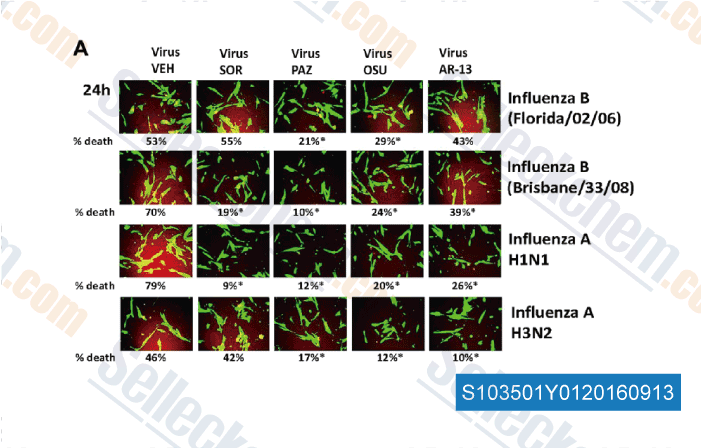
-
Datos de [ , , J Cell Physiol, 2016, 231(10):2286-302. ]
Sellecks Pazopanib HCl Ha sido citado por 57 Publicaciones
| Patient-derived rhabdomyosarcoma cells recapitulate the genetic and transcriptomic landscapes of primary tumors [ iScience, 2024, 27(10):110862] | PubMed: 39319271 |
| Cutoff value of IC50 for drug sensitivity in patient-derived tumor organoids in colorectal cancer [ iScience, 2023, 26(7):107116] | PubMed: 37426352 |
| Therapeutic and immunomodulatory potential of pazopanib in malignant phyllodes tumor [ NPJ Breast Cancer, 2022, 8(1):44] | PubMed: 35365682 |
| Establishment and Characterization of NCC-PMP1-C1: A Novel Patient-Derived Cell Line of Metastatic Pseudomyxoma Peritonei [ J Pers Med, 2022, 12(2)258] | PubMed: 35207746 |
| Establishment and characterization of NCC-UPS4-C1: a novel cell line of undifferentiated pleomorphic sarcoma from a patient with Li-Fraumeni syndrome [ Hum Cell, 2022, 10.1007/s13577-022-00671-y] | PubMed: 35118583 |
| Preclinical Evaluation of Ixabepilone in Combination with VEGF Receptor and PARP Inhibitors in Taxane-Sensitive and Taxane-Resistant MDA-MB-231 Breast Cancer Cells [ J Pharm Sci, 2022, 111(8):2180-2190] | PubMed: 35700798 |
| Pazopanib restricts small cell lung cancer proliferation via reactive oxygen species-mediated endoplasmic reticulum stress [ Thorac Cancer, 2022, 13(17):2421-2428] | PubMed: 35866204 |
| Proteogenomic characterization identifies clinically relevant subgroups of intrahepatic cholangiocarcinoma [ Cancer Cell, 2021, S1535-6108(21)00659-0] | PubMed: 34971568 |
| Integrated transcriptional-phenotypic analysis captures systemic immunomodulation following antiangiogenic therapy in renal cell carcinoma patients [ Clin Transl Med, 2021, 11(6):e434] | PubMed: 34185403 |
| Synergistic PIM kinase and proteasome inhibition as a therapeutic strategy for MYC-overexpressing triple-negative breast cancer [ Cell Chem Biol, 2021, S2451-9456(21)00400-1] | PubMed: 34525344 |
POLÍTICA DE DEVOLUCIÓN
La Política de Devolución Incondicional de Selleck Chemical garantiza una experiencia de compra en línea fluida para nuestros clientes. Si no está satisfecho con su compra de alguna manera, puede devolver cualquier artículo(s) dentro de los 7 días posteriores a su recepción. En caso de problemas de calidad del producto, ya sean problemas relacionados con el protocolo o con el producto, puede devolver cualquier artículo(s) dentro de los 365 días a partir de la fecha de compra original. Siga las instrucciones a continuación al devolver productos.
ENVÍO Y ALMACENAMIENTO
Los productos Selleck se transportan a temperatura ambiente. Si recibe el producto a temperatura ambiente, tenga la seguridad de que el Departamento de Inspección de Calidad de Selleck ha realizado experimentos para verificar que la colocación a temperatura normal durante un mes no afectará la actividad biológica de los productos en polvo. Después de la recogida, guarde el producto de acuerdo con los requisitos descritos en la hoja de datos. La mayoría de los productos Selleck son estables en las condiciones recomendadas.
NO PARA USO HUMANO, DIAGNÓSTICO VETERINARIO O TERAPÉUTICO.