
Datos técnicos
| Fórmula | C15H20O3 |
||||||
| Peso molecular | 248.32 | Número CAS | 20554-84-1 | ||||
| Solubilidad (25°C)* | In vitro | DMSO | 49 mg/mL (197.32 mM) | ||||
| Ethanol | 49 mg/mL (197.32 mM) | ||||||
| Water | Insoluble | ||||||
| In vivo (Agregue los solventes al producto individualmente y en orden.) |
|
||||||
|
* <1 mg/ml significa ligeramente soluble o insoluble. * Tenga en cuenta que Selleck prueba la solubilidad de todos los compuestos internamente, y la solubilidad real puede diferir ligeramente de los valores publicados. Esto es normal y se debe a ligeras variaciones entre lotes. * Envío a temperatura ambiente (Las pruebas de estabilidad demuestran que este producto se puede enviar sin medidas de refrigeración.) |
|||||||
Preparación de soluciones madre
Actividad biológica
| Descripción | (-)-Parthenolide, un inhibidor de la vía del Nuclear Factor-κB, agota específicamente la proteína HDAC1 sin afectar a otras HDAC de clase I/II; También promueve la ubiquitinación de MDM2 y activa las funciones celulares de p53. | ||||
|---|---|---|---|---|---|
| Objetivos |
|
||||
| In vitro | El partenólido (PTL), una lactona sesquiterpénica purificada de los brotes de la matricaria, inhibe la actividad de la peptidasa 7 específica de ubiquitina (USP7) y desubiquitina y estabiliza la β-catenina, que es el factor de transcripción clave de la vía de señalización Wnt, lo que sugiere que el PTL es un agente anticancerígeno prometedor que se dirige a la señalización aberrante USP7/Wnt. |
||||
| In vivo | El partenólido (PN), un inhibidor de P65, aumenta significativamente el volumen tumoral en un modelo de ratón con xenoinjerto subcutáneo de cáncer gástrico (CG), lo que puede revertirse con gastrina. |
Protocolo (de referencia)
| Ensayo celular: |
|
|---|---|
| Estudio en animales: |
|
Referencias
|
Validación de productos por parte del cliente
-Parthenolide-S234101W0220161110.gif)
-
, , Harvard University, 2014.
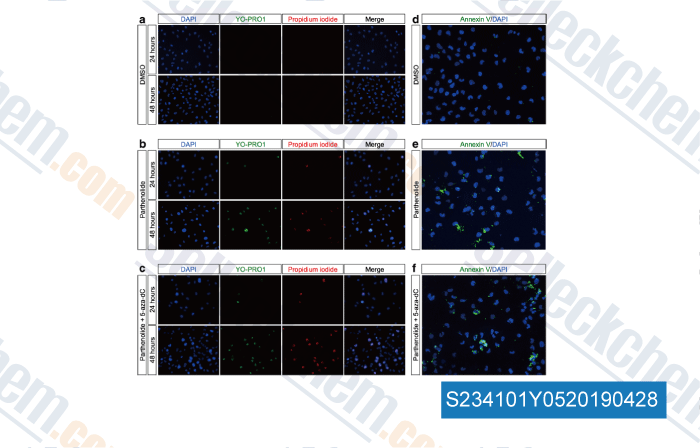
-
Datos de [ , , Cell Oncol (Dordr), 2017, 40(3):263-279 ]
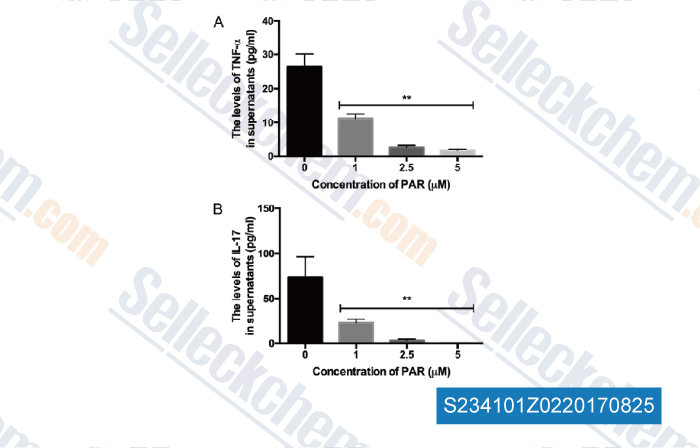
-
Datos de [ , , J Neuroimmunol, 2017, 305:154-161 ]
Sellecks (-)-Parthenolide Ha sido citado por 27 Publicaciones
| Ketogenic diet and β-hydroxybutyrate inhibit HDAC1 to preserve vascular smooth muscle cell function in thoracic aortic aneurysm [ J Adv Res, 2025, S2090-1232(25)00353-4] | PubMed: 40398746 |
| Synergistic activity of S63845 and parthenolide to overcome acquired resistance to MEK1/2 inhibitor in melanoma cells: Mechanisms and therapeutic potential [ Biomed Pharmacother, 2025, 188:118183] | PubMed: 40424823 |
| Development of translational read-through-inducing drugs as novel therapeutic options for patients with Fanconi anemia [ Cell Death Discov, 2025, 11(1):286] | PubMed: 40544182 |
| TNFSF14-HVEM/LTβR Exacerbates Keratinocyte Abnormalities and IMQ-Induced Psoriatic Skin Inflammation via Activating NF-κB/TWIST1 Signalling Pathway [ J Cell Mol Med, 2025, 29(15):e70774] | PubMed: 40768619 |
| Astaxanthin suppresses the malignant behaviors of nasopharyngeal carcinoma cells by blocking PI3K/AKT and NF-κB pathways via miR-29a-3p [ Genes Environ, 2024, 46(1):10] | PubMed: 38649975 |
| Parthenolide Targets NLRP3 to Treat Inflammasome-Related Diseases [ Int Immunopharmacol, 2023, 119:110229.] | PubMed: 37167640 |
| Connexin43 is associated with the progression of clear cell renal carcinoma and is regulated by tangeretin to sygergize with tyrosine kinase inhibitors [ Transl Oncol, 2023, 35:101712] | PubMed: 37354638 |
| Histone deacetylase 1 controls cardiomyocyte proliferation during embryonic heart development and cardiac regeneration in zebrafish [ PLoS Genet, 2021, 17(11):e1009890] | PubMed: 34723970 |
| Reduced Mitochondrial Apoptotic Priming Drives Resistance to BH3 Mimetics in Acute Myeloid Leukemia [ Cancer Cell, 2020, 38(6):872-890.e6] | PubMed: 33217342 |
| Lack of FGF21 promotes NASH-HCC transition via hepatocyte-TLR4-IL-17A signaling [ Theranostics, 2020, 10(22):9923-9936] | PubMed: 32929325 |
POLÍTICA DE DEVOLUCIÓN
La Política de Devolución Incondicional de Selleck Chemical garantiza una experiencia de compra en línea fluida para nuestros clientes. Si no está satisfecho con su compra de alguna manera, puede devolver cualquier artículo(s) dentro de los 7 días posteriores a su recepción. En caso de problemas de calidad del producto, ya sean problemas relacionados con el protocolo o con el producto, puede devolver cualquier artículo(s) dentro de los 365 días a partir de la fecha de compra original. Siga las instrucciones a continuación al devolver productos.
ENVÍO Y ALMACENAMIENTO
Los productos Selleck se transportan a temperatura ambiente. Si recibe el producto a temperatura ambiente, tenga la seguridad de que el Departamento de Inspección de Calidad de Selleck ha realizado experimentos para verificar que la colocación a temperatura normal durante un mes no afectará la actividad biológica de los productos en polvo. Después de la recogida, guarde el producto de acuerdo con los requisitos descritos en la hoja de datos. La mayoría de los productos Selleck son estables en las condiciones recomendadas.
NO PARA USO HUMANO, DIAGNÓSTICO VETERINARIO O TERAPÉUTICO.