
Datos técnicos
| Fórmula | C23H31NO7 |
||||||
| Peso molecular | 433.49 | Número CAS | 128794-94-5 | ||||
| Solubilidad (25°C)* | In vitro | DMSO | 86 mg/mL (198.38 mM) | ||||
| Water | Insoluble | ||||||
| Ethanol | Insoluble | ||||||
| In vivo (Agregue los solventes al producto individualmente y en orden.) |
|
||||||
|
* <1 mg/ml significa ligeramente soluble o insoluble. * Tenga en cuenta que Selleck prueba la solubilidad de todos los compuestos internamente, y la solubilidad real puede diferir ligeramente de los valores publicados. Esto es normal y se debe a ligeras variaciones entre lotes. * Envío a temperatura ambiente (Las pruebas de estabilidad demuestran que este producto se puede enviar sin medidas de refrigeración.) |
|||||||
Preparación de soluciones madre
Actividad biológica
| Descripción | Mycophenolate mofetil es un inhibidor no competitivo, selectivo y reversible de la inosina monofosfato deshidrogenasa I/II con una IC50 de 39 nM y 27 nM, respectivamente. Este compuesto induce apoptosis dependiente de caspasas e inhibición del ciclo celular en células de mieloma múltiple. | ||||
|---|---|---|---|---|---|
| Objetivos |
|
||||
| In vitro | Mycophenolate mofetil es un profármaco éster del inmunosupresor activo ácido micofenólico (MPA). Este último muestra una actividad de inhibición no competitiva, selectiva y reversible contra la inosina monofosfato deshidrogenasa tipo I/II con una IC50 de 39 nM y 27 nM, respectivamente. Además, el MPA también produce la inhibición dependiente de la concentración de la proliferación de células T estimuladas por ConA, células B estimuladas por LPS y células T específicas de aloantígenos con una IC50 de 100 nM, 120 nM y 51 nM, respectivamente. Este compuesto con una alta concentración de 10 μg/mL induce una fuerte apoptosis en cultivos de células microgliales y aumenta el número de células apoptóticas inmunorreactivas a la caspasa-3 activada. Además, (1 μg/mL) inhibe fuertemente la proliferación tanto de células microgliales como de astrocitos. Un estudio reciente muestra que esta sustancia química atenúa significativamente la extensión de la muerte neuronal en cultivos de rebanadas hipocampales organotípicas después de una lesión neuronal de manera dependiente del tiempo. |
||||
| In vivo | En un modelo de trasplante cardíaco heterotópico de rata ACI a Lewis, el tratamiento con Mycophenolate mofetil a dosis de 20 mg/kg y 40 mg/kg conduce a una prolongación de la supervivencia del injerto, con un tiempo medio de supervivencia (MST) de 14,5 días y 18,5 días, respectivamente. En el modelo de ratón de esclerodermia inducida por bleomicina (BLM), este compuesto reduce la infiltración de células inflamatorias, el contenido de hidroxiprolina tisular y el grosor dérmico. |
Protocolo (de referencia)
| Ensayo de quinasa: |
|
|---|---|
| Ensayo celular: |
|
| Estudio en animales: |
|
Referencias
|
Validación de productos por parte del cliente
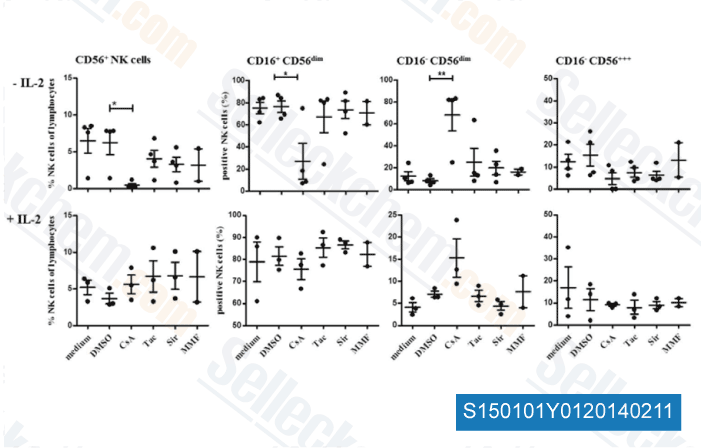
-
Datos de [ Front Immunol , 2013 , 4, 46 ]
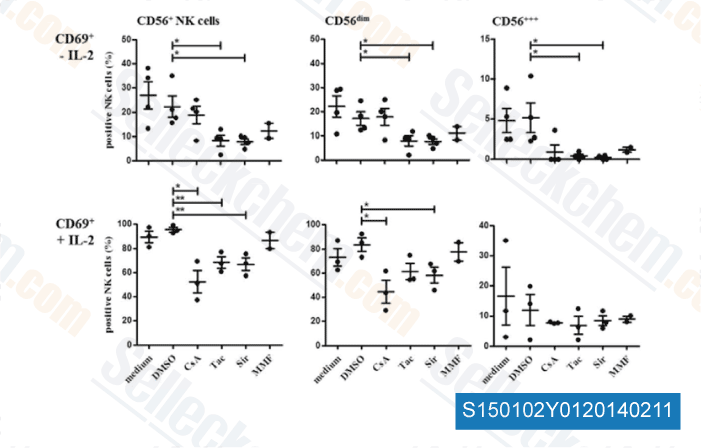
-
Datos de [ Front Immunol , 2013 , 4, 46 ]
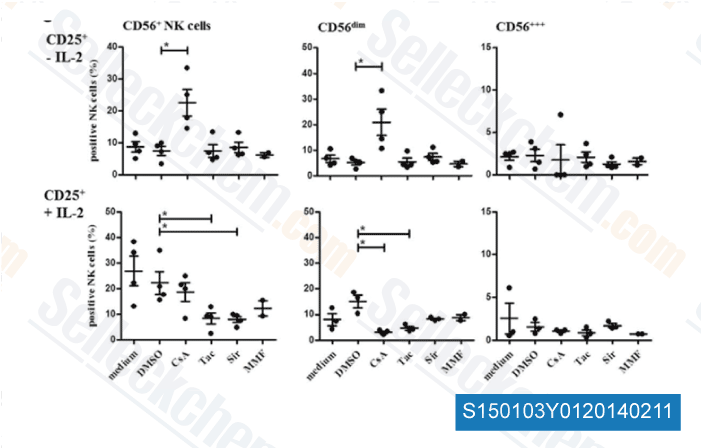
-
Datos de [ Front Immunol , 2013 , 4:, 46 ]
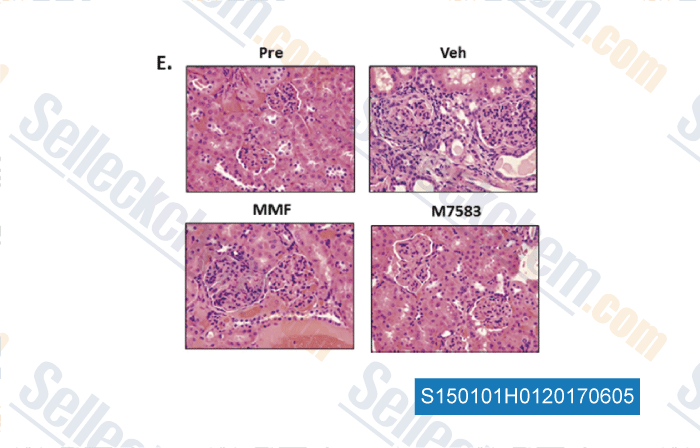
-
Datos de [ , , Clin Immunol, 2016, 164:65-77 ]
Sellecks Mycophenolate mofetil Ha sido citado por 14 Publicaciones
| Digital twins for in vivo metabolic flux estimations in patients with brain cancer [ Cell Metab, 2025, S1550-4131(25)00482-6] | PubMed: 41330373 |
| Genome-scale clustered regularly interspaced short palindromic repeats screen identifies nucleotide metabolism as an actionable therapeutic vulnerability in diffuse large B-cell lymphoma [ Haematologica, 2024, 109(12):3989-4006] | PubMed: 38841800 |
| Spatiotemporal Regulation of De Novo and Salvage Purine Synthesis during Brain Development [ eNeuro, 2023, 10(10)ENEURO.0159-23.2023] | PubMed: 37770184 |
| Spatiotemporal regulation ofde novoand salvage purine synthesis during brain development [ bioRxiv, 2023, 10.1101/2023.03.01.530588] | PubMed: None |
| Reversal of cancer gene expression identifies repurposed drugs for diffuse intrinsic pontine glioma [ Acta Neuropathol Commun, 2022, 10(1):150] | PubMed: 36274161 |
| Comprehensive drug response profiling and pan-omic analysis identified therapeutic candidates and prognostic biomarkers for Asian cholangiocarcinoma [ iScience, 2022, 25(10):105182] | PubMed: 36248745 |
| GATA4 regulates mitochondrial biogenesis and functions during cardiac development and rescues cardiac and mitochondrial functions impaired by TKIs [ Research Square, 2022, Version 1] | PubMed: None |
| The effect of nintedanib versus mycophenolate mofetil in the Fra2 mouse model of systemic sclerosis-associated interstitial lung disease [ Clin Exp Rheumatol, 2021, N/A] | PubMed: 33886452 |
| Purine metabolism regulates DNA repair and therapy resistance in glioblastoma [ Nat Commun, 2020, 11(1):3811] | PubMed: 32732914 |
| IMPDH Inhibitors for Antitumor Therapy in Tuberous Sclerosis Complex [ JCI Insight, 2020, 9;5(7):e135071] | PubMed: 32271165 |
POLÍTICA DE DEVOLUCIÓN
La Política de Devolución Incondicional de Selleck Chemical garantiza una experiencia de compra en línea fluida para nuestros clientes. Si no está satisfecho con su compra de alguna manera, puede devolver cualquier artículo(s) dentro de los 7 días posteriores a su recepción. En caso de problemas de calidad del producto, ya sean problemas relacionados con el protocolo o con el producto, puede devolver cualquier artículo(s) dentro de los 365 días a partir de la fecha de compra original. Siga las instrucciones a continuación al devolver productos.
ENVÍO Y ALMACENAMIENTO
Los productos Selleck se transportan a temperatura ambiente. Si recibe el producto a temperatura ambiente, tenga la seguridad de que el Departamento de Inspección de Calidad de Selleck ha realizado experimentos para verificar que la colocación a temperatura normal durante un mes no afectará la actividad biológica de los productos en polvo. Después de la recogida, guarde el producto de acuerdo con los requisitos descritos en la hoja de datos. La mayoría de los productos Selleck son estables en las condiciones recomendadas.
NO PARA USO HUMANO, DIAGNÓSTICO VETERINARIO O TERAPÉUTICO.