
Datos técnicos
| Fórmula | C23H21N5O3S |
||||||
| Peso molecular | 447.51 | Número CAS | 850879-09-3 | ||||
| Solubilidad (25°C)* | In vitro | DMSO | 32 mg/mL (71.5 mM) | ||||
| Water | Insoluble | ||||||
| Ethanol | Insoluble | ||||||
| In vivo (Agregue los solventes al producto individualmente y en orden.) |
|
||||||
|
* <1 mg/ml significa ligeramente soluble o insoluble. * Tenga en cuenta que Selleck prueba la solubilidad de todos los compuestos internamente, y la solubilidad real puede diferir ligeramente de los valores publicados. Esto es normal y se debe a ligeras variaciones entre lotes. * Envío a temperatura ambiente (Las pruebas de estabilidad demuestran que este producto se puede enviar sin medidas de refrigeración.) |
|||||||
Preparación de soluciones madre
Actividad biológica
| Descripción | Amuvatinib (MP-470, HPK 56) es un inhibidor potente y multi-dirigido de c-Kit, PDGFRα y Flt3 con IC50 de 10 nM, 40 nM y 81 nM, respectivamente. Suprime c-MET y c-RET, y también es activo como inhibidor de la proteína de reparación de ADN Rad51 con actividad antineoplásica. Fase 2. | |||||||||||
|---|---|---|---|---|---|---|---|---|---|---|---|---|
| Objetivos |
|
|||||||||||
| In vitro | La sal de hidrocloruro de Amuvatinib (MP-470) inhibe varias mutaciones de c-Kit, incluyendo c-KitD816V, c-KitD816H, c-KitV560G y c-KitV654A, así como un mutante de Flt3 (Flt3D835Y) y dos mutantes de PDGFRα (PDGFRαV561D y PDGFRαD842V), con IC50 de 10 nM a 8,4 μM. También se une e inhibe varios mutantes de c-Kit, incluyendo c-KitK642E, c-KitD816V y c-KitK642E/D816V. Este compuesto inhibe potentemente la proliferación de células OVCAR-3, A549, NCI-H647, DMS-153 y DMS-114, con IC50 de 0,9 μM–7,86 μM. También inhibe c-Kit y PDGFRα, con valores de IC50 de 31 μM y 27 μM, respectivamente. Demuestra una potente citotoxicidad contra las células MiaPaCa-2, PANC-1 y GIST882, con IC50 de 1,6 μM a 3,0 μM. En células MDA-MB-231, (1 μM) inhibe la fosforilación de tirosina de AXL. En células LNCaP y PC-3, pero no en DU145, exhibe citotoxicidad con IC50 de 4 μM y 8 μM, respectivamente, e induce apoptosis a 10 μM. En células LNCaP, (10 μM) provoca una detención en G1 y disminuye la fosforilación de Akt y ERK1/2. En células SF767, (10 μM) inhibe la fosforilación de c-Met y sensibiliza las células a la radiación. En combinación con la radiación, (10 μM) inhibe la actividad de la glucógeno sintasa quinasa (GSK)3β, induce apoptosis y altera la reparación de roturas de dsDNA, probablemente a través de la supresión de Rad51. |
|||||||||||
| In vivo | En modelos de xenoinjerto de ratón de células HT-29, A549 y SB-CL2, Amuvatinib (MP-470) (10 mg/kg–75 mg/kg por vía i.p. o 50 mg/kg–200 mg/kg por vía oral) inhibe el crecimiento tumoral. En ratones con xenoinjertos de LNCaP, este compuesto (20 mg/kg) combinado con Erlotinib induce significativamente la inhibición del crecimiento tumoral (TGI). |
Protocolo (de referencia)
| Ensayo de quinasa: |
|
|---|---|
| Ensayo celular: |
|
| Estudio en animales: |
|
Referencias
|
Validación de productos por parte del cliente
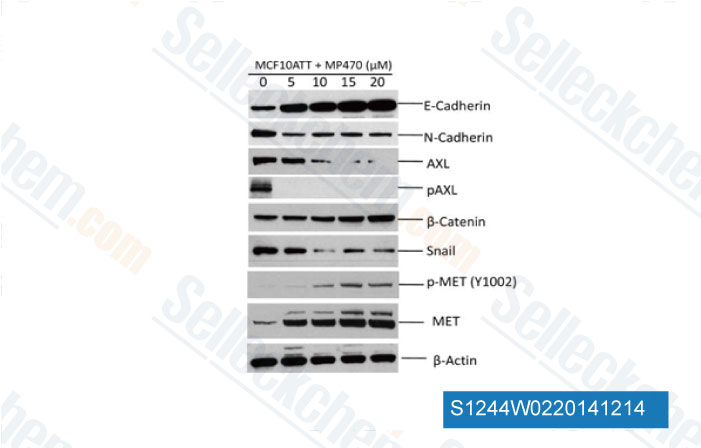
-
Datos de [ Oncogene , 2014 , 33(10), 1316-24 ]
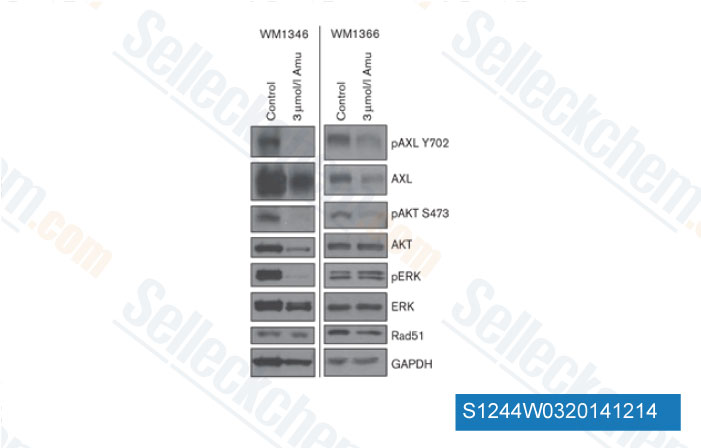
-
Datos de [ Melanoma Res , 2014 , 24(5), 448-53 ]
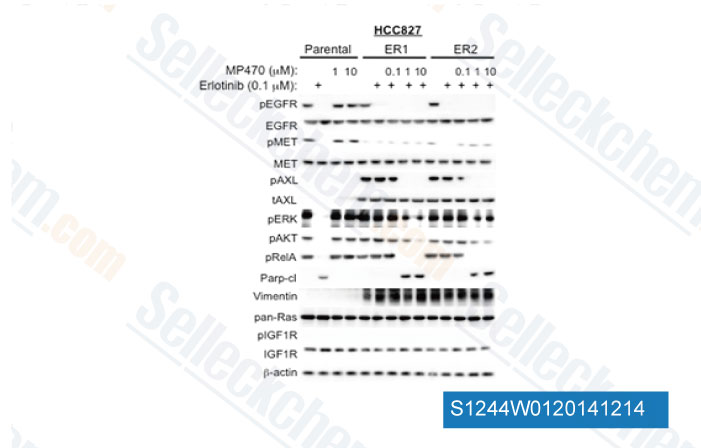
-
Datos de [ Nat Genet , 2012 , 44(8), 852-60 ]
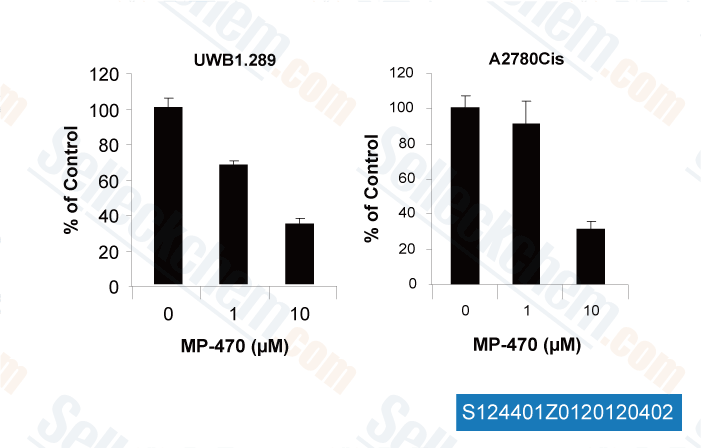
-
, , Dr. Yong-Weon Yi from Georgetown University Medical Center
Sellecks Amuvatinib (MP-470) Ha sido citado por 21 Publicaciones
| Tumorigenesis Driven by BRAFV600E Requires Secondary Mutations that Overcome it's Feedback Inhibition of RAC1 and Migration [ Cancer Res, 2025, 10.1158/0008-5472.CAN-24-2220] | PubMed: 39992718 |
| Synthetic Lethal Combinations of DNA Repair Inhibitors and Genotoxic Agents to Target High-Risk Diffuse Large B Cell Lymphoma [ Hematol Oncol, 2025, 43(5):e70131] | PubMed: 40847617 |
| Tumorigenesis driven by the BRAFV600E oncoprotein requires secondary mutations that overcome its feedback inhibition of migration and invasion [ bioRxiv, 2024, 2023.11.21.568071] | PubMed: 38659913 |
| Amuvatinib Blocks SARS-CoV-2 Infection at the Entry Step of the Viral Life Cycle [ Microbiol Spectr, 2023, e0510522.] | PubMed: 36995225 |
| Establishment and Characterization of NCC-PMP1-C1: A Novel Patient-Derived Cell Line of Metastatic Pseudomyxoma Peritonei [ J Pers Med, 2022, 12(2)258] | PubMed: 35207746 |
| Establishment and characterization of NCC-UPS4-C1: a novel cell line of undifferentiated pleomorphic sarcoma from a patient with Li-Fraumeni syndrome [ Hum Cell, 2022, 10.1007/s13577-022-00671-y] | PubMed: 35118583 |
| βIII-tubulin suppression enhances the activity of Amuvatinib to inhibit cell proliferation in c-Met positive non-small cell lung cancer cells [ Cancer Med, 2022, 10.1002/cam4.5128] | PubMed: 35946957 |
| STING-Mediated Interferon Induction by Herpes Simplex Virus 1 Requires the Protein Tyrosine Kinase Syk [ mBio, 2021, 12(6):e0322821] | PubMed: 34933455 |
| Establishment and characterization of NCC-MFS4-C1: a novel patient-derived cell line of myxofibrosarcoma [ Hum Cell, 2021, 34(6):1911-1918] | PubMed: 34383271 |
| Establishment and characterization of novel patient-derived cell lines from giant cell tumor of bone [ Hum Cell, 2021, 10.1007/s13577-021-00579-z] | PubMed: 34304386 |
POLÍTICA DE DEVOLUCIÓN
La Política de Devolución Incondicional de Selleck Chemical garantiza una experiencia de compra en línea fluida para nuestros clientes. Si no está satisfecho con su compra de alguna manera, puede devolver cualquier artículo(s) dentro de los 7 días posteriores a su recepción. En caso de problemas de calidad del producto, ya sean problemas relacionados con el protocolo o con el producto, puede devolver cualquier artículo(s) dentro de los 365 días a partir de la fecha de compra original. Siga las instrucciones a continuación al devolver productos.
ENVÍO Y ALMACENAMIENTO
Los productos Selleck se transportan a temperatura ambiente. Si recibe el producto a temperatura ambiente, tenga la seguridad de que el Departamento de Inspección de Calidad de Selleck ha realizado experimentos para verificar que la colocación a temperatura normal durante un mes no afectará la actividad biológica de los productos en polvo. Después de la recogida, guarde el producto de acuerdo con los requisitos descritos en la hoja de datos. La mayoría de los productos Selleck son estables en las condiciones recomendadas.
NO PARA USO HUMANO, DIAGNÓSTICO VETERINARIO O TERAPÉUTICO.