
Datos técnicos
| Fórmula | C37H48N4O5 |
||||||
| Peso molecular | 628.8 | Número CAS | 192725-17-0 | ||||
| Solubilidad (25°C)* | In vitro | DMSO | 126 mg/mL (200.38 mM) | ||||
| Ethanol | 126 mg/mL (200.38 mM) | ||||||
| Water | Insoluble | ||||||
| In vivo (Agregue los solventes al producto individualmente y en orden.) |
|
||||||
|
* <1 mg/ml significa ligeramente soluble o insoluble. * Tenga en cuenta que Selleck prueba la solubilidad de todos los compuestos internamente, y la solubilidad real puede diferir ligeramente de los valores publicados. Esto es normal y se debe a ligeras variaciones entre lotes. * Envío a temperatura ambiente (Las pruebas de estabilidad demuestran que este producto se puede enviar sin medidas de refrigeración.) |
|||||||
Preparación de soluciones madre
Actividad biológica
| Descripción | Lopinavir (ABT-378) es un potente inhibidor de la HIV protease con una Ki de 1,3 pM en un ensayo sin células. | ||
|---|---|---|---|
| Objetivos |
|
||
| In vitro | Lopinavir (ABT-378) se une a la HIV protease mutante (V82A, V82F y V82T) con un Ki de 4,9 pM, 3,7 pM y 3,6 pM, respectivamente. Inhibe el 93% de la actividad de la HIV protease de tipo salvaje a 0,5 nM, y también suprime la actividad de la HIV protease en ausencia y presencia de 50% de HS con una EC50 de 17 nM y 102 nM, respectivamente, en células MT4. Este compuesto se convierte en varios metabolitos de manera dependiente de NADPH en microsomas hepáticos con los metabolitos primarios M-3 y M-4. Es un potente inhibidor del eflujo de Rh123 en monocapas Caco-2 con una IC50 de 1,7 mM. Su exposición (72 horas) en células LS 180V reduce el contenido de Rh123 intracelular, e induce los niveles de proteína inmunorreactiva y ARN mensajero de P-glicoproteína en células LS 180V. Inhibe el clon C6 del subtipo C con una IC50 de 9,4 nM. Además, inhibe el CYP3A con una IC50 de 7,3 mM en microsomas hepáticos humanos, mientras que produce una inhibición insignificante o débil de los CYP1A2, 2B6, 2C9, 2C19 y 2D6 humanos. | ||
| In vivo | Lopinavir (ABT-378) (10 mg/kg, por vía oral) da como resultado una Cmax de 0,8 μg/mL y una biodisponibilidad oral del 25% en ratas. |
Protocolo (de referencia)
| Estudio en animales:[1] |
|
|---|
Referencias
|
Validación de productos por parte del cliente
![Low-micromolar amounts of chloroquine, chlorpromazine, loperamide, and lopinavir inhibit MERS-CoV-induced cytopathology. Huh7 cells in 96-well plates were infected with MERS-CoV isolate EMC/2012 (MOI, 0.005) in the presence of 0 to 20 uM LPV. Cells were incubated for 2 days, and cell viability was monitored using an MTS assay. In addition, the potential toxicity of compound treatment only was monitored in parallel mock-infected Huh7 cell cultures. Graphs show the results (averages and standard deviations [SD]) of a representative experiment that was performed in quadruplicate. All experiments were repeated at least twice. For each compound, the calculated EC50, CC50, and SI values are given.](https://file.selleckchem.com/downloads/review/700px/Lopinavir-S1380Z0120141215.gif)
-
Datos de [ Antimicrob Agents Chemother , 2014 , 58(8), 4875-84 ]
-
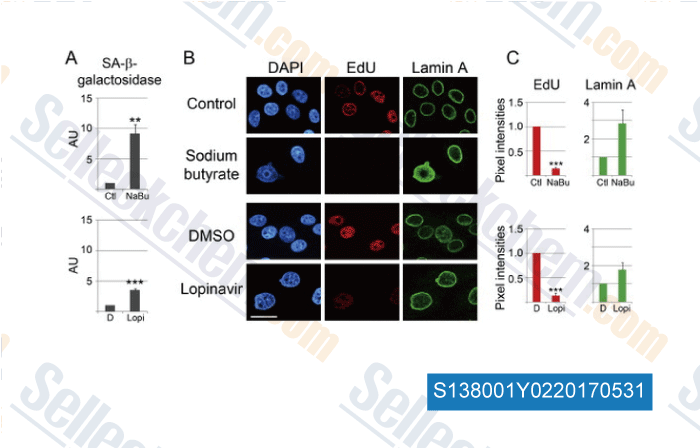
Datos de [ , , Biochim Biophys Acta, 2017, 1864(3):475-486 ]
Sellecks Lopinavir (ABT-378) Ha sido citado por 46 Publicaciones
| Exploring the Therapeutic Potential of Cordyceps Mushroom on SARS-CoV-2 Using Virtual Screening against Mpro and In Vitro Validation of Cordycepin [ J Microbiol Biotechnol, 2025, 35:e2411063] | PubMed: 40147924 |
| Reactivated endogenous retroviruses promote protein aggregate spreading [ Nat Commun, 2023, 14(1):5034] | PubMed: 37596282 |
| Stabilization of the Dimeric State of SARS-CoV-2 Main Protease by GC376 and Nirmatrelvir [ Int J Mol Sci, 2023, 24(7)6062] | PubMed: 37047038 |
| Garbage in, garbage out: how reliable training data improved a virtual screening approach against SARS-CoV-2 MPro [ Front Pharmacol, 2023, 14:1193282] | PubMed: 37426813 |
| The Interleukin-11/IL-11 Receptor Promotes Glioblastoma Survival and Invasion under Glucose-Starved Conditions through Enhanced Glutaminolysis [ Int J Mol Sci, 2023, 24(4)3356] | PubMed: 36834778 |
| Stabilization of the Dimeric State of SARS-CoV-2 Main Protease by GC376 and Nirmatrelvir [ Int. J. Mol. Sci, 2023, 10.3390/ijms24076062] | PubMed: None |
| Biological and Structural Analyses of New Potent Allosteric Inhibitors of HIV-1 Integrase [ Antimicrob Agents Chemother, 2023, 67(7):e0046223] | PubMed: 37310224 |
| The IDentif.AI-x pandemic readiness platform: Rapid prioritization of optimized COVID-19 combination therapy regimens [ NPJ Digit Med, 2022, 5(1):83] | PubMed: 35773329 |
| Cell-to-cell transmission of HIV-1 from provirus-activated cells to resting naïve and memory human primary CD4 T cells is highly efficient and requires CD4 and F-actin but not chemokine receptors [ J Med Virol, 2022, 10.1002/jmv.28005] | PubMed: 35840493 |
| Significant role of host sialylated glycans in the infection and spread of severe acute respiratory syndrome coronavirus 2 [ PLoS Pathog, 2022, 18(6):e1010590] | PubMed: 35700214 |
POLÍTICA DE DEVOLUCIÓN
La Política de Devolución Incondicional de Selleck Chemical garantiza una experiencia de compra en línea fluida para nuestros clientes. Si no está satisfecho con su compra de alguna manera, puede devolver cualquier artículo(s) dentro de los 7 días posteriores a su recepción. En caso de problemas de calidad del producto, ya sean problemas relacionados con el protocolo o con el producto, puede devolver cualquier artículo(s) dentro de los 365 días a partir de la fecha de compra original. Siga las instrucciones a continuación al devolver productos.
ENVÍO Y ALMACENAMIENTO
Los productos Selleck se transportan a temperatura ambiente. Si recibe el producto a temperatura ambiente, tenga la seguridad de que el Departamento de Inspección de Calidad de Selleck ha realizado experimentos para verificar que la colocación a temperatura normal durante un mes no afectará la actividad biológica de los productos en polvo. Después de la recogida, guarde el producto de acuerdo con los requisitos descritos en la hoja de datos. La mayoría de los productos Selleck son estables en las condiciones recomendadas.
NO PARA USO HUMANO, DIAGNÓSTICO VETERINARIO O TERAPÉUTICO.