
Datos técnicos
| Fórmula | C32H31F2N3O2.3HCl |
||||||
| Peso molecular | 636.99 | Número CAS | 167465-36-3 | ||||
| Solubilidad (25°C)* | In vitro | DMSO | 127 mg/mL (199.37 mM) | ||||
| Water | 23 mg/mL (36.1 mM) | ||||||
| Ethanol | Insoluble | ||||||
| In vivo (Agregue los solventes al producto individualmente y en orden.) |
|
||||||
|
* <1 mg/ml significa ligeramente soluble o insoluble. * Tenga en cuenta que Selleck prueba la solubilidad de todos los compuestos internamente, y la solubilidad real puede diferir ligeramente de los valores publicados. Esto es normal y se debe a ligeras variaciones entre lotes. * Envío a temperatura ambiente (Las pruebas de estabilidad demuestran que este producto se puede enviar sin medidas de refrigeración.) |
|||||||
Preparación de soluciones madre
Actividad biológica
| Descripción | Zosuquidar 3HCl es un potente modulador de la multirresistencia a fármacos mediada por la P-glicoproteína con una Ki de 60 nM en un ensayo sin células. Fase 3. | ||
|---|---|---|---|
| Objetivos |
|
||
| In vitro | LY335979 inhibe competitivamente la unión en equilibrio de Pgp al bloquear el marcaje por fotoafinidad con [3H]azidopina de la Pgp en membranas plasmáticas de CEM/VLB100. LY335979 solo muestra citotoxicidad en líneas celulares sensibles a fármacos y MDR con IC50 que oscilan entre 6 μM y 16 μM y produce su capacidad para revertir completamente la resistencia de los oncolíticos a las líneas celulares MDR P388/ADR, MCF7/ADR, 2780AD o UCLA-P3.003VLB a una concentración de 0,1 y 0,5 μM. LY335979 restaura significativamente la sensibilidad a los fármacos en líneas celulares de leucemia que expresan P-gp, incluyendo K562/HHT40, K562/HHT90, K562/DOX y HL60/DNR, y mejora la citotoxicidad de las antraciclinas y la ozogamicina (Mylotarg) en blastos primarios de LMA con P-gp activa. Un artículo reciente indica que LY335979 inhibe completamente el transporte dirigido apicalmente de (Z)-endoxifeno en las células transducidas con ABCB1. |
Protocolo (de referencia)
| Ensayo de quinasa: |
|
|---|---|
| Ensayo celular: |
|
| Estudio en animales: |
|
Referencias
|
Validación de productos por parte del cliente
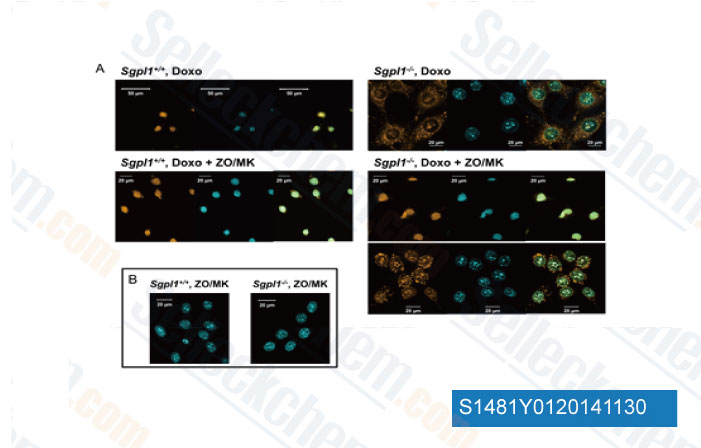
-
Datos de [ J Lipid Res , 2014 , 10.1194/jlr.M052761 ]
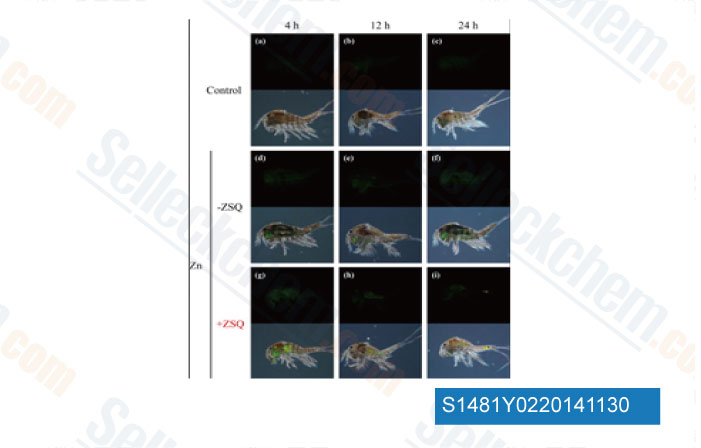
-
Datos de [ Aquat Toxicol , 2014 , 156C, 135-147 ]
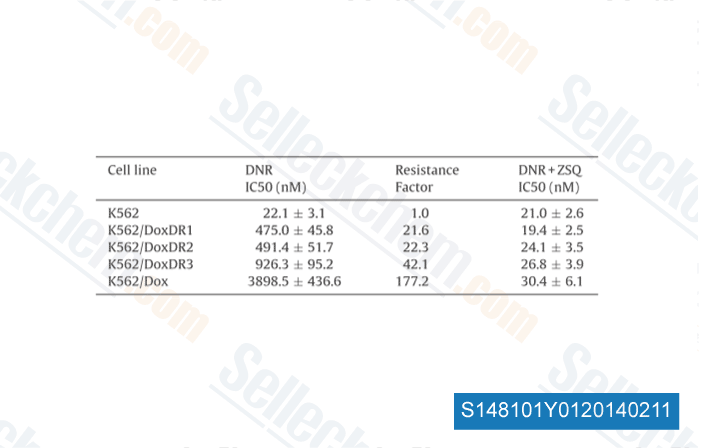
-
Datos de [ Pharmacol Res , 2013 , 67(1), 79-83 ]
![Inhibition of B-A steady state fluxes of digoxin and rhodamine 123 by increasing concentrations of zosuquidar (ZSQ). The iP-gp cell monolayers were investigated for digoxin (A) and rhodamine 123 (B) transport in the presence of increasing concentrations of zosuquidar (0.002–2.0 μM). The cells were preincubated with zosuquidar 10 min before addition of 3.12 μM rhodamine 123 or tracer amount of [3H]-digoxin at the abluminal site for B-A transport in a period of 120 min. The fluxes were estimated from the linear part of the accumulation curves. Values are presented as means ± SEM of three individual cell passages with two individual permeable supports (n =3, total N = 6).](https://file.selleckchem.com/downloads/review/700px/Zosuquidar-S148101X0620181107.gif)
-
Datos de [ , , Eur J Pharm Sci, 2018, 112:112-121 ]
Sellecks Zosuquidar 3HCl Ha sido citado por 34 Publicaciones
| Development of PROTACs for targeted degradation of oncogenic TRK fusions [ bioRxiv, 2025, 2025.06.18.660465] | PubMed: 40666929 |
| Inhibition of the transmembrane transporter ABCB1 overcomes resistance to doxorubicin in patient-derived organoid models of HCC [ Hepatol Commun, 2024, 8(5)e0437] | PubMed: 38696353 |
| Functional Blood-Brain Barrier Model with Tight Connected Minitissue by Liquid Substrates Culture [ Adv Healthc Mater, 2022, e2201984] | PubMed: 36394091 |
| Overcoming Resistance to Anti–Nectin-4 Antibody-Drug Conjugate [ Mol Cancer Ther, 2022, 21 (7): 1227–1235.] | PubMed: None |
| Overcoming Resistance to Anti-nectin-4 Antibody-Drug Conjugate [ Mol Cancer Ther, 2022, molcanther.0013.2022] | PubMed: 35534238 |
| Brain endothelial cells metabolize glutamate via glutamate dehydrogenase to replenish TCA-intermediates and produce ATP under hypoglycemic conditions [ J Neurochem, 2021, 157(6):1861-1875] | PubMed: 33025588 |
| Heat Shock Protein Inhibitor 17-Allyamino-17-Demethoxygeldanamycin, a Potent Inductor of Apoptosis in Human Glioma Tumor Cell Lines, Is a Weak Substrate for ABCB1 and ABCG2 Transporters [ Pharmaceuticals (Basel), 2021, 14(2)107] | PubMed: 33573093 |
| The blood-brain barrier studied in vitro across species [ PLoS One, 2021, 16(3):e0236770] | PubMed: 33711041 |
| Characterization of human pregnane X receptor activators identified from a screening of the Tox21 compound library [ Biochem Pharmacol, 2020, S0006-2952(20)30604-3] | PubMed: 33333074 |
| Testing of the Survivin Suppressant YM155 in a Large Panel of Drug-Resistant Neuroblastoma Cell Lines. [ Cancers (Basel), 2020, 2;12(3) pii: E577] | PubMed: 32131402 |
POLÍTICA DE DEVOLUCIÓN
La Política de Devolución Incondicional de Selleck Chemical garantiza una experiencia de compra en línea fluida para nuestros clientes. Si no está satisfecho con su compra de alguna manera, puede devolver cualquier artículo(s) dentro de los 7 días posteriores a su recepción. En caso de problemas de calidad del producto, ya sean problemas relacionados con el protocolo o con el producto, puede devolver cualquier artículo(s) dentro de los 365 días a partir de la fecha de compra original. Siga las instrucciones a continuación al devolver productos.
ENVÍO Y ALMACENAMIENTO
Los productos Selleck se transportan a temperatura ambiente. Si recibe el producto a temperatura ambiente, tenga la seguridad de que el Departamento de Inspección de Calidad de Selleck ha realizado experimentos para verificar que la colocación a temperatura normal durante un mes no afectará la actividad biológica de los productos en polvo. Después de la recogida, guarde el producto de acuerdo con los requisitos descritos en la hoja de datos. La mayoría de los productos Selleck son estables en las condiciones recomendadas.
NO PARA USO HUMANO, DIAGNÓSTICO VETERINARIO O TERAPÉUTICO.