Dacinostat (LAQ824)

N.º de catálogoS1095 Lote:S109502

Imprimir

Datos técnicos

Fórmula

C22H25N3O3

Peso molecular 379.459 Número CAS 404951-53-7
Solubilidad (25°C)* In vitro DMSO 76 mg/mL (200.28 mM)
Water Insoluble
Ethanol Insoluble
In vivo (Agregue los solventes al producto individualmente y en orden.)
Homogeneous suspension
CMC-NA
≥5mg/ml Taking the 1 mL working solution as an example, add 5 mg of this product to 1 ml of CMC-Na solution, mix evenly to obtain a homogeneous suspension with a final concentration of 5 mg/ml.
Clear solution
4% DMSO 40% PEG300 56%saline

Validado por los laboratorios Selleck. Si necesita ajustes en esta formulación, póngase en contacto con nuestro equipo de ventas para pruebas personalizadas.

3.760mg/ml (9.91mM) Taking the 1 mL working solution as an example, add 40 μL of 94 mg/ml clarified DMSO stock solution to 400 μL of PEG300, mix evenly to clarify it; then continue to add 560 μL of saline to adjust the volume to 1 mL. The mixed solution should be used immediately for optimal results. 
* <1 mg/ml significa ligeramente soluble o insoluble.
* Tenga en cuenta que Selleck prueba la solubilidad de todos los compuestos internamente, y la solubilidad real puede diferir ligeramente de los valores publicados. Esto es normal y se debe a ligeras variaciones entre lotes.
* Envío a temperatura ambiente (Las pruebas de estabilidad demuestran que este producto se puede enviar sin medidas de refrigeración.)

Preparación de soluciones madre

Actividad biológica

Descripción Dacinostat (LAQ824, NVP-LAQ824) es un nuevo inhibidor de HDAC con una IC50 de 32 nM y se sabe que activa el promotor p21.
Objetivos
p21 HDAC
(Cell-free assay)
32 nM
In vitro Dacinostat (LAQ824) activa la expresión del gen que codifica el inhibidor del ciclo celular p21 mediante la activación del promotor p21 con un 50 % de la activación máxima del promotor (AC50) de 0,30 μM. Inhibe el crecimiento celular tanto de H1299, una línea de carcinoma de pulmón no microcítico, como de HCT116, una línea de células de cáncer de colon con IC50 de 0,15 μM y 0,01 μM, respectivamente, y el efecto antiproliferativo de este compuesto es selectivo hacia las líneas celulares tumorales, mientras que solo induce la detención del crecimiento en fibroblastos normales. Además, induce un aumento dependiente de la dosis de la proteína p21 en células A549 y un aumento en el estado hipofosforilado del supresor tumoral Rb. Un estudio reciente muestra que LAQ824 induce cambios en la cromatina a nivel del promotor del gen IL-10 que conducen a un mayor reclutamiento de los represores transcripcionales HDAC11 y PU.1 e inhibe la producción de IL-10 en macrófagos murinos BALB/c.
In vivo Dacinostat (LAQ824) produce efectos inhibidores sobre el crecimiento tumoral de forma dependiente de la dosis sin citotoxicidad general en HCT116 y xenoinjertos de tumores de colon humano en ratones nude cuando se administra a 100 mg/kg.

Protocolo (de referencia)

Ensayo de quinasa:[1]
  • Ensayo de histona desacetilasa in vitro

    Las enzimas HDAC se purifican parcialmente del lisado celular H1299 mediante cromatografía de intercambio iónico utilizando la columna Q Sepharose Fast Flow. Los complejos enzimáticos se recolectan de 500 mg de lisado celular total mediante inmunoprecipitación con anticuerpo policlonal cdk2 o anticuerpo monoclonal cdk1/cdc2. Los inmunoprecipitados se resuspenden en tampón de cinasa (50 mM Hepes, pH 8, 10 mM MgCl2, 2,5 mM EDTA, 1 mM ditiotreitol, 20 mM ATP, 10 mM β-glicerofosfato, 0,1 mM NaVO4, 1 mM fluoruro de sodio, 50 mM ATP, 10 μCi de [γ-32P]ATP) junto con 1 μg de sustrato de proteína recombinante pRb (cdk2) o 10 ml de mezcla de histonas H1 que contiene 20 μg de sustrato (cdc2). La Rb fosforilada y la histona H1 se resuelven por electroforesis y se cuantifican utilizando un PhosphorImager. Este compuesto, Dacinostat (LAQ824), se utiliza en el ensayo.

Ensayo celular:[1]
  • Líneas celulares

    H1299, HCT116, DU145, PC3 and MDA435 cells

  • Concentraciones

    0-10 μM

  • Tiempo de incubación

    48 hours

  • Método

    Cell proliferation is measured using an adaptation of published procedures (3-(4,5-dimethylthiazol-2-yl)-5-(3-carboxymethoxy-phenyl)-2-(4-sulfonyl)-2H-tetrazolium assay). The cells are seeded in 12-well dishes and cultured in RPMI 1640 containing 10% FBS. To examine the growth inhibition by Dacinostat (LAQ824), the cells are cultured in the presence of various concentrations of this compound (up to 1,000 ng/mL). Viable cell numbers are determined by trypan blue dye exclusion, counted in a Nesbauer-type hemocytometer for 0 hour, 24 hours, and 48 hours. The same amount of ethanol is added to the RPMI 1640 medium as the control experiment. All experiments are performed in duplicate and repeated 3 times The average background value (treatment with medium alone) is subtracted from each experimental well; triplicate values are averaged for each compound dilution. The following formulas are used to calculate the percentage of growth: If X0, %Growth=(X-T0)/T0*100; If X>T0, %Growth=(X-T0)/(GC-T0)*100. where T0 is the average value of T0 − background, GC is the average value of untreated cells (in triplicate) − background, and X is the average value of compound-treated cells (in triplicate)-background. The “% Growth” is plotted against compound concentration and used to calculate the IC50 using the linear regression techniques between data points to predict the concentration of compounds at 50% inhibition.

Estudio en animales:[1]
  • Modelos animales

    HCT116 cells is injected s.c. into the right axillary (lateral) region of outbred athymic (nu/nu) female mice.

  • Dosificaciones

    ≤100 mg/kg

  • Administración

    Administered via i.v.

Referencias

  • https://pubmed.ncbi.nlm.nih.gov/14744786/
  • https://pubmed.ncbi.nlm.nih.gov/21368229/

Validación de productos por parte del cliente
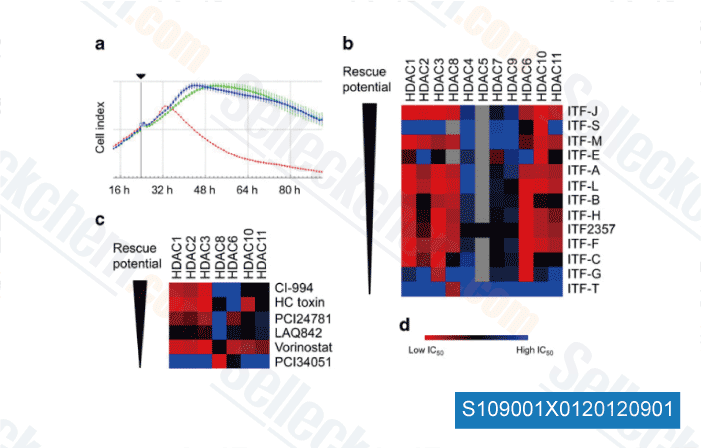
<p>Class I selective HDACi have the highest INS-1 rescue potential . INS-1 cells were monitored using the real-time xCELLigence system h and the impedance (cell adhesion) was measured as a surrogate of cell viability (cell index) as described in the Methods. (a ) The impedance of duplicates of control (green line), cytokine-exposed (red line) and cytokine+ITF-J-exposed INS-1 cells (blue line) was followed from the start of exposure (indicated by the arrow). Heat maps of 13 different ITF HDAC inhibitor compounds ( b )orsix different commercial HDAC inhibitor compounds (c) were made based on their IC50 values towards selected HDACs . The HDACi inhibitors are ranked after rescue potential according to ESM Tables 1, 2 .( c) Values are corrected for differences in potency since they varied from 33.3 (CI-994) to 0.041 (LAQ824). (d ) Colour code for both heat maps: low IC50 values coloured red, intermediate IC50 values coloured black and high IC50 values coloured blue; grey indicates undetermined IC50.</p>

Datos de [ Diabetologia , 2012 , 55(9), 2421-31 ]
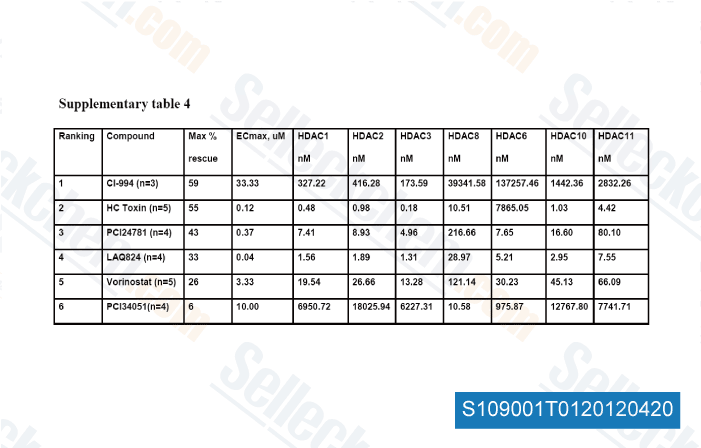
<p>Analyses of efficacy, potency and IC50 of HDAC inhibitors point toward HDACs 1–3 as relevant candidates for beta cell protection. Ranking and raw data on ITF drugs (Table 3) and commercial HDAC inhibitors (Table 4) underlying the heat maps of Fig. 1 (A and B). The HDAC inhibitor compounds were tested using a HDAC activity kit and recombinant proteins to determine IC50 values on each individual HDAC (right part of the table). Each drug was further tested using Real-Time Cell Analysis (RTCA) to score their maximal effective concentration (ECmax) as well as the corresponding rescue percentage of cytokine treated INS-1 cells. The drugs were ranked according to % rescue. * DMSO alone controls were included in each experiment, but not shown here. The results indicate that the highest concentrations of DMSO used here (1:1,000) were slightly potentiating the proliferation of the cells. The effects observed in this group of compounds were ascribed to the DMSO.?</p>

Datos de [ Diabetologia , 2012 , 55(9), 2421-2431 ]
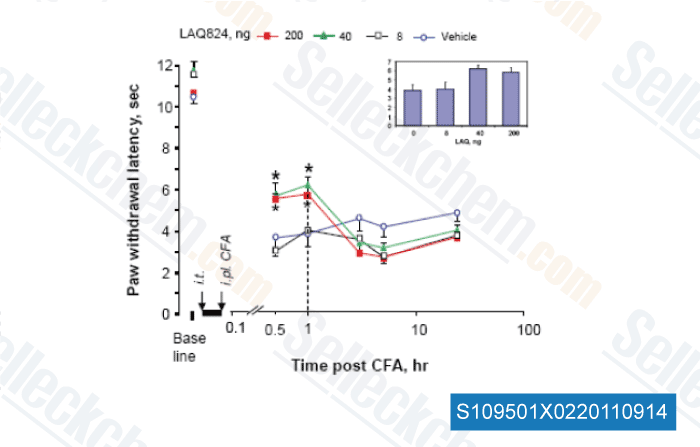
<p>Mice received intrathecally injected vehicle or  LAQ824 at indicated dose 30 min before unilateral injection of CFA. Paw withdrawal latency was measured before injections as baseline, and after CFA injections as hyperalgesia response.</p><div><div> </div></div><p> </p>

Datos de [ Mol Pain , 2010 , 6, 51 ]

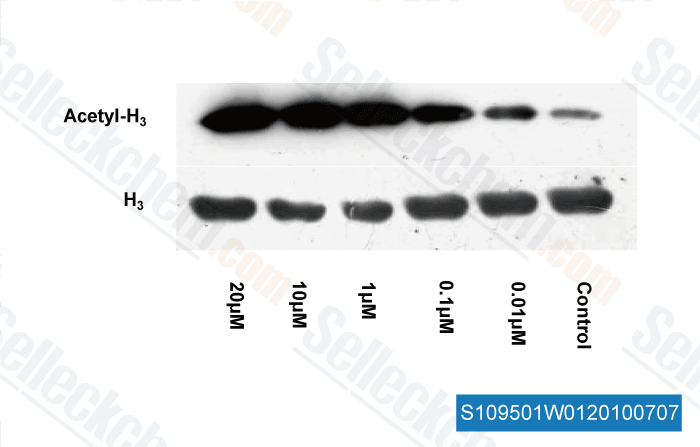
<p>Western blot analysis of Acetyl-H3 and H3. 0-10μM LAQ824 was added.</p><div><div> </div></div><p> </p>

, 2010 , Dr. Zhang of Tianjin Medical University

Sellecks Dacinostat (LAQ824) Ha sido citado por 22 Publicaciones

Inhibition of Notch Signaling Enhances Antitumor Activity of Histone Deacetylase Inhibitor LAQ824 [ Int J Mol Sci, 2023, 24(17)13660] PubMed: 37686467
Single-cell profiling-guided combination therapy of c-Fos and histone deacetylase inhibitors in diffuse large B-cell lymphoma [ Clin Transl Med, 2022, 12(5):e798] PubMed: 35522945
Histone Deacetylase Inhibitors as a Therapeutic Strategy to Eliminate Neoplastic "Stromal" Cells from Giant Cell Tumors of Bone [ Cancers (Basel), 2022, 14(19)4708] PubMed: 36230631
Locus specific epigenetic modalities of random allelic expression imbalance [ Nat Commun, 2021, 12(1):5330] PubMed: 34504093
Continuous Activity Assay for HDAC11 Enabling Reevaluation of HDAC Inhibitors [ ACS Omega, 2019, 4(22):19895-19904] PubMed: 31788622
Epigenetic Reprogramming with Antisense Oligonucleotides Enhances the Effectiveness of Androgen Receptor Inhibition in Castration-Resistant Prostate Cancer [ Cancer Res, 2018, 78(20):5731-5740] PubMed: 30135193
[ Cell Death Dis, 2018, ] PubMed: 29988031
Hippo signaling dysfunction induces cancer cell addiction to YAP [ Oncogene, 2018, 37(50):6414-6424] PubMed: 30068939
Identification of novel multi-stage histone deacetylase (HDAC) inhibitors that impair Schistosoma mansoni viability and egg production [ Parasit Vectors, 2018, 11(1):668] PubMed: 30587243
Measuring Histone Deacetylase Inhibition in the Brain [ Curr Protoc Pharmacol, 2018, 81(1):e41] PubMed: 29927058

POLÍTICA DE DEVOLUCIÓN
La Política de Devolución Incondicional de Selleck Chemical garantiza una experiencia de compra en línea fluida para nuestros clientes. Si no está satisfecho con su compra de alguna manera, puede devolver cualquier artículo(s) dentro de los 7 días posteriores a su recepción. En caso de problemas de calidad del producto, ya sean problemas relacionados con el protocolo o con el producto, puede devolver cualquier artículo(s) dentro de los 365 días a partir de la fecha de compra original. Siga las instrucciones a continuación al devolver productos.

ENVÍO Y ALMACENAMIENTO
Los productos Selleck se transportan a temperatura ambiente. Si recibe el producto a temperatura ambiente, tenga la seguridad de que el Departamento de Inspección de Calidad de Selleck ha realizado experimentos para verificar que la colocación a temperatura normal durante un mes no afectará la actividad biológica de los productos en polvo. Después de la recogida, guarde el producto de acuerdo con los requisitos descritos en la hoja de datos. La mayoría de los productos Selleck son estables en las condiciones recomendadas.

NO PARA USO HUMANO, DIAGNÓSTICO VETERINARIO O TERAPÉUTICO.