
Datos técnicos
| Fórmula | C15H12F2N6O3S |
||||||
| Peso molecular | 394.36 | Número CAS | 443797-96-4 | ||||
| Solubilidad (25°C)* | In vitro | DMSO | 79 mg/mL (200.32 mM) | ||||
| Water | Insoluble | ||||||
| Ethanol | Insoluble | ||||||
| In vivo (Agregue los solventes al producto individualmente y en orden.) |
|
||||||
|
* <1 mg/ml significa ligeramente soluble o insoluble. * Tenga en cuenta que Selleck prueba la solubilidad de todos los compuestos internamente, y la solubilidad real puede diferir ligeramente de los valores publicados. Esto es normal y se debe a ligeras variaciones entre lotes. * Envío a temperatura ambiente (Las pruebas de estabilidad demuestran que este producto se puede enviar sin medidas de refrigeración.) |
|||||||
Preparación de soluciones madre
Actividad biológica
| Descripción | JNJ-7706621 es un inhibidor pan-CDK con la mayor potencia sobre CDK1/2 con un IC50 de 9 nM/4 nM y mostrando una selectividad >6 veces mayor para CDK1/2 que para CDK3/4/6 en ensayos libres de células. También inhibe potentemente Aurora A/B y no tiene actividad sobre Plk1 y Wee1. | |||||||||||
|---|---|---|---|---|---|---|---|---|---|---|---|---|
| Objetivos |
|
|||||||||||
| In vitro | JNJ-7706621 también muestra cierta inhibición de VEGF-R2, FGF-R2 y GSK3β, con un IC50 de 154-254 nM. Este compuesto muestra un efecto inhibidor en un panel de tipos de células cancerosas humanas, incluyendo HeLa, HCT-116, SK-OV-3, PC3, DU145, A375, MDA-MB-231, MES-SA y MES-SA/Dx5, con un IC50 de 112-514 nM, independientemente del estado de p53, retinoblastoma o P-glicoproteína. Es varias veces menos potente para inhibir el crecimiento de tipos de células normales, incluyendo MRC-5, HASMC, HUVEC y HMVEC, con un IC50 de 3,67-5,42 μM. En células HeLa o U937, esta sustancia química (0,5-3 μM) retrasa la salida de G1, detiene las células en G2-M, induce la endoreduplicación, activa la apoptosis y reduce la formación de colonias. En una línea celular HeLa, el tratamiento incremental con concentraciones crecientes de este compuesto conduce a una resistencia de 16 veces, que puede estar mediada por ABCG2. | |||||||||||
| In vivo | En un modelo de xenoinjerto de ratón de tumor humano de melanoma A375, JNJ-7706621 (100 o 125 mg/kg) provoca la regresión del tumor. | |||||||||||
| Características | Un inhibidor de amplio espectro. |
Protocolo (de referencia)
| Ensayo de quinasa:[1] |
|
|---|---|
| Ensayo celular:[3] |
|
| Estudio en animales:[1] |
|
Referencias
|
Validación de productos por parte del cliente
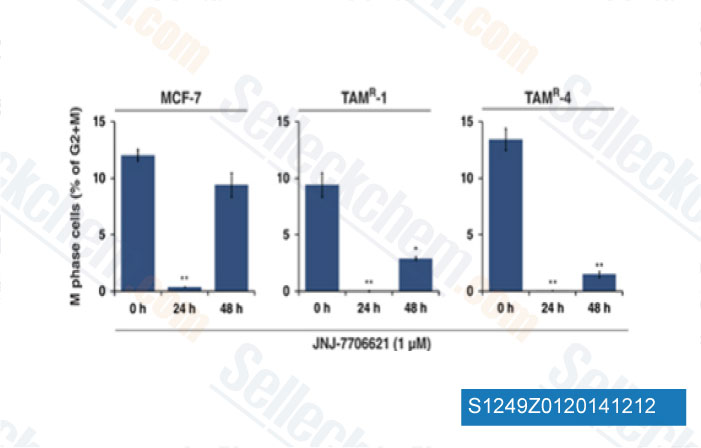
-
Datos de [ Oncogene , 2014 , 10.1038/onc.2014.351 ]
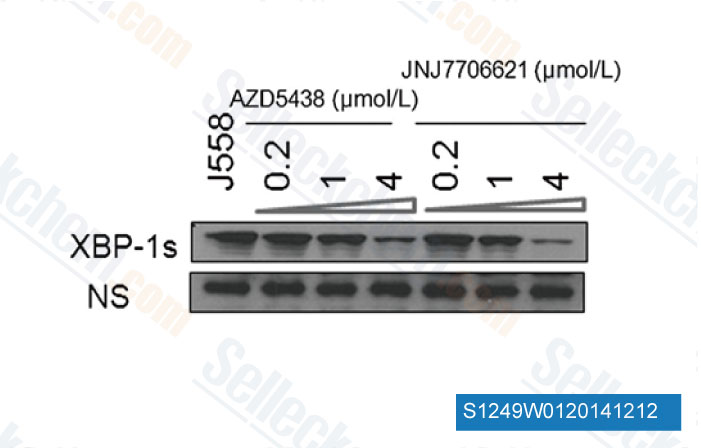
-
Datos de [ Mol Cancer Ther , 2014 , 13(3), 662-74 ]
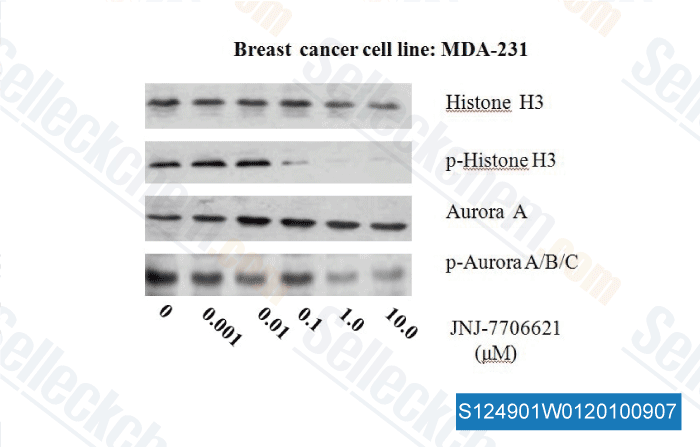
-
, , Dr. Zhang of Tianjin Medical University
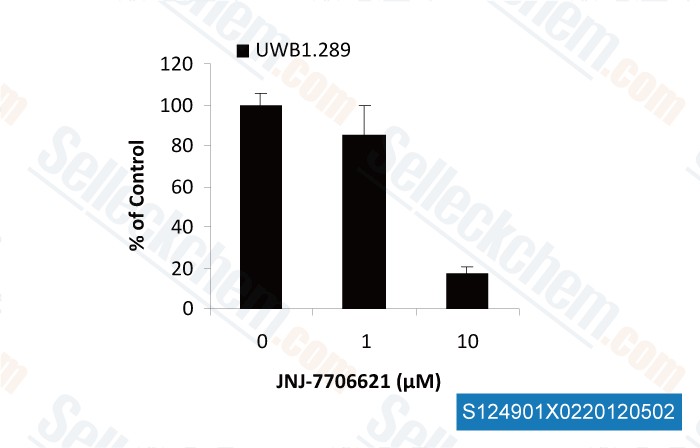
-
, , Dr. Yong-Weon Yi from Georgetown University Medical Center
Sellecks JNJ-7706621 Ha sido citado por 30 Publicaciones
| Combined therapy with DR5-targeting antibody-drug conjugate and CDK inhibitors as a strategy for advanced colorectal cancer [ Cell Rep Med, 2025, S2666-3791(25)00231-9] | PubMed: 40449480 |
| CDK1-mediated phosphorylation of LDHA fuels mitosis through LDHB-dependent lactate oxidation [ EMBO Rep, 2025, 10.1038/s44319-025-00573-8] | PubMed: 40940446 |
| Molecular basis of JAK kinase regulation guiding therapeutic approaches: Evaluating the JAK3 pseudokinase domain as a drug target [ Adv Biol Regul, 2025, 95:101072] | PubMed: 39755448 |
| Inactivation of TACC2 epigenetically represses CDKN1A and confers sensitivity to CDK inhibitors [ Med, 2025, S2666-6340(24)00482-3] | PubMed: 39793578 |
| Inhibitors of One or More Cellular Aurora Kinases Impair the Replication of Herpes Simplex Virus 1 and Other DNA and RNA Viruses with Diverse Genomes and Life Cycles [ Microbiol Spectr, 2023, 11(1):e0194322] | PubMed: 36537798 |
| Integrative analysis of drug response and clinical outcome in acute myeloid leukemia [ Cancer Cell, 2022, S1535-6108(22)00312-9] | PubMed: 35868306 |
| Nascent transcriptome reveals orchestration of zygotic genome activation in early embryogenesis [ Curr Biol, 2022, 32(19):4314-4324.e7] | PubMed: 36007528 |
| Inhibition of IκB Kinase Is a Potential Therapeutic Strategy to Circumvent Resistance to Epidermal Growth Factor Receptor Inhibition in Triple-Negative Breast Cancer Cells [ Cancers (Basel), 2022, 14(21)5215] | PubMed: 36358633 |
| Dual Inhibition of AKT and MEK Pathways Potentiates the Anti-Cancer Effect of Gefitinib in Triple-Negative Breast Cancer Cells [ Cancers (Basel), 2021, 13(6)1205] | PubMed: 33801977 |
| Trapping KSHV in Latency-Exploring Kinase Inhibitors as a Class of Anti-Virals that Target the KSHV Lytic Cycle [ ProQuest, 2021, 28714138] | PubMed: None |
POLÍTICA DE DEVOLUCIÓN
La Política de Devolución Incondicional de Selleck Chemical garantiza una experiencia de compra en línea fluida para nuestros clientes. Si no está satisfecho con su compra de alguna manera, puede devolver cualquier artículo(s) dentro de los 7 días posteriores a su recepción. En caso de problemas de calidad del producto, ya sean problemas relacionados con el protocolo o con el producto, puede devolver cualquier artículo(s) dentro de los 365 días a partir de la fecha de compra original. Siga las instrucciones a continuación al devolver productos.
ENVÍO Y ALMACENAMIENTO
Los productos Selleck se transportan a temperatura ambiente. Si recibe el producto a temperatura ambiente, tenga la seguridad de que el Departamento de Inspección de Calidad de Selleck ha realizado experimentos para verificar que la colocación a temperatura normal durante un mes no afectará la actividad biológica de los productos en polvo. Después de la recogida, guarde el producto de acuerdo con los requisitos descritos en la hoja de datos. La mayoría de los productos Selleck son estables en las condiciones recomendadas.
NO PARA USO HUMANO, DIAGNÓSTICO VETERINARIO O TERAPÉUTICO.