
Datos técnicos
| Fórmula | C19H13F2N7 |
||||||
| Peso molecular | 377.35 | Número CAS | 943540-75-8 | ||||
| Solubilidad (25°C)* | In vitro | DMSO | 50 mg/mL (132.5 mM) | ||||
| Water | Insoluble | ||||||
| Ethanol | Insoluble | ||||||
| In vivo (Agregue los solventes al producto individualmente y en orden.) |
|
||||||
|
* <1 mg/ml significa ligeramente soluble o insoluble. * Tenga en cuenta que Selleck prueba la solubilidad de todos los compuestos internamente, y la solubilidad real puede diferir ligeramente de los valores publicados. Esto es normal y se debe a ligeras variaciones entre lotes. * Envío a temperatura ambiente (Las pruebas de estabilidad demuestran que este producto se puede enviar sin medidas de refrigeración.) |
|||||||
Preparación de soluciones madre
Actividad biológica
| Descripción | JNJ-38877605 es un inhibidor ATP-competitivo de c-Met con una IC50 de 4 nM, 600 veces más selectivo para c-Met que otras 200 tirosina y serina-treonina quinasas. Fase 1. | ||
|---|---|---|---|
| Objetivos |
|
||
| In vitro | JNJ-38877605 muestra una selectividad de más de 600 veces para c-Met en comparación con más de 200 otras diversas tirosina y serina-treonina quinasas y también inhibe potentemente la fosforilación de c-Met estimulada por HGF y activada constitutivamente in vitro. En células EBC1, GTL16, NCI-H1993 y MKN45, este compuesto (500 nM) conduce a una reducción significativa de la fosforilación de Met y RON, otro actor clave en el crecimiento invasivo. Un estudio reciente muestra que este químico está involucrado en la modulación de la secreción de IL-8, GROa, uPAR e IL-6 en células GTL16. | ||
| In vivo | En ratones con xenoinjertos GTL16 establecidos, JNJ-38877605, administrado oralmente a 40 mg/kg/día durante 72 horas, resulta en una disminución estadísticamente significativa en los niveles plasmáticos de IL-8 humana (de 0,150 ng/mL a 0,050 ng/mL) y GROα (de 0,080 ng/mL a 0,030 ng/mL). Mientras que las concentraciones de uPAR en la sangre se reducen a más del 50% a la misma dosis. |
Protocolo (de referencia)
| Estudio en animales:[3] |
|
|---|
Referencias
|
Validación de productos por parte del cliente
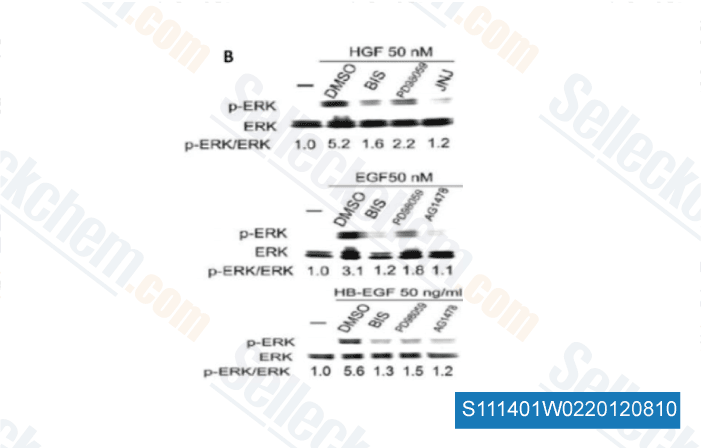
-
Datos de [ PLoS One , 2012 , 7, e44937 ]
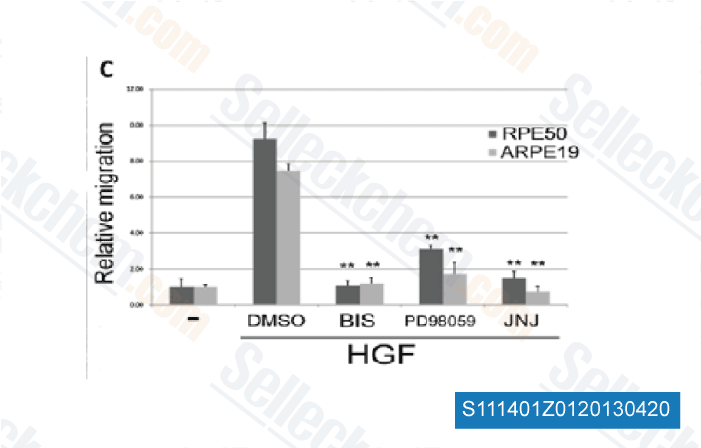
-
Datos de [ PLoS One , 2012 , 7, e44937 ]
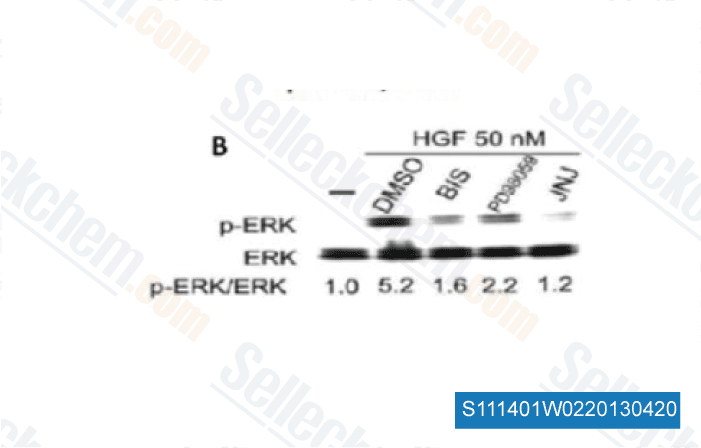
-
Datos de [ PLoS One , 2012 , 7, e44937 ]
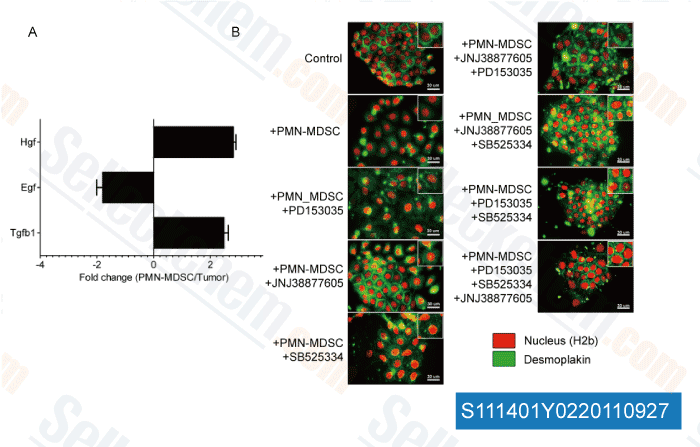
-
Datos de [ PLoS Biol , 2011 , 9, e1001162 ]
Sellecks JNJ-38877605 Ha sido citado por 54 Publicaciones
| Combined Therapy Targeting MET and Pro-HGF Activation Shows Significant Therapeutic Effect Against Liver Metastasis of CRPC [ Int J Mol Sci, 2025, 26(5)2308] | PubMed: 40076928 |
| Functional genomics reveals an off-target dependency of drug synergy in gastric cancer therapy [ Gastric Cancer, 2024, 10.1007/s10120-024-01537-y] | PubMed: 39033209 |
| The Receptor Tyrosine Kinase c-Met Promotes Lipid Accumulation in 3T3-L1 Adipocytes [ Int J Mol Sci, 2023, 24(9)8086] | PubMed: 37175792 |
| Temporal mapping and pharmacological manipulation of signaling architecture of Tyrosine kinases in Traumatic Brain Injury (TBI) [ oparu, 2023, 10.18725/OPARU-47820] | PubMed: None |
| Integrative analysis of drug response and clinical outcome in acute myeloid leukemia [ Cancer Cell, 2022, S1535-6108(22)00312-9] | PubMed: 35868306 |
| Precision Combination Therapies Based on Recurrent Oncogenic Coalterations [ Cancer Discov, 2022, 12(6):1542-1559] | PubMed: 35412613 |
| Efficacy of CAR-T immunotherapy in MET overexpressing tumors not eligible for anti-MET targeted therapy [ J Exp Clin Cancer Res, 2022, 41(1):309] | PubMed: 36271379 |
| MACC1 promotes pancreatic cancer metastasis by interacting with the EMT regulator SNAI1 [ Cell Death Dis, 2022, 13(11):923] | PubMed: 36333284 |
| STAT3 inhibition suppresses adaptive survival of ALK-rearranged lung cancer cells through transcriptional modulation of apoptosis [ NPJ Precis Oncol, 2022, 6(1):11] | PubMed: 35228642 |
| MET Oncogene Controls Invasive Growth by Coupling with NMDA Receptor [ Cancers (Basel), 2022, 14(18)4408] | PubMed: 36139568 |
POLÍTICA DE DEVOLUCIÓN
La Política de Devolución Incondicional de Selleck Chemical garantiza una experiencia de compra en línea fluida para nuestros clientes. Si no está satisfecho con su compra de alguna manera, puede devolver cualquier artículo(s) dentro de los 7 días posteriores a su recepción. En caso de problemas de calidad del producto, ya sean problemas relacionados con el protocolo o con el producto, puede devolver cualquier artículo(s) dentro de los 365 días a partir de la fecha de compra original. Siga las instrucciones a continuación al devolver productos.
ENVÍO Y ALMACENAMIENTO
Los productos Selleck se transportan a temperatura ambiente. Si recibe el producto a temperatura ambiente, tenga la seguridad de que el Departamento de Inspección de Calidad de Selleck ha realizado experimentos para verificar que la colocación a temperatura normal durante un mes no afectará la actividad biológica de los productos en polvo. Después de la recogida, guarde el producto de acuerdo con los requisitos descritos en la hoja de datos. La mayoría de los productos Selleck son estables en las condiciones recomendadas.
NO PARA USO HUMANO, DIAGNÓSTICO VETERINARIO O TERAPÉUTICO.