
Datos técnicos
| Fórmula | C23H27N7O3S2 |
||||||
| Peso molecular | 513.64 | Número CAS | 957054-30-7 | ||||
| Solubilidad (25°C)* | In vitro | DMSO | 100 mg/mL (194.68 mM) | ||||
| Water | Insoluble | ||||||
| Ethanol | Insoluble | ||||||
| In vivo (Agregue los solventes al producto individualmente y en orden.) |
|
||||||
|
* <1 mg/ml significa ligeramente soluble o insoluble. * Tenga en cuenta que Selleck prueba la solubilidad de todos los compuestos internamente, y la solubilidad real puede diferir ligeramente de los valores publicados. Esto es normal y se debe a ligeras variaciones entre lotes. * Envío a temperatura ambiente (Las pruebas de estabilidad demuestran que este producto se puede enviar sin medidas de refrigeración.) |
|||||||
Preparación de soluciones madre
Actividad biológica
| Descripción | Pictilisib (GDC-0941, RG7321) es un potente inhibidor de PI3Kα/δ con una IC50 de 3 nM en ensayos sin células, con modesta selectividad contra p110β (11 veces) y p110γ (25 veces). Pictilisib (GDC-0941) induce autophagy y apoptosis. Fase 2. | ||||||||||
|---|---|---|---|---|---|---|---|---|---|---|---|
| Objetivos |
|
||||||||||
| In vitro | Pictilisib (GDC-0941) es equipotente contra PI3Kα y PI3Kδ, así como contra los mutantes de PI3Kα E545-K y H1047-R, mostrando niveles modestos de selectividad contra PI3Kβ (10 veces) y PI3Kγ (25 veces), y mayores niveles de selectividad contra miembros de la clase II, III y IV de PI3K, incluyendo C2β, Vps34, DNA-PK y mTOR. Inhibe potentemente la fosforilación de Akt en células U87MG, PC3 y MDA-MB-361 con una IC50 de 46 nM, 37 nM y 28 nM, respectivamente. Este compuesto inhibe la proliferación de células U87MG, A2780, PC3 y MDA-MB-361 con una IC50 de 0,95 μM, 0,14 μM, 0,28 μM y 0,72 μM, respectivamente. Inhibe la proliferación de células amplificadas con HER2 que albergan mutaciones en PIK3CA con una IC50 de <500 nM, e inhibe eficazmente tanto la proliferación como la viabilidad de las células de cáncer de mama amplificadas con HER2. Inhibe significativamente el crecimiento de células HCT116, DLD1 y HT29 con una GI50 de 1081 nM, 1070 nM y 157 nM, respectivamente. También inhibe la proliferación de células tumorales, induce la apoptosis y suprime la población de centroblastos. |
||||||||||
| In vivo | Pictilisib (GDC-0941) muestra un metabolismo microsómico limitado, lo que resulta en una biodisponibilidad oral del 78 % . La administración de este compuesto a 75 mg/kg/día muestra un efecto inhibidor significativo contra xenoinjertos establecidos de glioblastoma humano U87MG en ratones atímicos NCr hembra, con una inhibición del crecimiento tumoral del 83 %. La administración oral de 150 mg/kg/día inhibe el crecimiento de xenoinjertos MDA-MB-361.1 amplificados con HER2 en ratones, y retrasa significativamente la progresión del tumor, en asociación con una potente apoptosis inducida en los tumores. El tratamiento con este compuesto (75 mg/kg/día) durante 2 semanas induce una reducción de ~40 % en el volumen tumoral de linfomas foliculares de células B espontáneos desarrollados en ratones PTEN+/-LKB1+/hipo, acompañado de la ablación de la fosforilación de las proteínas quinasas Akt, S6K y SGK (serum and glucocorticoid protein kinase). |
Protocolo (de referencia)
| Ensayo de quinasa: |
|
|---|---|
| Ensayo celular: |
|
| Estudio en animales: |
|
Referencias
|
Validación de productos por parte del cliente
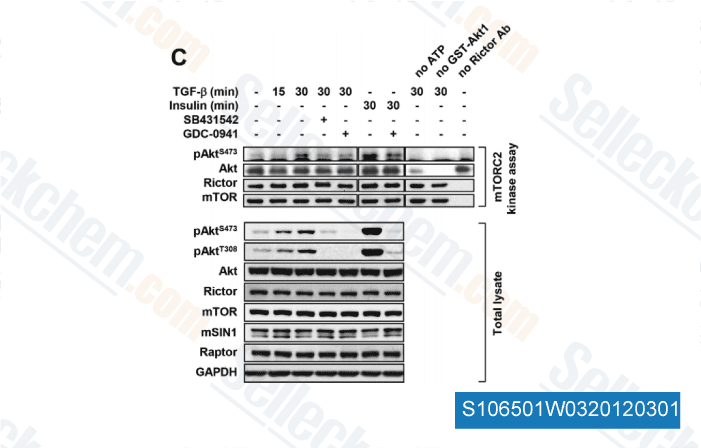
-
Datos de [ J Cell Sci , 2012 , 125(Pt 5), 1259-73 ]
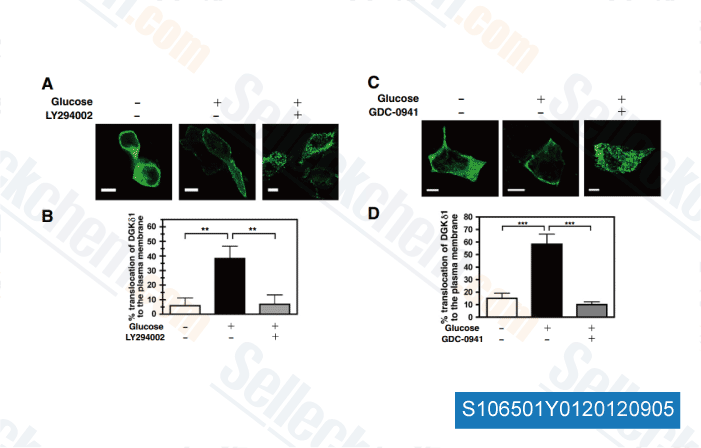
-
Datos de [ Biochim Biophys Acta , 2012 , 1823, 2210-6 ]
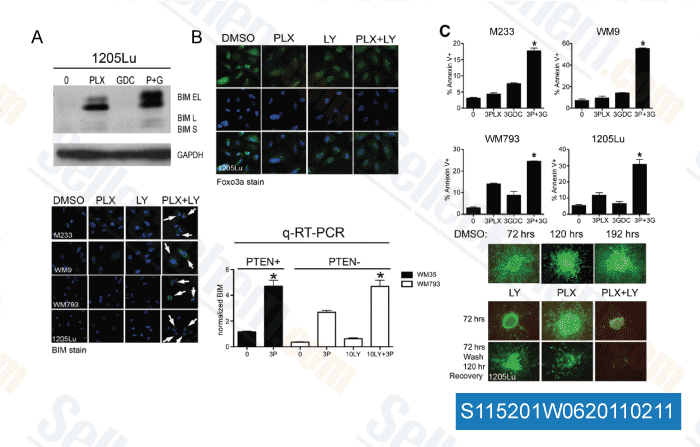
-
Datos de [ Cancer Res , 2011 , 71, 2750-2760 ]
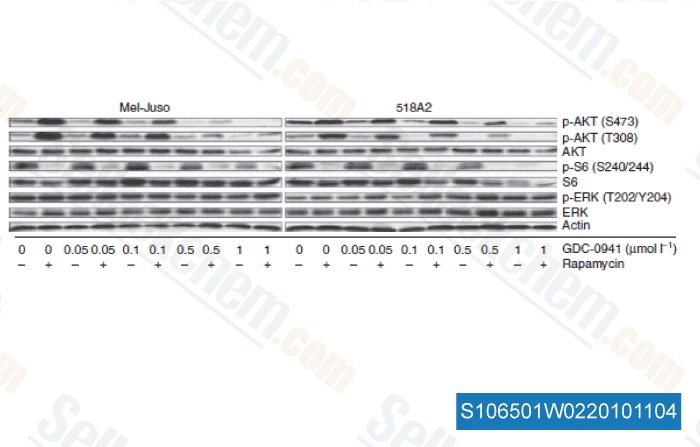
-
Datos de [ J Inves Der , 2010 , 131, 495-503 ]
Sellecks Pictilisib (GDC-0941) Ha sido citado por 461 Publicaciones
| Targeting PI3K inhibitor resistance in breast cancer with metabolic drugs [ Signal Transduct Target Ther, 2025, 10(1):92] | PubMed: 40113784 |
| Spike-in enhanced phosphoproteomics uncovers synergistic signaling responses to MEK inhibition in colon cancer cells [ Nat Commun, 2025, 16(1):4884] | PubMed: 40419504 |
| Axial nephron fate switching demonstrates a plastic system tunable on demand [ Nat Commun, 2025, 16(1):7912] | PubMed: 40855070 |
| EGFR TKIs suppress MUC1 glycosylation through the PI3K/AKT/SP1/C1GALT1 pathway to enhance TnMUC1 CAR-T efficacy in EGFR-mutant NSCLC [ Cell Rep Med, 2025, S2666-3791(25)00272-1] | PubMed: 40562040 |
| Heterogeneous Activation of Signaling Pathways and Therapeutic Vulnerabilities in KSHV-Associated Primary Effusion Lymphoma Cell Lines [ J Med Virol, 2025, 97(8):e70534] | PubMed: 40751690 |
| Separase Inhibition Enhances Gefitinib Sensitivity of Lung Cancer via PTBP1/TAK1/RIPK1-Mediated PANoptosis [ MedComm (2020), 2025, 6(11):e70432] | PubMed: 41122447 |
| Lactate shuttle between cytotrophoblast and syncytiotrophoblast in the placenta enhances ferroptosis resistance and maintains placental homeostasis: implications for early pregnancy loss [ Cell Commun Signal, 2025, 23(1):438] | PubMed: 41088442 |
| Anthrax ET activates Rac1 and RTK signaling to induce F-actin reorganization and endothelial permeability [ iScience, 2025, 28(11):113682] | PubMed: 41158867 |
| Anti-Influenza Activity of 6BIGOE: Improved Pharmacological Profile After Encapsulation in PLGA Nanoparticles [ Int J Mol Sci, 2025, 26(9)4235] | PubMed: 40362470 |
| Cartilage Oligomeric Matrix Protein Promotes Radiation Resistance in Non-Small Cell Lung Cancer In Vitro [ Int J Mol Sci, 2025, 26(6)2465] | PubMed: 40141111 |
POLÍTICA DE DEVOLUCIÓN
La Política de Devolución Incondicional de Selleck Chemical garantiza una experiencia de compra en línea fluida para nuestros clientes. Si no está satisfecho con su compra de alguna manera, puede devolver cualquier artículo(s) dentro de los 7 días posteriores a su recepción. En caso de problemas de calidad del producto, ya sean problemas relacionados con el protocolo o con el producto, puede devolver cualquier artículo(s) dentro de los 365 días a partir de la fecha de compra original. Siga las instrucciones a continuación al devolver productos.
ENVÍO Y ALMACENAMIENTO
Los productos Selleck se transportan a temperatura ambiente. Si recibe el producto a temperatura ambiente, tenga la seguridad de que el Departamento de Inspección de Calidad de Selleck ha realizado experimentos para verificar que la colocación a temperatura normal durante un mes no afectará la actividad biológica de los productos en polvo. Después de la recogida, guarde el producto de acuerdo con los requisitos descritos en la hoja de datos. La mayoría de los productos Selleck son estables en las condiciones recomendadas.
NO PARA USO HUMANO, DIAGNÓSTICO VETERINARIO O TERAPÉUTICO.