
Datos técnicos
| Fórmula | C19H18N4O2 |
||||||
| Peso molecular | 334.37 | Número CAS | 905281-76-7 | ||||
| Solubilidad (25°C)* | In vitro | DMSO | 66 mg/mL (197.38 mM) | ||||
| Ethanol | 5 mg/mL (14.95 mM) | ||||||
| Water | Insoluble | ||||||
| In vivo (Agregue los solventes al producto individualmente y en orden.) |
|
||||||
|
* <1 mg/ml significa ligeramente soluble o insoluble. * Tenga en cuenta que Selleck prueba la solubilidad de todos los compuestos internamente, y la solubilidad real puede diferir ligeramente de los valores publicados. Esto es normal y se debe a ligeras variaciones entre lotes. * Envío a temperatura ambiente (Las pruebas de estabilidad demuestran que este producto se puede enviar sin medidas de refrigeración.) |
|||||||
Preparación de soluciones madre
Actividad biológica
| Descripción | GDC-0879 (AR-00341677) es un inhibidor de B-Raf nuevo, potente y selectivo con una IC50 de 0,13 nM en células A375 y Colo205 con actividad también contra c-Raf; no se conoce inhibición de otras proteínas quinasas. | ||
|---|---|---|---|
| Objetivos |
|
||
| In vitro | GDC-0879 también inhibe la pERK celular con una IC50 de 63 nM. Este compuesto muestra una potencia comparable en las líneas celulares de melanoma A375 y carcinoma colorrectal Colo205, ambas mutantes B-RafV600E, con una IC50 de 59 nM y 29 nM para la inhibición de pMEK1 respectivamente. Inhibe potentemente B-RafV600E en células Malme3M con una IC50 de 0,75 μM. Este químico también muestra valores de EC50 < 0,5 μM en muchas células tumorales (A375, 624, SK-MEL-28, Malme3M, C32, 928, 888, G-361, Colo205, Colo206, SW1417, CL34 y Colo201). | ||
| In vivo | En ratones tratados con GDC-0879, tanto los tumores BRAFV600E derivados de líneas celulares como los derivados de pacientes exhiben una inhibición farmacodinámica más fuerte y sostenida (>90% durante 8 horas) y una mejor supervivencia en comparación con los tumores que expresan KRAS mutante. Aunque existe una implicación de la señalización RAF activada en la tumorigénesis inducida por RAS, se observa una disminución del tiempo hasta la progresión para algunos tumores con mutación KRAS después de la administración de este compuesto. Mientras que la eficacia mediada por este químico está estrictamente asociada con el estado de B-RafV600E, la inhibición de MEK también atenúa la proliferación y el crecimiento tumoral de líneas celulares que expresan BRAF de tipo salvaje (81% KRAS mutante, 38% KRAS de tipo salvaje). La respuesta de las células de melanoma B-RafV600E a este agente podría verse drásticamente alterada por la modulación farmacológica y genética de la actividad de la vía PI3K. |
Protocolo (de referencia)
| Estudio en animales:[2] |
|
|---|
Referencias
|
Validación de productos por parte del cliente

-
Datos de [ J Natl Cancer Inst , 2012 , 104(21), 1673-9 ]

-
Datos de [ J Natl Cancer Inst , 2012 , 104(21), 1673-9 ]
-
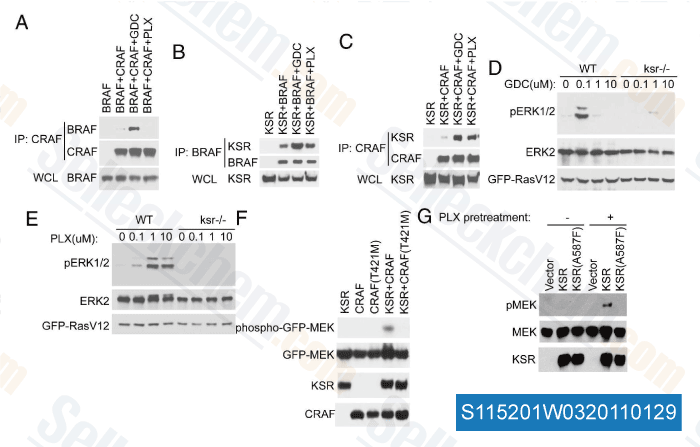
Datos de [ Proc Natl Acad Sci USA , 2011 , 108, 6067-6072 ]
-
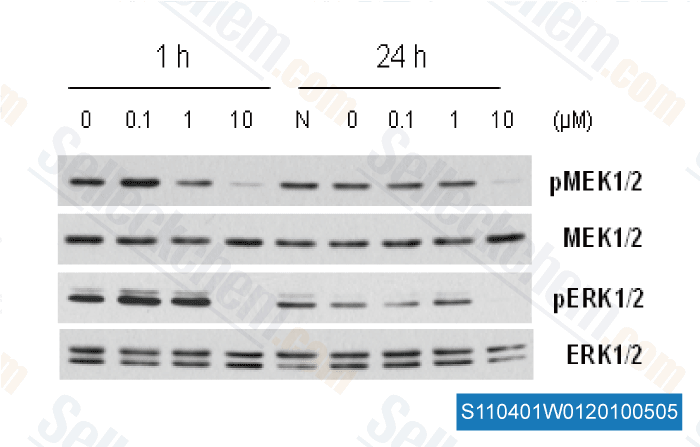
, , Dr. Jong-in Park from Medical College of Wisconsin
Sellecks GDC-0879 Ha sido citado por 43 Publicaciones
| Bioluminescence-based assays for quantifying endogenous protein interactions in live cells [ J Biol Chem, 2025, 301(8):110454] | PubMed: 40617353 |
| A structure-based modelling approach identifies effective drug combinations for RAS-mutant acute myeloid leukemia [ bioRxiv, 2025, 2025.04.29.651188] | PubMed: 40654850 |
| Tumour-selective activity of RAS-GTP inhibition in pancreatic cancer [ Nature, 2024, 629(8013):927-936] | PubMed: 38588697 |
| BRAFΔβ3-αC in-frame deletion mutants differ in their dimerization propensity, HSP90 dependence, and druggability [ Sci Adv, 2023, 9(35):eade7486] | PubMed: 37656784 |
| Integrative analysis of drug response and clinical outcome in acute myeloid leukemia [ Cancer Cell, 2022, S1535-6108(22)00312-9] | PubMed: 35868306 |
| Inhibition of IκB Kinase Is a Potential Therapeutic Strategy to Circumvent Resistance to Epidermal Growth Factor Receptor Inhibition in Triple-Negative Breast Cancer Cells [ Cancers (Basel), 2022, 14(21)5215] | PubMed: 36358633 |
| AKT1/FOXP3 axis-mediated expression of CerS6 promotes p53 mutant pancreatic tumorigenesis [ Cancer Lett, 2021, S0304-3835(21)00309-8] | PubMed: 34343636 |
| Dual Inhibition of AKT and MEK Pathways Potentiates the Anti-Cancer Effect of Gefitinib in Triple-Negative Breast Cancer Cells [ Cancers (Basel), 2021, 13(6)1205] | PubMed: 33801977 |
| A Live-Cell Screen for Altered Erk Dynamics Reveals Principles of Proliferative Control. [ Cell Syst, 2020, 10(3):240-253] | PubMed: 32191874 |
| RAF kinases are stabilized and required for dendritic cell differentiation and function. [ Cell Death Differ, 2019, 10.1038/s41418-019-0416-4] | PubMed: 31541179 |
POLÍTICA DE DEVOLUCIÓN
La Política de Devolución Incondicional de Selleck Chemical garantiza una experiencia de compra en línea fluida para nuestros clientes. Si no está satisfecho con su compra de alguna manera, puede devolver cualquier artículo(s) dentro de los 7 días posteriores a su recepción. En caso de problemas de calidad del producto, ya sean problemas relacionados con el protocolo o con el producto, puede devolver cualquier artículo(s) dentro de los 365 días a partir de la fecha de compra original. Siga las instrucciones a continuación al devolver productos.
ENVÍO Y ALMACENAMIENTO
Los productos Selleck se transportan a temperatura ambiente. Si recibe el producto a temperatura ambiente, tenga la seguridad de que el Departamento de Inspección de Calidad de Selleck ha realizado experimentos para verificar que la colocación a temperatura normal durante un mes no afectará la actividad biológica de los productos en polvo. Después de la recogida, guarde el producto de acuerdo con los requisitos descritos en la hoja de datos. La mayoría de los productos Selleck son estables en las condiciones recomendadas.
NO PARA USO HUMANO, DIAGNÓSTICO VETERINARIO O TERAPÉUTICO.