
Datos técnicos
| Fórmula | C17H14F3N3O2S |
||||||
| Peso molecular | 381.37 | Número CAS | 169590-42-5 | ||||
| Solubilidad (25°C)* | In vitro | DMSO | 76 mg/mL (199.28 mM) | ||||
| Ethanol | 76 mg/mL (199.28 mM) | ||||||
| Water | Insoluble | ||||||
| In vivo (Agregue los solventes al producto individualmente y en orden.) |
|
||||||
|
* <1 mg/ml significa ligeramente soluble o insoluble. * Tenga en cuenta que Selleck prueba la solubilidad de todos los compuestos internamente, y la solubilidad real puede diferir ligeramente de los valores publicados. Esto es normal y se debe a ligeras variaciones entre lotes. * Envío a temperatura ambiente (Las pruebas de estabilidad demuestran que este producto se puede enviar sin medidas de refrigeración.) |
|||||||
Preparación de soluciones madre
Actividad biológica
| Descripción | Celecoxib es un inhibidor selectivo de la COX-2 con una IC50 de 40 nM en células Sf9. | ||
|---|---|---|---|
| Objetivos |
|
||
| In vitro | Celecoxib muestra baja sensibilidad contra COX-1 con una IC50 de 15 μM. Este compuesto muestra un efecto antiproliferativo en líneas celulares de carcinoma nasofaríngeo (NPC) incluyendo HNE1 y CNE1-LMP1 con una IC50 de 32,86 μM y 61,31 μM, respectivamente. |
||
| In vivo | Celecoxib exhibe una potente actividad antiinflamatoria oral. Este compuesto reduce la inflamación aguda en el ensayo de edema por carragenina y la inflamación crónica en el modelo de artritis adyuvante con una ED50 de 7,1 mg/kg y 0,37 mg/kg/día, respectivamente. Además, también exhibe actividad analgésica en el modelo de hiperalgesia de Hargreaves con una ED50 de 34,5 mg/kg. Asimismo, este producto químico no produce toxicidad gastrointestinal aguda en ratas a dosis de hasta 200 mg/kg y no produce toxicidad gastrointestinal crónica en ratas a dosis de hasta 600 mg/kg/día durante 10 días. En un modelo de ratón hembra C3Hf/KamLaw, aumenta el tiempo de supervivencia medio de 105 días (rango, 79-145 días) después de 13,5 Gy de irradiación torácica local (LTI) sola a 142 días (rango, 94-155 días). |
Protocolo (de referencia)
| Ensayo de quinasa: |
|
|---|---|
| Ensayo celular: |
|
| Estudio en animales: |
|
Referencias
|
Validación de productos por parte del cliente
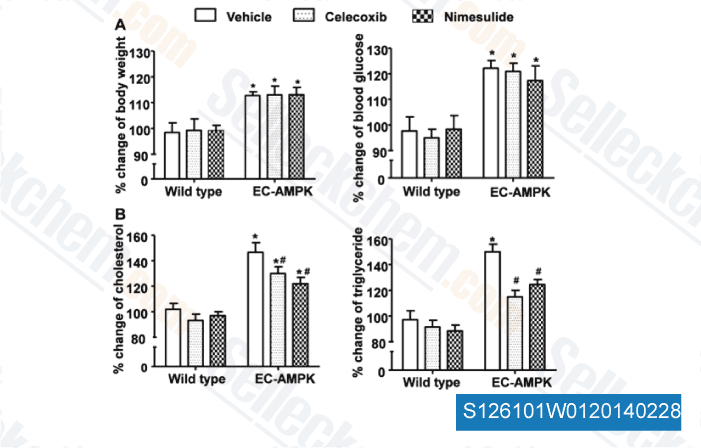
-
Datos de [ Br J Pharmacol , 2014 , 171(2), 498-508 ]
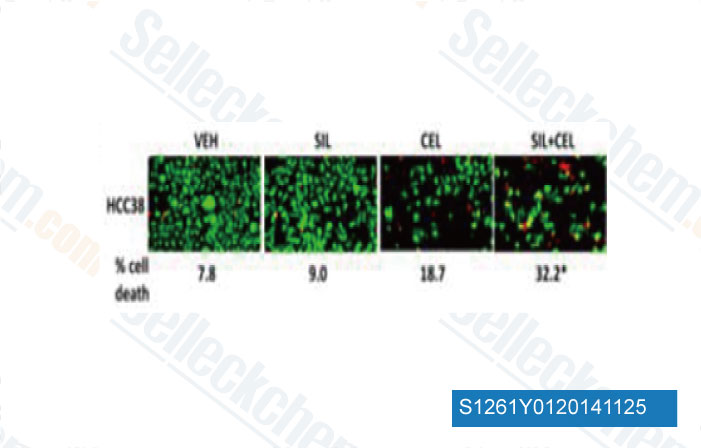
-
Datos de [ J Cell Physiol , 2014 , 10.1002/jcp.24843 ]
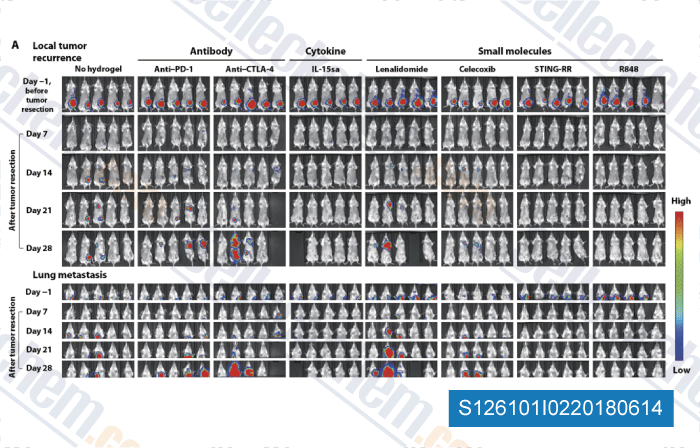
-
Datos de [ , , Science, 2018, 10(433), doi: 10.1126/scitranslmed.aar1916 ]
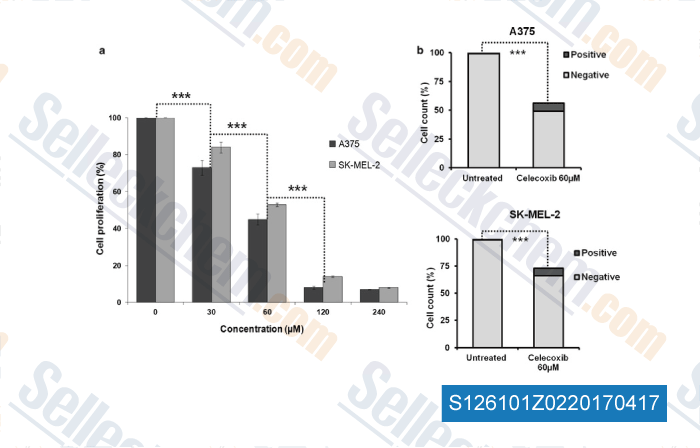
-
Datos de [ , , J Transl Med, 2017, 15(1):46 ]
Sellecks Celecoxib (SC-58635) Ha sido citado por 115 Publicaciones
| Tumor-initiating stem cells fine-tune the plasticity of neutrophils to sculpt a protective niche [ Cancer Cell, 2025, S1535-6108(25)00494-5] | PubMed: 41349542 |
| Monkeypox virus induces ferroptosis to facilitate viral replication and promotes inflammatory responses [ Emerg Microbes Infect, 2025, 14(1):2522877] | PubMed: 40536397 |
| The nonsteroidal anti-inflammatory drug sulindac reverses obesity-driven immunosuppression and triple-negative breast cancer progression [ Breast Cancer Res, 2025, 27(1):186] | PubMed: 41137072 |
| Carbonic anhydrase 2-derived drug-responsive domain regulates membrane-bound cytokine expression and function in engineered T cells [ Commun Biol, 2025, 8(1):28] | PubMed: 39789216 |
| Hyperoxia-activated Nrf2 regulates ferroptosis in intestinal epithelial cells and intervenes in inflammatory reaction through COX-2/PGE2/EP2 pathway [ Mol Med, 2025, 31(1):1] | PubMed: 39754066 |
| Protein kinase a suppresses antiproliferative effect of interferon-α in hepatocellular carcinoma by activation of protein tyrosine phosphatase SHP2 [ J Biol Chem, 2025, 301(2):108195] | PubMed: 39826687 |
| Missense Mutant p53 Transactivates Wnt/β-Catenin Signaling in Neighboring p53-Destabilized Cells through the COX-2/PGE2 Pathway [ Cancer Res Commun, 2025, 5(1):13-23] | PubMed: 39641656 |
| Leptin-mediated suppression of lipoprotein lipase cleavage enhances lipid uptake and facilitates lymph node metastasis in gastric cancer [ Cancer Commun (Lond), 2024, 10.1002/cac2.12583] | PubMed: 38958445 |
| Therapeutic Anti-Tumor Efficacy of DC-Based Vaccines Targeting TME-Associated Antigens Is Improved When Combined with a Chemokine-Modulating Regimen and/or Anti-PD-L1 [ Vaccines (Basel), 2024, 12(7)777] | PubMed: 39066414 |
| Celecoxib Combined with Tocilizumab Has Anti-Inflammatory Effects and Promotes the Recovery of Damaged Cartilage via the Nrf2/HO-1 Pathway In Vitro [ Biomolecules, 2024, 14(12)1636] | PubMed: 39766343 |
POLÍTICA DE DEVOLUCIÓN
La Política de Devolución Incondicional de Selleck Chemical garantiza una experiencia de compra en línea fluida para nuestros clientes. Si no está satisfecho con su compra de alguna manera, puede devolver cualquier artículo(s) dentro de los 7 días posteriores a su recepción. En caso de problemas de calidad del producto, ya sean problemas relacionados con el protocolo o con el producto, puede devolver cualquier artículo(s) dentro de los 365 días a partir de la fecha de compra original. Siga las instrucciones a continuación al devolver productos.
ENVÍO Y ALMACENAMIENTO
Los productos Selleck se transportan a temperatura ambiente. Si recibe el producto a temperatura ambiente, tenga la seguridad de que el Departamento de Inspección de Calidad de Selleck ha realizado experimentos para verificar que la colocación a temperatura normal durante un mes no afectará la actividad biológica de los productos en polvo. Después de la recogida, guarde el producto de acuerdo con los requisitos descritos en la hoja de datos. La mayoría de los productos Selleck son estables en las condiciones recomendadas.
NO PARA USO HUMANO, DIAGNÓSTICO VETERINARIO O TERAPÉUTICO.