
Datos técnicos
| Fórmula | C40H50N8O6 |
||||||
| Peso molecular | 738.88 | Número CAS | 1009119-64-5 | ||||
| Solubilidad (25°C)* | In vitro | DMSO | 148 mg/mL (200.3 mM) | ||||
| Ethanol | 148 mg/mL (200.3 mM) | ||||||
| Water | Insoluble | ||||||
| In vivo (Agregue los solventes al producto individualmente y en orden.) |
|
||||||
|
* <1 mg/ml significa ligeramente soluble o insoluble. * Tenga en cuenta que Selleck prueba la solubilidad de todos los compuestos internamente, y la solubilidad real puede diferir ligeramente de los valores publicados. Esto es normal y se debe a ligeras variaciones entre lotes. * Envío a temperatura ambiente (Las pruebas de estabilidad demuestran que este producto se puede enviar sin medidas de refrigeración.) |
|||||||
Preparación de soluciones madre
Actividad biológica
| Descripción | Daclatasvir (BMS-790052, EBP883) es un inhibidor altamente selectivo de HCV NS5A con una EC50 de 9-50 pM, para un amplio rango de genotipos de replicón de VHC y el virus infeccioso JFH-1 genotipo 2a en cultivo celular. Fase 3. | ||
|---|---|---|---|
| Objetivos |
|
||
| In vitro | Daclatasvir (BMS-790052) es uno de los inhibidores más potentes de la replicación del VHC reportados hasta ahora. Los valores medios de EC50 de este compuesto son 50 y 9 pM para los replicones de VHC genotipo 1a y 1b, respectivamente. Muestra un índice terapéutico (CC50/EC50) de al menos 105 y es inactivo frente a un panel de 10 virus de ARN y ADN, con una EC50 superior a 10 μM. Esto confirma su especificidad para el VHC. En células Huh7 que albergan los replicones de VHC genotipo 1b, bloquea la replicación del genoma del VHC, tanto transitoria como estable, con valores de EC50 que van de 1 a 15 pM. A concentraciones de 100 pM o 1 nM, se ha demostrado que altera la localización subcelular y el fraccionamiento bioquímico de NS5A. Este compuesto inhibe los replicones híbridos que contienen genes NS5A del genotipo 4 del VHC con una EC50 de 7-13 pM. El residuo 30 de NS5A es un sitio importante para la resistencia mediada por BMS-790052 en los replicones híbridos. | ||
| Características | Inhibidor de primera clase, altamente selectivo de la NS5A del virus de la hepatitis C (VHC) con valores de EC50 picomolares. |
Protocolo (de referencia)
| Ensayo de quinasa:[4] |
|
|---|---|
| Ensayo celular:[1] |
|
Referencias
|
Validación de productos por parte del cliente
![<p>The toxicity of BMS-790052 (BMS) and Telaprevir (TPV) was measured by seeding 96-well plates to 70% confluence and exposing the cells to up to 50 μM of compound for 72 hours. MTT [3-(4,5-dimethylthiazol-2-yl)-2,5-diphenyltetrazolium bromide] was added to each well at a final concentration of 500 μg/ml 4 h before dissolving crystals in 100 μl of DMSO and measuring at 550 nm UV wavelengths. The 50% cytotoxic concentration (CC50) was then calculation using the OD550 value and the following formula: log CC50=log concentration of HPP-[(HPP-50)/(HPP-LPP)×log d HPP: highest protective percentage closest to 50% LPP: Lowest protective percentage closest to 50% d: dilution factor</p>](https://file.selleckchem.com/downloads/review/700px/Telaprevir-VX950+BMS-790052-S153801B0120110611.gif)
-
, 2011 , Dr. Julie Sheldon,Dr Esteban Domingo and Dr Celia Perales
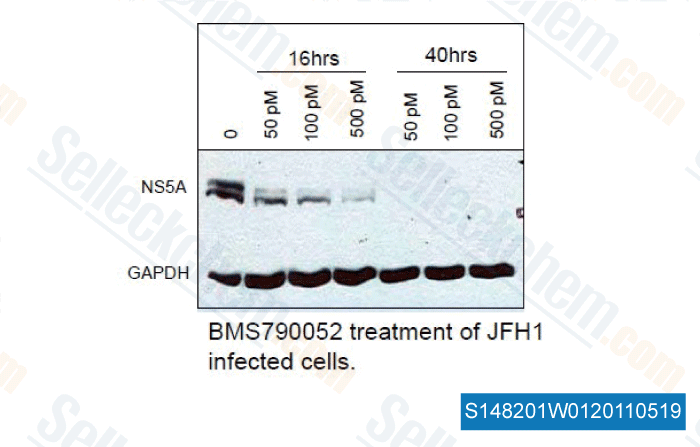
-
, 2011 , Dr. Anita Nag of Florida State University
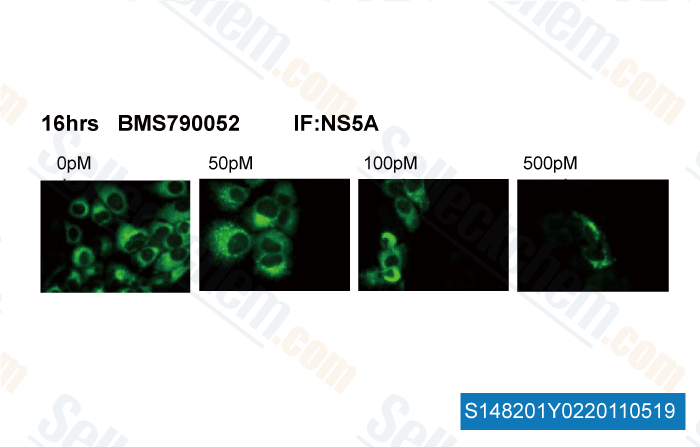
-
, 2011 , Dr. Anita Nag of Florida State University
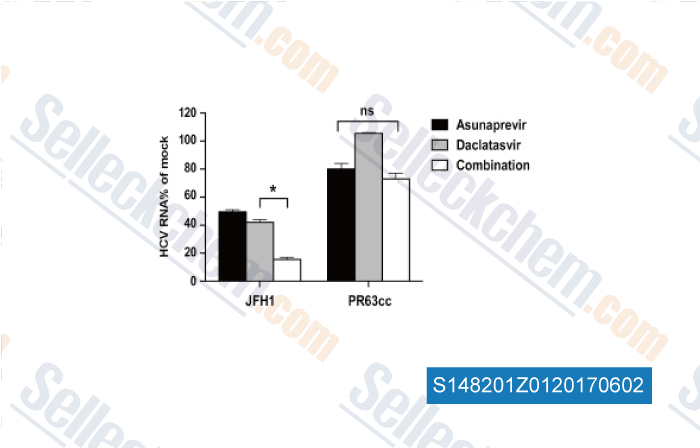
-
Datos de [ , , Antiviral Res, 2017, 139:18-24 ]
Sellecks Daclatasvir (BMS-790052) Ha sido citado por 58 Publicaciones
| Rapid hepatitis C virus replication machinery removal after antiviral treatment with DAA monitored by multimodal imaging [ Structure, 2025, S0969-2126(25)00193-5] | PubMed: 40553718 |
| Hepatitis C virus-induced differential transcriptional traits in host cells after persistent infection elimination by direct-acting antivirals in cell culture [ J Med Virol, 2024, 96(7):e29787] | PubMed: 38988177 |
| Antiviral drugs prolong survival in murine recessive dystrophic epidermolysis bullosa [ EMBO Mol Med, 2024, 16(4):870-884] | PubMed: 38462666 |
| Patient-derived rhabdomyosarcoma cells recapitulate the genetic and transcriptomic landscapes of primary tumors [ iScience, 2024, 27(10):110862] | PubMed: 39319271 |
| Unraveling the dynamics of hepatitis C virus adaptive mutations and their impact on antiviral responses in primary human hepatocytes [ J Virol, 2024, e0192123.] | PubMed: 38319104 |
| Mechanisms of Action of the Host-Targeting Agent Cyclosporin A and Direct-Acting Antiviral Agents against Hepatitis C Virus [ Viruses, 2023, 15(4)981] | PubMed: 37112961 |
| Hepatitis C virus cell culture adaptive mutations enhance cell culture propagation by multiple mechanisms but boost antiviral responses in primary human hepatocytes [ bioRxiv, 2023, 2023.11.22.568224] | PubMed: 38045248 |
| Combination of antiviral drugs inhibits SARS-CoV-2 polymerase and exonuclease and demonstrates COVID-19 therapeutic potential in viral cell culture [ Commun Biol, 2022, 5(1):154] | PubMed: 35194144 |
| Going Viral: An Investigation into the Chameleonic Behaviour of Antiviral Compounds [ Chemistry, 2022, e202202798.] | PubMed: 36286339 |
| Correlation of hepatitis C virus-mediated endoplasmic reticulum stress with autophagic flux impairment and hepatocarcinogenesis [ Med Mol Morphol, 2021, 10.1007/s00795-020-00271-5] | PubMed: 33386512 |
POLÍTICA DE DEVOLUCIÓN
La Política de Devolución Incondicional de Selleck Chemical garantiza una experiencia de compra en línea fluida para nuestros clientes. Si no está satisfecho con su compra de alguna manera, puede devolver cualquier artículo(s) dentro de los 7 días posteriores a su recepción. En caso de problemas de calidad del producto, ya sean problemas relacionados con el protocolo o con el producto, puede devolver cualquier artículo(s) dentro de los 365 días a partir de la fecha de compra original. Siga las instrucciones a continuación al devolver productos.
ENVÍO Y ALMACENAMIENTO
Los productos Selleck se transportan a temperatura ambiente. Si recibe el producto a temperatura ambiente, tenga la seguridad de que el Departamento de Inspección de Calidad de Selleck ha realizado experimentos para verificar que la colocación a temperatura normal durante un mes no afectará la actividad biológica de los productos en polvo. Después de la recogida, guarde el producto de acuerdo con los requisitos descritos en la hoja de datos. La mayoría de los productos Selleck son estables en las condiciones recomendadas.
NO PARA USO HUMANO, DIAGNÓSTICO VETERINARIO O TERAPÉUTICO.