
Dactolisib (BEZ235)

N.º de catálogoS1009 Lote:S100919

Imprimir

Datos técnicos

Fórmula

C30H23N5O

Peso molecular 469.55 Número CAS 915019-65-7
Solubilidad (25°C)* In vitro DMSO 9 mg/mL (19.16 mM)
Water Insoluble
Ethanol Insoluble
In vivo (Agregue los solventes al producto individualmente y en orden.)
Homogeneous suspension
CMC-NA
≥5mg/ml Taking the 1 mL working solution as an example, add 5 mg of this product to 1 ml of CMC-Na solution, mix evenly to obtain a homogeneous suspension with a final concentration of 5 mg/ml.
* <1 mg/ml significa ligeramente soluble o insoluble.
* Tenga en cuenta que Selleck prueba la solubilidad de todos los compuestos internamente, y la solubilidad real puede diferir ligeramente de los valores publicados. Esto es normal y se debe a ligeras variaciones entre lotes.
* Envío a temperatura ambiente (Las pruebas de estabilidad demuestran que este producto se puede enviar sin medidas de refrigeración.)

Preparación de soluciones madre

Actividad biológica

Descripción Dactolisib (BEZ235, NVP-BEZ235) es un inhibidor dual de PI3K y mTOR competitivo de ATP para p110α/γ/δ/β y mTOR(p70S6K) con una IC50 de 4 nM /5 nM /7 nM /75 nM /6 nM en ensayos libres de células, respectivamente. Inhibe ATR con una IC50 de 21 nM en células 3T3TopBP1-ER, induce autophagy y suprime la replicación del VIH-1. Fase 2.
Objetivos
p110α
(Cell-free assay)
p110γ
(Cell-free assay)
mTOR (p70S6K)
(Cell-free assay)
p110δ
(Cell-free assay)
ATR
(3T3TopBP1-ER cells)
Ver más
4 nM 5 nM 6 nM 7 nM 21 nM
In vitro Dactolisib (BEZ235) reduce significativamente los niveles de fosforilación de la quinasa activada por mTOR p70S6K. Esto resulta en una reducción de los niveles de S235/S236P-RPS6 con una IC50 de 6,5 nM. La actividad de este compuesto contra mTOR se determina utilizando un ensayo bioquímico mTOR K-LISA con una IC50 de 20,7 nM. Muestra una actividad ligeramente menor contra su paralog β con una IC50 de 75 nM. La vía PI3K/Akt/mTOR a menudo se activa constitutivamente en células tumorales humanas. BEZ235 bloquea la actividad de la quinasa PI3K y mTOR al unirse a la hendidura de unión de ATP de estas enzimas. Ambas líneas celulares PTEN-null, PC3M y U87MG, muestran una reducción dosis-dependiente en la proliferación celular cuando se tratan con concentraciones crecientes de Dactolisib con una GI50 promedio de 10-12 nM. Es un inhibidor catalítico de mTORC1/2.
In vivo Dactolisib (BEZ235) induce la regresión de los tumores (69%) sin un efecto estadísticamente significativo sobre el aumento de peso corporal. En conjunto, estos resultados preliminares de eficacia in vivo muestran que causa la estasis de la enfermedad cuando se administra oralmente como agente único y puede mejorar la eficacia de otros agentes anticancerígenos cuando se utiliza en estudios de combinación.

Protocolo (de referencia)

Ensayo de quinasa:

[1]

  • Ensayos in vitro de proteínas quinasa, PI3K y mTOR

    Las proteínas PI3Kα, β y δ están compuestas por el dominio iSH2 de p85 fusionado en el extremo NH2 a la proteína p110 de longitud completa, con la excepción de α que tampoco contiene los últimos 20 aminoácidos. PI3Kγ se produce como proteína de longitud completa eliminada por sus primeros 144 aminoácidos. Todas las construcciones se fusionan a una etiqueta His COOH-terminal para una purificación conveniente y luego se clonan en los plásmidos pBlue-Bac4.5 (para las isoformas α, β y δ) o pVL1393 (para la isoforma γ). Los diferentes vectores se cotransfectan luego con ADN genómico BaculoGold WT utilizando métodos recomendados por el proveedor para la producción de los respectivos baculovirus y proteínas recombinantes. Dactolisib (BEZ235) se prueba para su actividad contra PI3K utilizando un ensayo Kinase-Glo. La reacción de la quinasa se realiza en una placa negra de 384 pocillos. Cada pocillo se carga con 50 μL de elementos de prueba (en 90% de DMSO) y 5 μL de tampón de reacción que contiene 10 μg/mL de sustrato PI (l-α-fosfatidilinositol; Avanti Polar Lipids; preparado en 3% de octil-glucósido) y las proteínas PI3K (10, 25, 10 y 150 nM de p110α, p110β, p110δ y p110γ, respectivamente) se añaden a ella. La reacción se inicia con la adición de 5 μL de 1 μM de ATP preparado en el tampón de reacción y se incuba durante 60 (para p110α, p110β y p110δ) o 120 min (para p110γ). Se detiene con la adición de 10 μL de tampón Kinase-Glo. Las placas se leen luego en un lector Synergy 2 para la detección de luminiscencia.

Ensayo celular:

[2]

  • Líneas celulares

    HCT116, DLD-1 and SW480 cells

  • Concentraciones

    0-1 μM

  • Tiempo de incubación

    48 hours

  • Método

    The human CRC cell lines, HCT116 (PIK3CA mutant; kinase domain at H1047R), DLD-1 (PIK3CA mutant; helical domain at E545K), and SW480 (PIK3CA wild-type) and isogenic DLD-1 PIK3CA mutant as well as wild-type cells are maintained in DMEM with 10% FBS and 1 × Penicillin/Streptomycin. Cells are plated at different initial densities (HCT116: 3 × 10³ cells/well, DLD-1: 5.5 × 10³ cells/well, SW480: 4.5 × 10³ cells/well, DLD-1 PIK3CA mutant: 7 × 10³ cells/well, and DLD-1 PIK3CA wild-type: 9 × 10³ cells/well) to account for differential growth kinetics. After 16 hours, cells are incubated with increasing concentrations of Dactolisib (BEZ235), and the drug-containing growth medium is changed every 24 hours. Cell viability is assessed 16 hours after the initial plating and 48 hours after initiation of treatment with this compound using the colorimetric MTS assay CellTiter 96® AQueous One Solution Cell Proliferation Assay, as per the manufacturer's instructions. Cell viability after drug treatment is normalized to that of untreated cells also grown for 48 hours. For western blot analysis, cells are plated with zero or maximum inhibitory dose (500 nM) of it for 2, 6, 24, or 48 hours.

Estudio en animales:

[1]

  • Modelos animales

    Female Harlan athymic nude mice

  • Dosificaciones

    45 mg/kg

  • Administración

    p.o.

Referencias

  • https://pubmed.ncbi.nlm.nih.gov/18606717/
  • https://pubmed.ncbi.nlm.nih.gov/21966435/
  • https://pubmed.ncbi.nlm.nih.gov/21791089/
  • https://pubmed.ncbi.nlm.nih.gov/20606035/
  • https://pubmed.ncbi.nlm.nih.gov/21412767/
  • https://pubmed.ncbi.nlm.nih.gov/22662154/
  • https://pubmed.ncbi.nlm.nih.gov/20876803/
  • https://pubmed.ncbi.nlm.nih.gov/21552262/

Validación de productos por parte del cliente
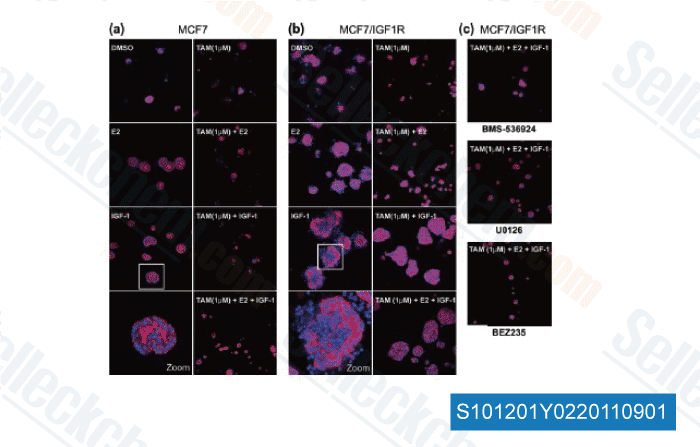
<p>Three-dimensional responses of MCF7/IGF-1R cells to TAM (1 μM), E2 and IGF-1. Compared to parental MCF7 cells (a), MCF7/IGF-1R cells (b) in three-dimensional (3D) culture formed bigger acini in response to IGF-1 stimulation and displayed significant TAM resistance when treated with TAM (1 μM) + E2 + IGF-1, which was removable by kinase inhibitors BMS-536924, U0126 and BEZ235 (c). Cells (10,000/well) were seeded in 96-well plates. Acini were formed on 100% Matrigel and cultured for 14 days in starving medium containing 2% Matrigel and 5% charcoal/dextran-stripped fetal bovine serum with the treatments as indicated. Concentrations used: TAM (1 μM), E2 (1 nM) and IGF-1 (100 ng/mL). Confocal image original magnification, × 20. Red, rhodamine phalloidin (actin). Blue, Hoechst blue stain. Results are representative of two individual experiments.</p>

Datos de [ Breast Cancer Res , 2011 , 13, R52 ]
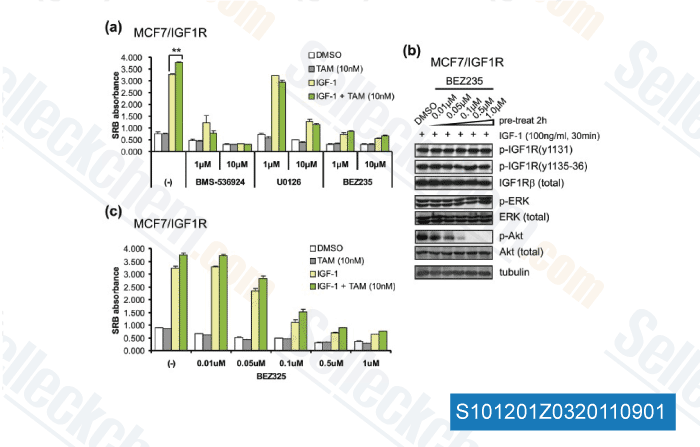
<p>TAM (10 nM) agonistic behavior in MCF7/IGF-1R cells is not inhibited by phosphatidylinositol 3-kinase/Akt inhibitor BEZ235. (a) Inhibitory effects of kinase inhibitors BMS-536924, U0126 and BEZ235 on agonistic effect of TAM (10 nM) in the presence of IGF-1 (100 ng/mL). **P < 0.01. (b) Inhibitory effects of phosphatidylinositol 3-kinase (PI3K)/Akt inhibitor BEZ235 at various dose ranges on IGF-1R signaling. (c) Agonistic behavior of TAM (10 nM) in response to BEZ235 kinase inhibitor. (-), no BEZ235. Results are representative of three independent experiments. Data are expressed as means ± SD.</p>

Datos de [ Breast Cancer Res , 2011 , 13:R52 ]
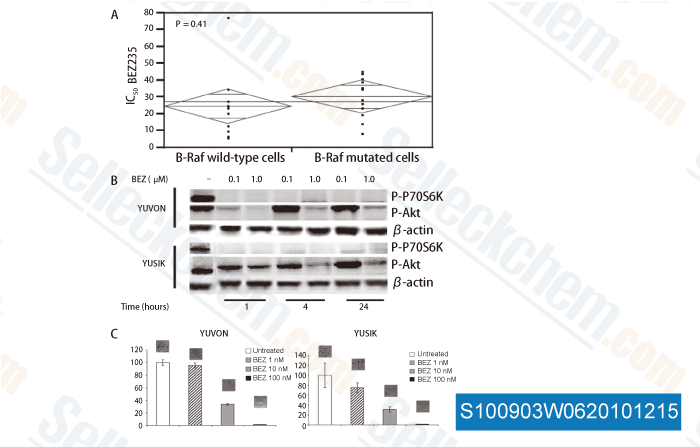
<p>A, ANOVA of IC50 values of the dual PI3K/mTOR inhibitor NVP-BEZ235 in 23 melanoma cell lines showing no significant difference in sensitivity to this compound in B-Raf mutant and Braf wild-type cells. B, decreases in pAkt and pP70S6K in a dose and time-dependent fashion in 2 melanoma cell lines treated with NVP-BEZ235. pP70S6K levels are undetectable at all concentrations and time points studied, whereas levels of pAkt start rising again after 4 hours of drug exposure in a dose-dependent fashion. C, clonogenic assays in 2 melanoma cell lines (YUVON and YUSIK) treated with NVP-BEZ235 at different concentrations. NVPBEZ235 was effective in inhibiting colony formation at low nanomolar concentrations.</p>

Datos de [ Clin Cancer Res , 2010 , 16, 6029-6039 ]
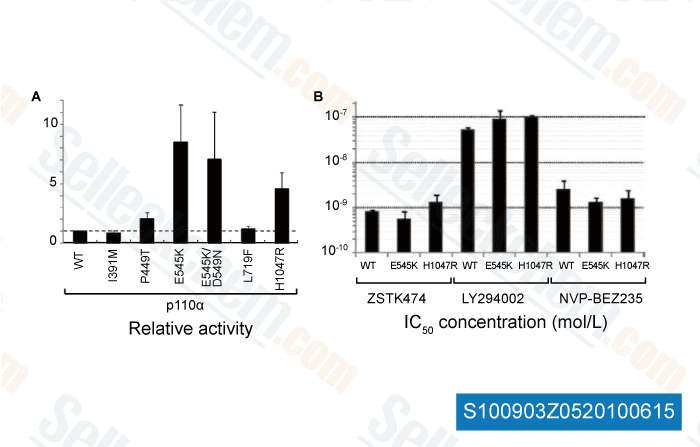
<p>Relative kinase activities of p110α mutants and the inhibitory effect of PI3K inhibitors against hotspot mutants of p110α. A, recombinant FLAG-tagged PI3K p110α/p85α protein complex produced in 293T cells was immunoprecipitated , and the immunoprecipitates were used for the quantitative PI3K-HTRF assay (32).</p><div><div>B, effect of three PI3K inhibitors (ZSTK474, LY294002, and NVP-BEZ235) on the enzymatic activity of two hotspot mutants (E545K and H1047R) p110α compared with the wild-type. No striking difference was observed in the IC50 concentrations of these inhibitors between wild-type and mutant p110α.</div><div> </div></div><p> </p>

Datos de [ Cancer Res , 2010 , 70, 4982-4994 ]

Sellecks Dactolisib (BEZ235) Ha sido citado por 519 Publicaciones

Neuroimmune Microenvironment Reprogramming via Immuno-piezoelectric Transducers for Synergistic Stem Cell Therapy in Traumatic Brain Injury [ Adv Mater, 2025, e12810.] PubMed: 41030193
Ataluren improves hematopoietic and pancreatic disorders in Shwachman-Diamond syndrome patients: a compassionate program case-series [ Nat Commun, 2025, 16(1):8189] PubMed: 40897730
TIGIT deficiency promotes autoreactive CD4+ T-cell responses through a metabolic‒epigenetic mechanism in autoimmune myositis [ Nat Commun, 2025, 16(1):4502] PubMed: 40374622
Spatial covariance reveals isothiocyanate natural products adjust redox stress to restore function in alpha-1-antitrypsin deficiency [ Cell Rep Med, 2025, 6(1):101917] PubMed: 39809267
Heterogeneous Activation of Signaling Pathways and Therapeutic Vulnerabilities in KSHV-Associated Primary Effusion Lymphoma Cell Lines [ J Med Virol, 2025, 97(8):e70534] PubMed: 40751690
Macrophage CCL7 promotes resistance to immunotherapy for colorectal cancer by regulating the infiltration of macrophages and CD8+ T cells [ J Immunother Cancer, 2025, 13(11)e013027] PubMed: 41290259
YAP1 promoter-associated noncoding RNA affects Ewing sarcoma cell tumorigenicity by regulating YAP1 expression [ Cell Mol Biol Lett, 2025, 30(1):63] PubMed: 40414844
Perilipin2-dependent lipid droplets accumulation promotes metastasis of oral squamous cell carcinoma via epithelial-mesenchymal transition [ Cell Death Discov, 2025, 11(1):30] PubMed: 39875372
Depleting the action of EZH2 through PI3K-mTOR inhibition to overcome metastasis and immunotherapy resistance in triple-negative breast cancer [ Mol Cancer Ther, 2025, 10.1158/1535-7163.MCT-24-0693] PubMed: 40497697
Changes in Melanoma Cell Morphology Following Inhibition of Cell Invasion by Third-Generation mTOR Kinase Inhibitors [ Int J Mol Sci, 2025, 26(16)7770] PubMed: 40869090

POLÍTICA DE DEVOLUCIÓN
La Política de Devolución Incondicional de Selleck Chemical garantiza una experiencia de compra en línea fluida para nuestros clientes. Si no está satisfecho con su compra de alguna manera, puede devolver cualquier artículo(s) dentro de los 7 días posteriores a su recepción. En caso de problemas de calidad del producto, ya sean problemas relacionados con el protocolo o con el producto, puede devolver cualquier artículo(s) dentro de los 365 días a partir de la fecha de compra original. Siga las instrucciones a continuación al devolver productos.

ENVÍO Y ALMACENAMIENTO
Los productos Selleck se transportan a temperatura ambiente. Si recibe el producto a temperatura ambiente, tenga la seguridad de que el Departamento de Inspección de Calidad de Selleck ha realizado experimentos para verificar que la colocación a temperatura normal durante un mes no afectará la actividad biológica de los productos en polvo. Después de la recogida, guarde el producto de acuerdo con los requisitos descritos en la hoja de datos. La mayoría de los productos Selleck son estables en las condiciones recomendadas.

NO PARA USO HUMANO, DIAGNÓSTICO VETERINARIO O TERAPÉUTICO.