
Datos técnicos
| Fórmula | C22H18N4OS |
||||||
| Peso molecular | 386.47 | Número CAS | 319460-85-0 | ||||
| Solubilidad (25°C)* | In vitro | DMSO | 41 mg/mL (106.08 mM) | ||||
| Water | Insoluble | ||||||
| Ethanol | Insoluble | ||||||
| In vivo (Agregue los solventes al producto individualmente y en orden.) |
|
||||||
|
* <1 mg/ml significa ligeramente soluble o insoluble. * Tenga en cuenta que Selleck prueba la solubilidad de todos los compuestos internamente, y la solubilidad real puede diferir ligeramente de los valores publicados. Esto es normal y se debe a ligeras variaciones entre lotes. * Envío a temperatura ambiente (Las pruebas de estabilidad demuestran que este producto se puede enviar sin medidas de refrigeración.) |
|||||||
Preparación de soluciones madre
Actividad biológica
| Descripción | Axitinib es un inhibidor multi-objetivo de VEGFR1, VEGFR2, VEGFR3, PDGFRβ y c-Kit con IC50 de 0.1 nM, 0.2 nM, 0.1-0.3 nM, 1.6 nM y 1.7 nM en células endoteliales de aorta porcina, respectivamente. | |||||||||||
|---|---|---|---|---|---|---|---|---|---|---|---|---|
| Objetivos |
|
|||||||||||
| In vitro | Axitinib podría bloquear la autofosforilación celular de VEGFR y la viabilidad de las células endoteliales mediada por VEGF, la formación de tubos y la señalización río abajo. Este compuesto inhibe la proliferación de diversas líneas celulares con IC50 de >10,000 nM (IGR-N91), 849 nM (IGR-NB8), 274 nM (SH-SY5Y) y 573 nM (HUVEC no estimuladas por VEGF). | |||||||||||
| In vivo | Axitinib exhibe una inhibición primaria en modelos trasplantados ortotópicamente como M24met (melanoma), HCT-116 (cáncer colorrectal) y SN12C (carcinoma de células renales). Este compuesto retrasa el crecimiento tumoral en 11.4 días en comparación con los controles (p.o. 30 mg/kg) y disminuye la densidad media de vasos (MVD) a 21, en comparación con 49 en los controles, en xenoinjertos de flanco IGR-N91. Inhibe significativamente el crecimiento y altera la microvasculatura tumoral en el modelo de cáncer de mama BT474 a 10-100 mg/kg. Ha mostrado actividad como agente único en varios tumores, incluidos el carcinoma de células renales, el cáncer de tiroides, el cáncer de pulmón de células no pequeñas y el melanoma. | |||||||||||
| Características | Superior como terapia de segunda línea en relación con sorafenib (estándar de atención actual). |
Protocolo (de referencia)
| Ensayo de quinasa: |
|
|---|---|
| Ensayo celular: |
|
| Estudio en animales: |
|
Referencias
|
Validación de productos por parte del cliente
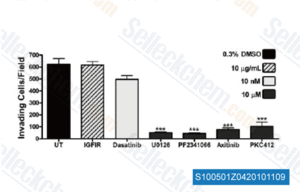
-
Datos de [ J Biomol Screen , 2011 , 16, 141-154 ]
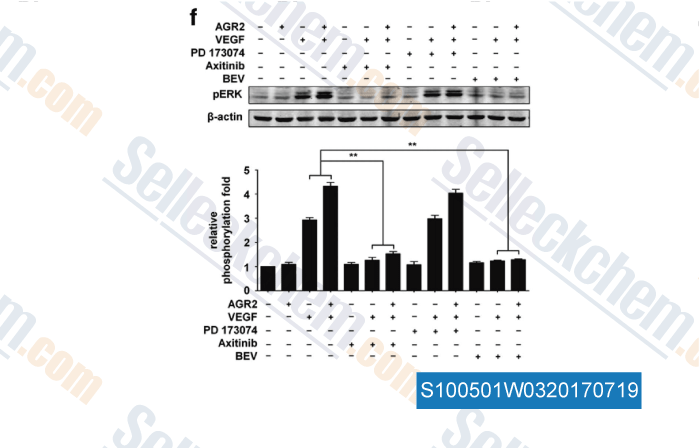
-
, , Oncogene, 2017, 36(36):5098-5109
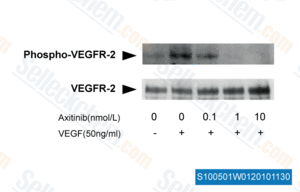
-
, , Dr. Cheri Pasch of UW Madison
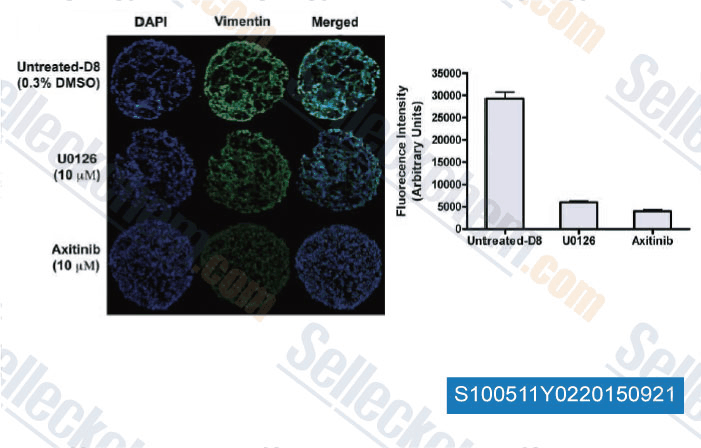
-
Datos de [ , , J Biomol Screen, 2011,16: 141-154 ]
Sellecks Axitinib (AG-013736) Ha sido citado por 194 Publicaciones
| Effective targeting of PDGFRA-altered high-grade glioma with avapritinib [ Cancer Cell, 2025, S1535-6108(25)00070-4] | PubMed: 40086436 |
| Luteolin prevents axitinib-induced kidney damage in mice [ Chem Biol Interact, 2025, 418:111628] | PubMed: 40609923 |
| Regulatory feedback between VEGF and ERK pathways controls tip-cell expression during sea urchin skeletogenesis [ Development, 2025, 152(13)dev204684] | PubMed: 40492925 |
| Revealing the Potential of Solamargine for Anti Metastasis and Angiogenesis Inhibition in Nasopharyngeal Carcinoma [ J Inflamm Res, 2025, 18:4879-4898] | PubMed: 40224395 |
| IL1RA+ Myeloid-derived Suppressor Cells Activate Epithelial-mesenchymal Transition to Facilitate Lymphatic and Hepatic Metastasis in Pancreatic Ductal Carcinoma [ J Clin Transl Hepatol, 2025, 13(11):935-948] | PubMed: 41306373 |
| A Novel Cell-Penetrating Peptide-Vascular Endothelial Growth Factor Small Interfering Ribonucleic Acid Complex That Mediates the Inhibition of Angiogenesis by Human Umbilical Vein Endothelial Cells and in an Ex Vivo Mouse Aorta Ring Model [ Biomater Res, 2025, 29:0120] | PubMed: 39780959 |
| Piezo1 regulates meningeal lymphatic vessel drainage and alleviates excessive CSF accumulation [ Nat Neurosci, 2024, 10.1038/s41593-024-01604-8] | PubMed: 38528202 |
| Targeting PDGF signaling of cancer-associated fibroblasts blocks feedback activation of HIF-1α and tumor progression of clear cell ovarian cancer [ Cell Rep Med, 2024, S2666-3791(24)00201-5] | PubMed: 38670097 |
| FLT1 activation in cancer cells promotes PARP-inhibitor resistance in breast cancer [ EMBO Mol Med, 2024, 10.1038/s44321-024-00094-2] | PubMed: 38956205 |
| The molecular basis of Abelson kinase regulation by its αI-helix [ Elife, 2024, 12RP92324] | PubMed: 38588001 |
POLÍTICA DE DEVOLUCIÓN
La Política de Devolución Incondicional de Selleck Chemical garantiza una experiencia de compra en línea fluida para nuestros clientes. Si no está satisfecho con su compra de alguna manera, puede devolver cualquier artículo(s) dentro de los 7 días posteriores a su recepción. En caso de problemas de calidad del producto, ya sean problemas relacionados con el protocolo o con el producto, puede devolver cualquier artículo(s) dentro de los 365 días a partir de la fecha de compra original. Siga las instrucciones a continuación al devolver productos.
ENVÍO Y ALMACENAMIENTO
Los productos Selleck se transportan a temperatura ambiente. Si recibe el producto a temperatura ambiente, tenga la seguridad de que el Departamento de Inspección de Calidad de Selleck ha realizado experimentos para verificar que la colocación a temperatura normal durante un mes no afectará la actividad biológica de los productos en polvo. Después de la recogida, guarde el producto de acuerdo con los requisitos descritos en la hoja de datos. La mayoría de los productos Selleck son estables en las condiciones recomendadas.
NO PARA USO HUMANO, DIAGNÓSTICO VETERINARIO O TERAPÉUTICO.