
Datos técnicos
| Fórmula | C26H30FN7O3 |
||||||
| Peso molecular | 507.56 | Número CAS | 722544-51-6 | ||||
| Solubilidad (25°C)* | In vitro | DMSO | 100 mg/mL (197.02 mM) | ||||
| Water | Insoluble | ||||||
| Ethanol | Insoluble | ||||||
| In vivo (Agregue los solventes al producto individualmente y en orden.) |
|
||||||
|
* <1 mg/ml significa ligeramente soluble o insoluble. * Tenga en cuenta que Selleck prueba la solubilidad de todos los compuestos internamente, y la solubilidad real puede diferir ligeramente de los valores publicados. Esto es normal y se debe a ligeras variaciones entre lotes. * Envío a temperatura ambiente (Las pruebas de estabilidad demuestran que este producto se puede enviar sin medidas de refrigeración.) |
|||||||
Preparación de soluciones madre
Actividad biológica
| Descripción | Defosbarasertib (AZD1152-HQPA, AZD2811, INH-34, Barasertib-HQPA) es un inhibidor altamente selectivo de Aurora B con una IC50 de 0,37 nM en un ensayo sin células, ~3700 veces más selectivo para Aurora B que para Aurora A. Fase 1. | ||
|---|---|---|---|
| Objetivos |
|
||
| In vitro | Barasertib (AZD1152-HQPA), un inhibidor altamente selectivo de Aurora B, provoca poliploidía y apoptosis en muchas líneas celulares de cáncer. |
||
| In vivo | Barasertib (AZD1152-HQPA) es un inhibidor de la quinasa aurora B y tiene eficacia contra xenoinjertos de líneas celulares de CPNM/RB1, PDX de CPNM/RB1 y tumores neuroendocrinos/Rb1 autóctonos. |
Protocolo (de referencia)
| Ensayo celular: |
|
|---|
Referencias
|
Validación de productos por parte del cliente
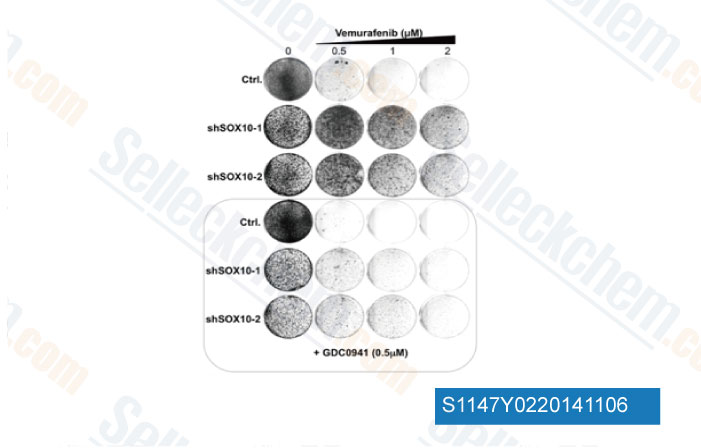
-
Datos de [ Nature , 2014 , 508(7494), 118-22 ]
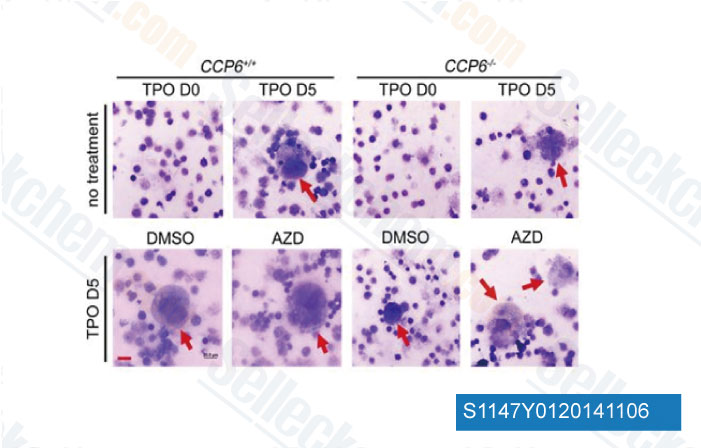
-
Datos de [ J Exp Med , 2014 , 10.1084/jem.20141123 ]
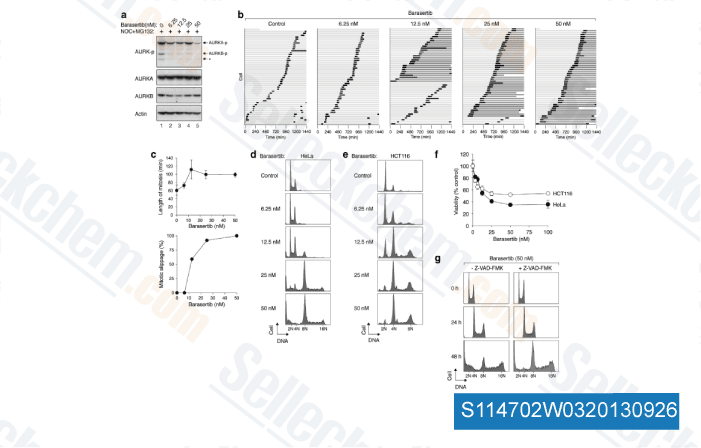
-
Datos de [ Oncogene , 2014 , 33, 3550-60 ]
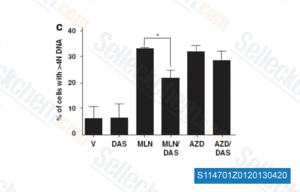
-
Datos de [ Oncogene , 2012 , 31, 1217–1227 ]
Sellecks Barasertib-HQPA (AZD2811) Ha sido citado por 171 Publicaciones
| High-throughput screening identifies Aurora kinase B as a critical therapeutic target for Merkel cell carcinoma [ Nat Commun, 2025, 16(1):1583] | PubMed: 39939315 |
| Unraveling AURKB as a potential therapeutic target in pulmonary hypertension using integrated transcriptomic analysis and pre-clinical studies [ Cell Rep Med, 2025, 6(2):101964] | PubMed: 39933527 |
| Aurora B controls microtubule stability to regulate abscission dynamics in stem cells [ Cell Rep, 2025, 44(2):115238] | PubMed: 39854207 |
| Identification of chemical inhibitors targeting long noncoding RNA through gene signature-based high throughput screening [ Int J Biol Macromol, 2025, 292:139119] | PubMed: 39722392 |
| Oversized cells activate global proteasome-mediated protein degradation to maintain cell size homeostasis [ Elife, 2025, 14e75393] | PubMed: 39791360 |
| The mechanoresponsive chromosomal passenger complex sustains furrow ingression under confinement [ J Mol Cell Biol, 2025, mjaf019] | PubMed: 40693957 |
| Overcoming MET-targeted drug resistance in MET-amplified lung cancer by aurora kinase B inhibition [ Biochim Biophys Acta Mol Cell Res, 2025, 1872(7):120001] | PubMed: 40499687 |
| Proteomic profiling identifies upregulation of aurora kinases causing resistance to taxane-type chemotherapy in triple negative breast cancer [ Sci Rep, 2025, 15(1):3211] | PubMed: 39863788 |
| Nucleosome stability safeguards cell identity, stress resilience and healthy aging [ bioRxiv, 2025, 2025.09.17.676776] | PubMed: 41000743 |
| Proteogenomic characterization of small cell lung cancer identifies biological insights and subtype-specific therapeutic strategies [ Cell, 2024, 187(1):184-203.e28] | PubMed: 38181741 |
POLÍTICA DE DEVOLUCIÓN
La Política de Devolución Incondicional de Selleck Chemical garantiza una experiencia de compra en línea fluida para nuestros clientes. Si no está satisfecho con su compra de alguna manera, puede devolver cualquier artículo(s) dentro de los 7 días posteriores a su recepción. En caso de problemas de calidad del producto, ya sean problemas relacionados con el protocolo o con el producto, puede devolver cualquier artículo(s) dentro de los 365 días a partir de la fecha de compra original. Siga las instrucciones a continuación al devolver productos.
ENVÍO Y ALMACENAMIENTO
Los productos Selleck se transportan a temperatura ambiente. Si recibe el producto a temperatura ambiente, tenga la seguridad de que el Departamento de Inspección de Calidad de Selleck ha realizado experimentos para verificar que la colocación a temperatura normal durante un mes no afectará la actividad biológica de los productos en polvo. Después de la recogida, guarde el producto de acuerdo con los requisitos descritos en la hoja de datos. La mayoría de los productos Selleck son estables en las condiciones recomendadas.
NO PARA USO HUMANO, DIAGNÓSTICO VETERINARIO O TERAPÉUTICO.