
Datos técnicos
| Fórmula | C19H23N7O2 |
||||||
| Peso molecular | 381.43 | Número CAS | 896466-04-9 | ||||
| Solubilidad (25°C)* | In vitro | DMSO | 76 mg/mL (199.25 mM) | ||||
| Ethanol | 76 mg/mL (199.25 mM) | ||||||
| Water | Insoluble | ||||||
| In vivo (Agregue los solventes al producto individualmente y en orden.) |
|
||||||
|
* <1 mg/ml significa ligeramente soluble o insoluble. * Tenga en cuenta que Selleck prueba la solubilidad de todos los compuestos internamente, y la solubilidad real puede diferir ligeramente de los valores publicados. Esto es normal y se debe a ligeras variaciones entre lotes. * Envío a temperatura ambiente (Las pruebas de estabilidad demuestran que este producto se puede enviar sin medidas de refrigeración.) |
|||||||
Preparación de soluciones madre
Actividad biológica
| Descripción | AT9283 es un potente inhibidor de JAK2/3 con una IC50 de 1,2 nM/1,1 nM en ensayos sin células; también potente contra Aurora A/B, Abl1(T315I). | |||||||||||
|---|---|---|---|---|---|---|---|---|---|---|---|---|
| Objetivos |
|
|||||||||||
| In vitro | AT9283 induce un fenotipo poliploide claro al inhibir la actividad de Aurora B kinase en células HCT116 con una IC50 de 30 nM. Además, este compuesto también produce una potente inhibición en la formación de colonias de HCT116. |
|||||||||||
| In vivo | En ratones con xenoinjertos de carcinoma de colon humano HCT116, el tratamiento con AT9283 (15 mg/kg y 20 mg/kg) durante 16 días resulta en una inhibición significativa del crecimiento tumoral del 67% y 76%, respectivamente. Además, este compuesto también exhibe una vida media significativamente más larga en tumores (2,5 horas) en comparación con el plasma (0,5 horas) y una biodisponibilidad oral modesta en ratones (Fp.o. = 24%). |
Protocolo (de referencia)
| Ensayo de quinasa: |
|
|---|---|
| Ensayo celular: |
|
| Estudio en animales: |
|
Referencias
|
Validación de productos por parte del cliente
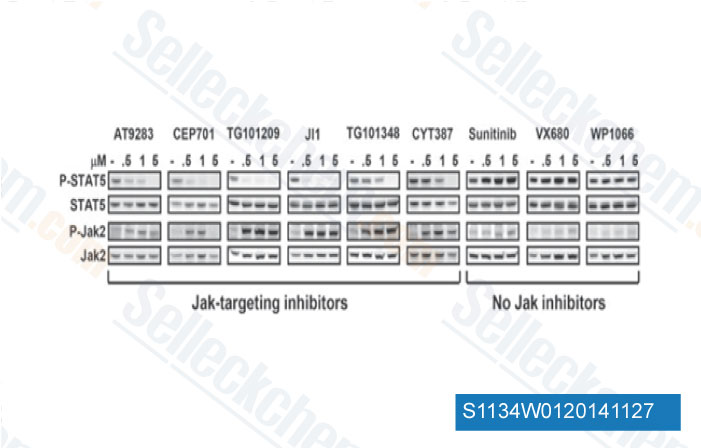
-
Datos de [ J Cell Mol Med , 2013 , 17(2), 265-76 ]
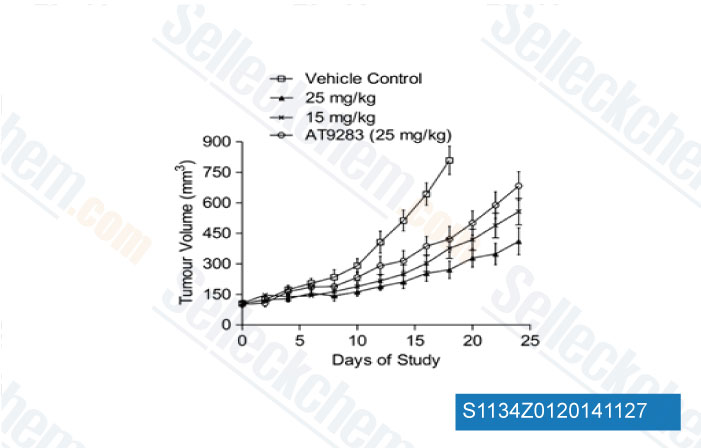
-
Datos de [ Drug Development Reseach , 2013 , 272-281 ]
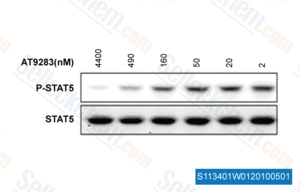
-
, , Dr. Claude Haan and Catherine Rolvering of Universite du Luxembourg
Sellecks AT9283 Ha sido citado por 37 Publicaciones
| Overcoming MET-targeted drug resistance in MET-amplified lung cancer by aurora kinase B inhibition [ Biochim Biophys Acta Mol Cell Res, 2025, 1872(7):120001] | PubMed: 40499687 |
| FAM207A acts as a novel and potential biomarker in lung adenocarcinoma and shapes the immunesuppressive tumor microenvironment [ Clin Exp Med, 2025, 25(1):125] | PubMed: 40259152 |
| Molecular basis of JAK kinase regulation guiding therapeutic approaches: Evaluating the JAK3 pseudokinase domain as a drug target [ Adv Biol Regul, 2025, 95:101072] | PubMed: 39755448 |
| DLGAP5 promotes lung adenocarcinoma growth via upregulating PLK1 and serves as a therapeutic target [ J Transl Med, 2024, 22(1):209] | PubMed: 38414025 |
| Regulation of Cell Cycle Progression through RB Phosphorylation by Nilotinib and AT-9283 in Human Melanoma A375P Cells [ Int J Mol Sci, 2024, 25(5)2956] | PubMed: 38474202 |
| Selective impact of ALK and MELK inhibition on ERα stability and cell proliferation in cell lines representing distinct molecular phenotypes of breast cancer [ Sci Rep, 2024, 14(1):8200] | PubMed: 38589728 |
| The Aurora kinase inhibitor AT9283 inhibits Burkitt lymphoma growth by regulating Warburg effect [ PeerJ, 2023, 11:e16581] | PubMed: 38099309 |
| Selective Impact of ALK and MELK Inhibition on ERα Stability and Cell Proliferation in Cell Lines Representing Distinct Molecular Phenotypes of Breast Cancer [ bioRxiv, 2023, 10.1101/2023.12.19.572304] | PubMed: none |
| Inhibition of IκB Kinase Is a Potential Therapeutic Strategy to Circumvent Resistance to Epidermal Growth Factor Receptor Inhibition in Triple-Negative Breast Cancer Cells [ Cancers (Basel), 2022, 14(21)5215] | PubMed: 36358633 |
| PERV induces CXCL10 in human monocytes and monocyte-derived primary cells [ Intervirology, 2022, 10.1159/000527074] | PubMed: 36382641 |
POLÍTICA DE DEVOLUCIÓN
La Política de Devolución Incondicional de Selleck Chemical garantiza una experiencia de compra en línea fluida para nuestros clientes. Si no está satisfecho con su compra de alguna manera, puede devolver cualquier artículo(s) dentro de los 7 días posteriores a su recepción. En caso de problemas de calidad del producto, ya sean problemas relacionados con el protocolo o con el producto, puede devolver cualquier artículo(s) dentro de los 365 días a partir de la fecha de compra original. Siga las instrucciones a continuación al devolver productos.
ENVÍO Y ALMACENAMIENTO
Los productos Selleck se transportan a temperatura ambiente. Si recibe el producto a temperatura ambiente, tenga la seguridad de que el Departamento de Inspección de Calidad de Selleck ha realizado experimentos para verificar que la colocación a temperatura normal durante un mes no afectará la actividad biológica de los productos en polvo. Después de la recogida, guarde el producto de acuerdo con los requisitos descritos en la hoja de datos. La mayoría de los productos Selleck son estables en las condiciones recomendadas.
NO PARA USO HUMANO, DIAGNÓSTICO VETERINARIO O TERAPÉUTICO.