
Datos técnicos
| Fórmula | C11H8O4 |
||||||
| Peso molecular | 204.18 | Número CAS | 14003-96-4 | ||||
| Solubilidad (25°C)* | In vitro | DMSO | 41 mg/mL (200.8 mM) | ||||
| Water | Insoluble | ||||||
| Ethanol | Insoluble | ||||||
| In vivo (Agregue los solventes al producto individualmente y en orden.) |
|
||||||
|
* <1 mg/ml significa ligeramente soluble o insoluble. * Tenga en cuenta que Selleck prueba la solubilidad de todos los compuestos internamente, y la solubilidad real puede diferir ligeramente de los valores publicados. Esto es normal y se debe a ligeras variaciones entre lotes. * Envío a temperatura ambiente (Las pruebas de estabilidad demuestran que este producto se puede enviar sin medidas de refrigeración.) |
|||||||
Preparación de soluciones madre
Actividad biológica
| Descripción | 4μ8C (IRE1 Inhibitor III) es un potente y selectivo inhibidor de la IRE1 Rnase con una IC50 de 76 nM. | ||
|---|---|---|---|
| Objetivos |
|
||
| In vitro | 4μ8C bloquea el acceso del sustrato (RIDD) al sitio activo de IRE1 e inactiva selectivamente tanto el empalme de Xbp1 como la degradación de ARNm mediada por IRE1. La inhibición de IRE1 induce posteriormente ER stress sin toxicidad aguda medible. 4μ8C, como inhibidor de IRE1, bloquea la producción de IL-4, IL-5 e IL-13 de las células T CD4+. |
||
| In vivo | 4μ8c es un IRE1 Inhibitor III que reduce la lesión aterosclerótica y mitiga eficazmente el desarrollo de la placa en ratones. |
||
| Características | Inhibidor selectivo de la IRE1 Rnase, utilizado como plataforma para el desarrollo de nuevos fármacos de acción local. |
Protocolo (de referencia)
| Ensayo de quinasa: |
|
|---|---|
| Ensayo celular: |
|
| Estudio en animales: |
|
Referencias
|
Validación de productos por parte del cliente

-
Datos de [ , , Free Radic Biol Med, 2018, 124:395-407 ]
-
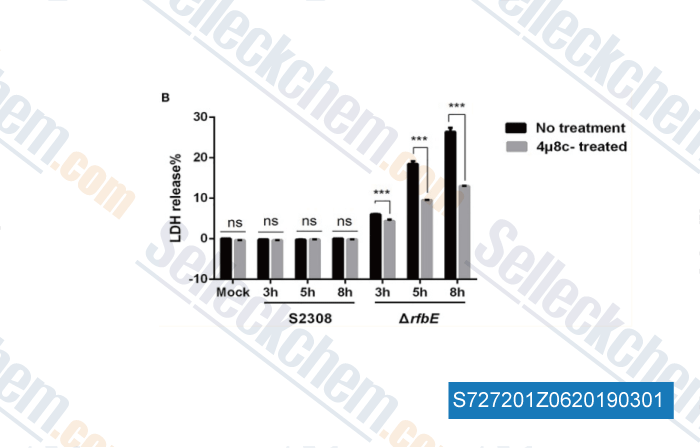
Datos de [ , , Front Microbiol, 2017, 8:2129 ]
-
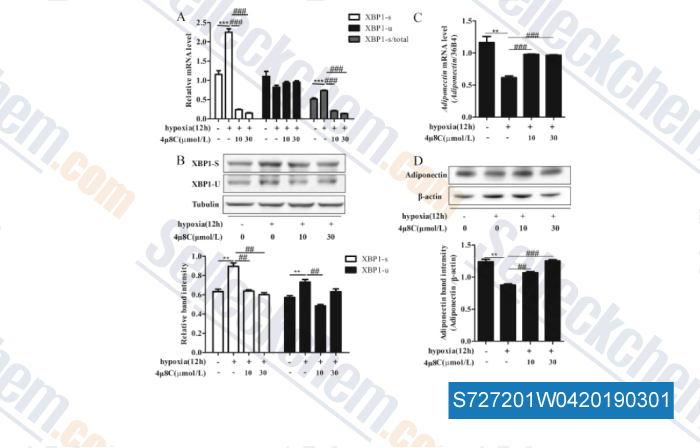
Datos de [ , , Front Cell Infect Microbiol, 2017, 7:422 ]
-
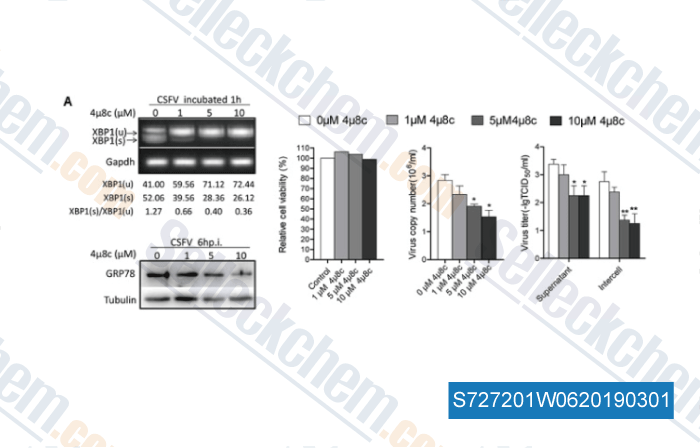
Datos de [ , , Biochem Biophys Res Commun, 2017, 493(1):346-351 ]
Sellecks 4μ8C Ha sido citado por 57 Publicaciones
| TaIRE1-mediated unconventional splicing of the TabZIP60 mRNA and the miR172 precursor regulates heat stress tolerance in wheat [ J Integr Plant Biol, 2025, 67(9):2388-2400.] | PubMed: 40607649 |
| TaIRE1-mediated unconventional splicing of the TabZIP60 mRNA and the miR172 precursor regulates heat stress tolerance in wheat [ J Integr Plant Biol, 2025, 10.1111/jipb.13963] | PubMed: 40607649 |
| The IRE1α/XBP1-mediated upregulation of LMTK2 attenuates endoplasmic reticulum stress by enhancing autophagic activity [ Cancer Lett, 2025, 633:217993] | PubMed: 40834986 |
| Curcumin Attenuates Fumonisin B1-Induced PK-15 Cell Apoptosis by Upregulating miR-1249 Expression to Inhibit the IRE1/MKK7/JNK/CASPASE3 Signaling Pathway [ Antioxidants (Basel), 2025, 14(2)168] | PubMed: 40002355 |
| Mitochondrial ROS-ER Stress Axis Governs IL-10 Production in Neutrophils and Regulates Inflammation in Murine Chlamydia pneumoniae Lung Infection [ Cells, 2025, 14(19)1523] | PubMed: 41090752 |
| Oridonin alleviates SiNPs-induced pulmonary fibrosis by inhibiting pyroptosis via IRE1α-XBP1s-NLRP3 pathway [ Int Immunopharmacol, 2025, 164:115388] | PubMed: 40845545 |
| PERK Regulates Epithelial-Mesenchymal Transition Through Autophagy and Lipid Metabolism in Lens Epithelial Cells [ Invest Ophthalmol Vis Sci, 2025, 66(5):35] | PubMed: 40408092 |
| MAM-Mediated Mitochondrial Ca2+ Overload and Endoplasmic Reticulum Stress Aggravates Synaptic Plasticity Impairment in Diabetic Mice [ Brain Sci, 2025, 15(11)1157] | PubMed: 41300164 |
| TMED4 facilitates regulatory T cell suppressive function via ROS homeostasis in tumor and autoimmune mouse models [ J Clin Invest, 2024, 135(1)e179874] | PubMed: 39480507 |
| MANF facilitates breast cancer cell survival under glucose-starvation conditions via PRKN-mediated mitophagy regulation [ Autophagy, 2024, 1-22.] | PubMed: 39147386 |
POLÍTICA DE DEVOLUCIÓN
La Política de Devolución Incondicional de Selleck Chemical garantiza una experiencia de compra en línea fluida para nuestros clientes. Si no está satisfecho con su compra de alguna manera, puede devolver cualquier artículo(s) dentro de los 7 días posteriores a su recepción. En caso de problemas de calidad del producto, ya sean problemas relacionados con el protocolo o con el producto, puede devolver cualquier artículo(s) dentro de los 365 días a partir de la fecha de compra original. Siga las instrucciones a continuación al devolver productos.
ENVÍO Y ALMACENAMIENTO
Los productos Selleck se transportan a temperatura ambiente. Si recibe el producto a temperatura ambiente, tenga la seguridad de que el Departamento de Inspección de Calidad de Selleck ha realizado experimentos para verificar que la colocación a temperatura normal durante un mes no afectará la actividad biológica de los productos en polvo. Después de la recogida, guarde el producto de acuerdo con los requisitos descritos en la hoja de datos. La mayoría de los productos Selleck son estables en las condiciones recomendadas.
NO PARA USO HUMANO, DIAGNÓSTICO VETERINARIO O TERAPÉUTICO.