
solo para uso en investigación
Ropinirole HCl Dopamine Receptor Inhibidor
Cat. No.: S3189
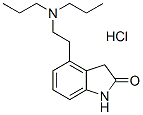
Estructura química
Peso molecular: 296.84
Control de calidad (Quality Control)
| Dianas relacionadas | Adrenergic Receptor AChR 5-HT Receptor COX Calcium Channel Histamine Receptor GABA Receptor TRP Channel Cholinesterase (ChE) GluR |
|---|---|
| Otros Dopamine Receptor Inhibidores | MPTP Hydrochloride Trifluoperazine Trifluoperazine 2HCl Penfluridol Rotundine Domperidone Sulpiride Azaperone Levosulpiride SCH-23390 hydrochloride |
Información química, almacenamiento y estabilidad (Chemical Information, Storage & Stability)
| Peso molecular | 296.84 | Fórmula | C16H24N2O.HCl |
Almacenamiento (Desde la fecha de recepción) | |
|---|---|---|---|---|---|
| Nº CAS | 91374-20-8 | Descargar SDF | Almacenamiento de soluciones madre |
|
|
| Sinónimos | SKF-101468A | Smiles | CCCN(CCC)CCC1=C2CC(=O)NC2=CC=C1.Cl | ||
Solubilidad (Solubility)
|
In vitro |
Water : 59 mg/mL
DMSO
: 30 mg/mL
(101.06 mM)
Ethanol : Insoluble |
Calculadora de Molaridad
|
In vivo |
|||||
Calculadora de formulación in vivo (Solución clara)
Paso 1: Introduzca la información a continuación (Recomendado: Un animal adicional para tener en cuenta la pérdida durante el experimento)
Paso 2: Introduzca la formulación in vivo (Esto es solo la calculadora, no la formulación. Por favor, contáctenos primero si no hay una formulación in vivo en la sección de Solubilidad.)
Resultados del cálculo:
Concentración de trabajo: mg/ml;
Método para preparar el líquido maestro de DMSO: mg fármaco predissuelto en μL DMSO ( Concentración del líquido maestro mg/mL, Por favor, contáctenos primero si la concentración excede la solubilidad del DMSO del lote del fármaco. )
Método para preparar la formulación in vivo: Tomar μL DMSO líquido maestro, luego añadirμL PEG300, mezclar y clarificar, luego añadirμL Tween 80, mezclar y clarificar, luego añadir μL ddH2O, mezclar y clarificar.
Método para preparar la formulación in vivo: Tomar μL DMSO líquido maestro, luego añadir μL Aceite de maíz, mezclar y clarificar.
Nota: 1. Por favor, asegúrese de que el líquido esté claro antes de añadir el siguiente disolvente.
2. Asegúrese de añadir el (los) disolvente(s) en orden. Debe asegurarse de que la solución obtenida, en la adición anterior, sea una solución clara antes de proceder a añadir el siguiente disolvente. Se pueden utilizar métodos físicos como el vórtice, el ultrasonido o el baño de agua caliente para ayudar a la disolución.
Mecanismo de acción (Mechanism of Action)
| Targets/IC50/Ki |
D2 receptor
29 nM(Ki)
|
|---|---|
| In vitro |
Ropinirole scavenges free radicals and suppresses lipid peroxidation in the Fe2+–H2O2 reaction system.
|
| In vivo |
Ropinirole (50 mg/kg, i.p.) causes biphasic spontaneous locomotor activity in mice. Ropinirole (0.05-1.0 mg/kg SC) dose-dependently inhibits the dyskinesias induced by 2-di-n-propylamino-5,6-di-hydroxytetralin in mice. Ropirtirole, at doses of 1 and 10 μg, injected unilaterally directly into the striatum of the rat causes marked, contralateral (away from the side of injection) asymmetry and circling in mice. Ropinirole (0.05-1.0 mg/kg SC or 0.1 mg/kg PO) reverses all motor and behavioural deficits induced by MPTP in marmosets. Ropinirole (2 mg/kg, i.p.) for 7 days increases GSH, catalase and SOD activities in the striatum and protected striatal dopaminergic neurons against 6-hydroxydopamine (6-OHDA) in mice. Ropinirole (0.2 mg/kg, i.p.) improves the use of previously akinetic forelimb and produced robust circling behavior in lesioned rats with striatal over-expression of both D2R and D3R compared to lesioned animals that received blank vector. The subtherapeutic dose of ropinirole generates only modest motor effects in lesioned rats with sole over-expression of D2R or D3R. Ropinirole (1-8 mg t.i.d.) is rapidly and completely absorbed with oral bioavailability of 55%, clearance of 780 mL/min, elimination half-life of 6 hours in healthy volunteer. Since the major route of elimination for Ropinirole is by the CYP enzyme system, mainly by CYP1A2 and also by CYP3A4, inhibition of the former and possibly the latter may reduce the agent’s clearance and lead to drug accumulation. Ropinirole (0.25 mg-4.0 mg per day) treatment significantly improves patients' ability to initiate sleep, the amount of stage 2 sleep and sleep adequacy compared with placebo. Periodic limb movements with arousal per hour decreases from 7.0 to 2.5 with ropinirole but increases from 4.2 to 6.0 with placebo. Periodic limb movements while awake per hour decreases from 56.5 to 23.6 with ropinirole but increases from 46.6 to 56.1 with placebo.
|
Referencias |
|
Información del ensayo clínico (Clinical Trial Information)
(datos de https://clinicaltrials.gov, actualizado el 2024-06-21)
| Número NCT | Reclutamiento | Condiciones | Patrocinador/Colaboradores | Fecha de inicio | Fases |
|---|---|---|---|---|---|
| NCT06468371 | COMPLETED | Hemodialysis; Restless Legs Syndrome; ESRD (End Stage Renal Disease); Diabetes Complications |
Lahore General Hospital |
2022-01-02 | |
| NCT03806530 | COMPLETED | End Stage Renal Disease; Restless Legs Syndrome |
Population Health Research Institute |
2019-05-01 | PHASE3 |
| NCT03176966 | COMPLETED | Muscle Cramp; Cirrhosis |
Vanderbilt University Medical Center |
2016-09-02 | PHASE4 |
| NCT03038308 | COMPLETED | Hyperprolactinemia; Prolactinoma |
Columbia University |
2016-09-16 | PHASE1; PHASE2 |
| NCT03708237 | TERMINATED | Restless Legs Syndrome; End Stage Renal Disease |
University of Alberta |
2019-02-19 | PHASE2 |
| NCT03708237 | Terminated | Restless Legs Syndrome|End Stage Renal Disease |
University of Alberta |
2019-02-19 | Phase 2 |

Los productos son solo para uso de investigación. No para uso humano. No vendemos a pacientes.
©Copyright 2013 Selleck Chemicals. Todos los derechos reservados.