
solo para uso en investigación
Guadecitabine sodium Inhibidor de DNMT
Cat. No.: S7013
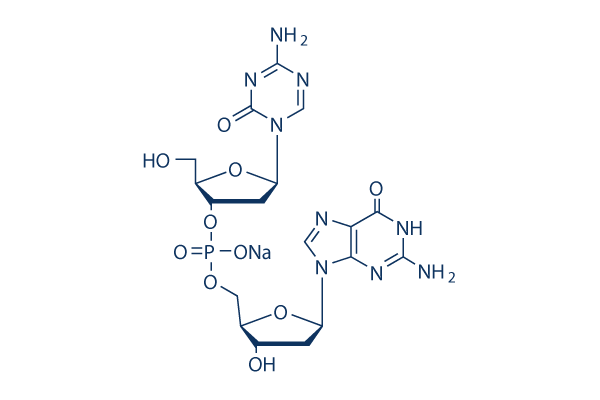
Estructura química
Peso molecular: 579.39
Control de calidad (Quality Control)
- Citado en Nature Medicine por su máxima calidad
- COA
- NMR
- HPLC
- SDS
- Hoja de datos
| Dianas relacionadas | PRMT EZH2 MAT2A DNA Methyltransferase LSD1 JMJD G9a/GLP MLL NSD FTO |
|---|---|
| Productos destacados | Y-27632 Dihydrochloride SB431542 CHIR-99021 (Laduviglusib) RMC-7977 RMC-6236 (Daraxonrasib) MRTX1133 MG132 Z-VAD-FMK VT3989 IAG933 |
Información química, almacenamiento y estabilidad (Chemical Information, Storage & Stability)
| Peso molecular | 579.39 | Fórmula | C18 H23 N9 O10 P . Na |
Almacenamiento (Desde la fecha de recepción) | |
|---|---|---|---|---|---|
| Nº CAS | 929904-85-8 | -- | Almacenamiento de soluciones madre |
|
|
| Sinónimos | SGI-110 sodium; S-110 sodium | Smiles | C1C(C(OC1N2C=NC3=C2N=C(NC3=O)N)COP(=O)([O-])OC4CC(OC4CO)N5C=NC(=NC5=O)N)O.[Na+] | ||
Solubilidad (Solubility)
|
In vitro |
DMSO
: 100 mg/mL
(172.59 mM)
Water : 50 mg/mL Ethanol : Insoluble |
Calculadora de Molaridad
|
In vivo |
|||||
Calculadora de formulación in vivo (Solución clara)
Paso 1: Introduzca la información a continuación (Recomendado: Un animal adicional para tener en cuenta la pérdida durante el experimento)
Paso 2: Introduzca la formulación in vivo (Esto es solo la calculadora, no la formulación. Por favor, contáctenos primero si no hay una formulación in vivo en la sección de Solubilidad.)
Resultados del cálculo:
Concentración de trabajo: mg/ml;
Método para preparar el líquido maestro de DMSO: mg fármaco predissuelto en μL DMSO ( Concentración del líquido maestro mg/mL, Por favor, contáctenos primero si la concentración excede la solubilidad del DMSO del lote del fármaco. )
Método para preparar la formulación in vivo: Tomar μL DMSO líquido maestro, luego añadirμL PEG300, mezclar y clarificar, luego añadirμL Tween 80, mezclar y clarificar, luego añadir μL ddH2O, mezclar y clarificar.
Método para preparar la formulación in vivo: Tomar μL DMSO líquido maestro, luego añadir μL Aceite de maíz, mezclar y clarificar.
Nota: 1. Por favor, asegúrese de que el líquido esté claro antes de añadir el siguiente disolvente.
2. Asegúrese de añadir el (los) disolvente(s) en orden. Debe asegurarse de que la solución obtenida, en la adición anterior, sea una solución clara antes de proceder a añadir el siguiente disolvente. Se pueden utilizar métodos físicos como el vórtice, el ultrasonido o el baño de agua caliente para ayudar a la disolución.
Mecanismo de acción (Mechanism of Action)
| Targets/IC50/Ki |
DNA methyltransferase
|
|---|---|
| In vitro |
Guadecitabine (SGI-110) is a 5-aza-2′-deoxycytidine-containing demethylating dinucleotide that works via a mechanism similar to that of 5-aza-CdR after incorporation of its aza-moiety into DNA. However, it is well protected from deamination by cytidine deaminase. This compound (1 μM) induces a significant decrease in the level of methylation in both T24 and HCT116 cells and is able to induce robust p16 expression. It also causes depletion of extractable DNMT1 in cells at 1 μM concentration. Furthermore, it decreases the plating efficiency of T24 bladder carcinoma cells in a dose-dependent manner, with no colonies forming at 10 μM concentration, which is quite similar to 5-aza-CdR in T24 cells. It shows immunomodulatory activity in vitro. At 1 μM, it induces/up-regulates the expression of several cancer/testis antigens (CTA) (i.e., MAGE-A1, MAGE-A2, MAGE-A3, MAGE-A4, MAGE-A10, GAGE1-2, GAGE 1-6, NY-ESO-1, and SSX 1-5) in cancer cell lines (cutaneous melanoma, mesothelioma, renal cell carcinoma, and sarcoma cells), both at mRNA and at protein levels. This compound also up-regulates the expression of HLA class I antigens and of ICAM-1, resulting in improved recognition of cancer cells by gp100-specific CTL. |
| In vivo |
Guadecitabine (SGI-110) is as effective as 5-Aza-CdR, but is better tolerated in mice. This compound (10 mg/kg) displays potent activity on inducing p16 expression, reducing DNA methylation at the p16 promoter region, and retarding tumor growth in human xenograft. It is effective by both i.p. and s.c. deliveries. |
Referencias |
|
Información del ensayo clínico (Clinical Trial Information)
(datos de https://clinicaltrials.gov, actualizado el 2026-08-05)
| Número NCT | Reclutamiento | Condiciones | Patrocinador/Colaboradores | Fecha de inicio | Fases |
|---|---|---|---|---|---|
| NCT03220477 | ACTIVE_NOT_RECRUITING | Lung Cancer |
Memorial Sloan Kettering Cancer Center |
2017-08-04 | PHASE1 |
| NCT02935361 | ACTIVE_NOT_RECRUITING | Chronic Myelomonocytic Leukemia; Myelodysplastic Syndrome; Recurrent Acute Myeloid Leukemia With Myelodysplasia-Related Changes |
University of Southern California |
2016-11-02 | PHASE1; PHASE2 |
| NCT02998567 | ACTIVE_NOT_RECRUITING | Non Small Cell Lung Cancer |
Royal Marsden NHS Foundation Trust |
2017-01-26 | PHASE1 |
| NCT02684162 | COMPLETED | Acute Myeloid Leukemia; Chronic Myelomonocytic Leukemia; Myelodysplastic Syndrome; Recurrent Acute Myeloid Leukemia; Recurrent Myelodysplastic Syndrome |
M.D. Anderson Cancer Center |
2016-06-22 | PHASE2 |
| NCT02131597 | COMPLETED | High Risk Myelodysplastic Syndrome |
M.D. Anderson Cancer Center |
2014-11-10 | PHASE2 |
| NCT04340843 | ACTIVE_NOT_RECRUITING | Locally Advanced Unresectable Primary Central Chondrosarcoma; Metastatic Primary Central Chondrosarcoma; Unresectable Primary Central Chondrosarcoma |
National Cancer Institute (NCI) |
2020-09-08 | PHASE2 |

Los productos son solo para uso de investigación. No para uso humano. No vendemos a pacientes.
©Copyright 2013 Selleck Chemicals. Todos los derechos reservados.