
solo para uso en investigación
Dinaciclib (SCH 727965) CDK Inhibidor
Cat. No.: S2768

Estructura química
Peso molecular: 396.49
Control de calidad (Quality Control)
Productos que se suelen utilizar junto con Dinaciclib (SCH 727965)
Cultivo celular, tratamiento y concentración de trabajo
(Cell Culture, Treatment & Working Concentration)
| Líneas celulares | Tipo de ensayo | Concentración | Tiempo de incubación | Formulación | Descripción de la actividad | PMID |
|---|---|---|---|---|---|---|
| CA46 | Apoptosis Assay | 100 nM | 24 h | induces cell cycle arrest | 25289887 | |
| Kasumi-1 | Apoptosis Assay | 100 nM | 24 h | induces cell cycle arrest | 25289887 | |
| U937 | Function Assay | 2/5/10 nM | 3 h | blocks induction of XBP-1s and downstream targets | 24362465 | |
| 8226 | Function Assay | 2/5/10 nM | 4 h | blocks induction of XBP-1s and downstream targets | 24362465 | |
| H929 | Function Assay | 2/5/10 nM | 4 h | blocks induction of XBP-1s and downstream targets | 24362465 | |
| K562 | Function Assay | 1.5/3/8 nM | 6 h | blocks induction of XBP-1s and downstream targets | 24362465 | |
| BaF3/Bcr-abl | Function Assay | 1.5/3/8 nM | 6 h | blocks induction of XBP-1s and downstream targets | 24362465 | |
| U937 | Function Assay | 2/10 nM | 3 h | blocks induction of XBP-1s and downstream targets | 24362465 | |
| 1205Lu | Growth Inhibition Assay | 10/30 nM | 72 h | inhibits cell growth and survival | 23527225 | |
| WM1366 | Growth Inhibition Assay | 10/30 nM | 72 h | inhibits cell growth and survival | 23527225 | |
| RD | Growth Inhibition Assay | IC50=8.2 nM | 22315240 | |||
| Rh41 | Growth Inhibition Assay | IC50=10.5 nM | 22315240 | |||
| Rh18 | Growth Inhibition Assay | IC50=10.5 nM | 22315240 | |||
| Rh30 | Growth Inhibition Assay | IC50=9 nM | 22315240 | |||
| BT-12 | Growth Inhibition Assay | IC50=8.5 nM | 22315240 | |||
| CHLA-266 | Growth Inhibition Assay | IC50=7.3 nM | 22315240 | |||
| TC-71 | Growth Inhibition Assay | IC50=3.9 nM | 22315240 | |||
| CHLA-9 | Growth Inhibition Assay | IC50=8 nM | 22315240 | |||
| CHLA-10 | Growth Inhibition Assay | IC50=6.3 nM | 22315240 | |||
| CHLA-258 | Growth Inhibition Assay | IC50=9.9 nM | 22315240 | |||
| GBM2 | Growth Inhibition Assay | IC50=6.5 nM | 22315240 | |||
| NB-1643 | Growth Inhibition Assay | IC50=3.3 nM | 22315240 | |||
| NB-EBc1 | Growth Inhibition Assay | IC50=7 nM | 22315240 | |||
| CHLA-90 | Growth Inhibition Assay | IC50=7.5 nM | 22315240 | |||
| CHLA-136 | Growth Inhibition Assay | IC50=9.8 nM | 22315240 | |||
| NALM-6 | Growth Inhibition Assay | IC50=4.6 nM | 22315240 | |||
| COG-LL-317 | Growth Inhibition Assay | IC50=6.5 nM | 22315240 | |||
| RS4;11 | Growth Inhibition Assay | IC50=5.1 nM | 22315240 | |||
| MOLT-4 | Growth Inhibition Assay | IC50=9.3 nM | 22315240 | |||
| CCRF-CEM | Growth Inhibition Assay | IC50=5.6 nM | 22315240 | |||
| Kasumi-1 | Growth Inhibition Assay | IC50=4.5 nM | 22315240 | |||
| Karpas-299 | Growth Inhibition Assay | IC50=3.9 nM | 22315240 | |||
| Ramos-RA1 | Growth Inhibition Assay | IC50=7.9 nM | 22315240 | |||
| MIAPaCa-2 | Growth Inhibition Assay | 72 h | GI50=10 nM | 21768779 | ||
| Pa20C | Growth Inhibition Assay | 72 h | GI50=20 nM | 21768779 | ||
| ML-1 | Apoptosis Assay | 1-1000 nM | 4 h | induces apoptosis slightly | 21768777 | |
| Cytotoxicity assay | MDA-MB-436 | 72 hrs | IC50 = 0.005 μM | 23600925 | ||
| Cytotoxicity assay | NCI-H929 | 72 hrs | IC50 = 0.005 μM | 23600925 | ||
| Cytotoxicity assay | MDA-MB-231 | 72 hrs | IC50 = 0.005 μM | 23600925 | ||
| Cytotoxicity assay | SK-ES-1 | 72 hrs | IC50 = 0.005 μM | 23600925 | ||
| Cytotoxicity assay | A673 | 72 hrs | IC50 = 0.005 μM | 23600925 | ||
| Cytotoxicity assay | SK-BR-3 | 72 hrs | IC50 = 0.005 μM | 23600925 | ||
| Cytotoxicity assay | MNNG-HOS | 72 hrs | IC50 = 0.0055 μM | 23600925 | ||
| Cytotoxicity assay | SK-UT-1 | 72 hrs | IC50 = 0.006 μM | 23600925 | ||
| Cytotoxicity assay | U266 | 72 hrs | IC50 = 0.006 μM | 23600925 | ||
| Cytotoxicity assay | RPMI18226 | 72 hrs | IC50 = 0.009 μM | 23600925 | ||
| Cytotoxicity assay | SW872 | 72 hrs | IC50 = 0.0095 μM | 23600925 | ||
| Cytotoxicity assay | T47D | 72 hrs | IC50 = 0.01 μM | 23600925 | ||
| Apoptosis assay | A673 | 24 hrs | EC50 = 0.011 μM | 23600925 | ||
| Cytotoxicity assay | MCF7 | 72 hrs | IC50 = 0.02 μM | 23600925 | ||
| Function assay | Sf9 | IC50 = 0.072 μM | 26741853 | |||
| Function assay | sf9 | IC50 = 0.002 μM | 26851505 | |||
| Function assay | Sf9 | 1 hr | IC50 = 0.001 μM | 27171036 | ||
| Function assay | Sf9 | 1 hr | IC50 = 0.001 μM | 27171036 | ||
| Function assay | Sf9 | 1 hr | IC50 = 0.001 μM | 27171036 | ||
| Function assay | Sf9 | 1 hr | IC50 = 0.001 μM | 27171036 | ||
| Function assay | Sf9 | 1 hr | IC50 = 0.003 μM | 27171036 | ||
| Function assay | Sf9 | 1 hr | IC50 = 0.003 μM | 27171036 | ||
| Function assay | Sf9 | 1 hr | IC50 = 0.004 μM | 27171036 | ||
| Function assay | Sf9 | 1 hr | IC50 = 0.004 μM | 27171036 | ||
| Function assay | Sf9 | 10 uM | IC50 = 0.004 μM | 29329658 | ||
| Function assay | Sf9 | 1 hr | IC50 = 0.001 μM | 29853338 | ||
| Function assay | Sf9 | 1 hr | IC50 = 0.001 μM | 29853338 | ||
| Function assay | Sf9 | 1 hr | IC50 = 0.003 μM | 29853338 | ||
| Function assay | Sf9 | 1 hr | IC50 = 0.004 μM | 29853338 | ||
| Antiproliferative assay | MOLM13 | 72 hrs | GI50 = 0.0033 μM | 30253346 | ||
| Antiproliferative assay | MEC1 | 72 hrs | GI50 = 0.0036 μM | 30253346 | ||
| Antiproliferative assay | MOLM14 | 72 hrs | GI50 = 0.0045 μM | 30253346 | ||
| Antiproliferative assay | COLO205 | 72 hrs | GI50 = 0.0068 μM | 30253346 | ||
| Antiproliferative assay | HL60 | 72 hrs | GI50 = 0.008 μM | 30253346 | ||
| Antiproliferative assay | Ramos | 72 hrs | GI50 = 0.0086 μM | 30253346 | ||
| Antiproliferative assay | GISTT1 | 72 hrs | GI50 = 0.0088 μM | 30253346 | ||
| Antiproliferative assay | U937 | 72 hrs | GI50 = 0.01 μM | 30253346 | ||
| Antiproliferative assay | A431 | 72 hrs | GI50 = 0.011 μM | 30253346 | ||
| Antiproliferative assay | SKM1 | 72 hrs | GI50 = 0.011 μM | 30253346 | ||
| Antiproliferative assay | MEC2 | 72 hrs | GI50 = 0.011 μM | 30253346 | ||
| Antiproliferative assay | A375 | 72 hrs | GI50 = 0.011 μM | 30253346 | ||
| Antiproliferative assay | OCI-AML3 | 72 hrs | GI50 = 0.013 μM | 30253346 | ||
| Antiproliferative assay | BE(2)-M17 | 72 hrs | GI50 = 0.021 μM | 30253346 | ||
| Antiproliferative assay | CHO | 72 hrs | GI50 = 0.16 μM | 30253346 | ||
| Function assay | NCI-H929 | 0.005 uM | 24 hrs | Inhibition of CDK2-mediated Rb phosphorylation at Ser 807/811 in human NCI-H929 cells at 0.005 uM after 24 hrs by immunoblotting analysis | 23600925 | |
| Function assay | A673 | 0.05 uM | 24 hrs | Inhibition of CDK2-mediated Rb phosphorylation at Ser 807/811 in human A673 cells at 0.05 uM after 24 hrs by immunoblotting analysis | 23600925 | |
| Apoptosis assay | MEC1 | 0.01 uM | 24 hrs | Induction of apoptosis in human MEC1 cells assessed as decrease in MCL-1 level at 0.01 uM after 24 hrs by immunoblotting analysis | 30253346 | |
| Apoptosis assay | HL60 | 0.01 uM | 24 hrs | Induction of apoptosis in human HL60 cells assessed as decrease in MCL-1 level at 0.01 uM after 24 hrs by immunoblotting analysis | 30253346 | |
| Apoptosis assay | MV4-11 | 0.01 uM | 24 hrs | Induction of apoptosis in human MV4-11 cells assessed as decrease in c-MYC level at 0.01 uM after 24 hrs by immunoblotting analysis | 30253346 | |
| Apoptosis assay | MEC1 | 0.01 uM | 24 hrs | Induction of apoptosis in human MEC1 cells assessed as decrease in c-MYC level at 0.01 uM after 24 hrs by immunoblotting analysis | 30253346 | |
| Apoptosis assay | MV4-11 | 0.01 uM | 24 hrs | Induction of apoptosis in human MV4-11 cells assessed as decrease in MCL-1 level at 0.01 uM after 24 hrs by immunoblotting analysis | 30253346 | |
| Apoptosis assay | HL60 | 0.01 uM | 24 hrs | Induction of apoptosis in human HL60 cells assessed as decrease in c-MYC level at 0.01 uM after 24 hrs by immunoblotting analysis | 30253346 | |
| Cytotoxicity assay | U2OS | 96 hrs | IC50 = 0.006 μM | ChEMBL | ||
| Function assay | U2OS | 1 hr | IC50 = 0.007 μM | ChEMBL | ||
| Haga clic para ver más datos experimentales de líneas celulares | ||||||
Información química, almacenamiento y estabilidad (Chemical Information, Storage & Stability)
| Peso molecular | 396.49 | Fórmula | C21H28N6O2 |
Almacenamiento (Desde la fecha de recepción) | |
|---|---|---|---|---|---|
| Nº CAS | 779353-01-4 | Descargar SDF | Almacenamiento de soluciones madre |
|
|
| Sinónimos | SCH727965, PS-095760 | Smiles | CCC1=C2N=C(C=C(N2N=C1)NCC3=C[N+](=CC=C3)[O-])N4CCCCC4CCO | ||
Solubilidad (Solubility)
|
In vitro |
DMSO
: 79 mg/mL
(199.24 mM)
Ethanol : 35 mg/mL Water : Insoluble |
Calculadora de Molaridad
|
In vivo |
|||||
Calculadora de formulación in vivo (Solución clara)
Paso 1: Introduzca la información a continuación (Recomendado: Un animal adicional para tener en cuenta la pérdida durante el experimento)
Paso 2: Introduzca la formulación in vivo (Esto es solo la calculadora, no la formulación. Por favor, contáctenos primero si no hay una formulación in vivo en la sección de Solubilidad.)
Resultados del cálculo:
Concentración de trabajo: mg/ml;
Método para preparar el líquido maestro de DMSO: mg fármaco predissuelto en μL DMSO ( Concentración del líquido maestro mg/mL, Por favor, contáctenos primero si la concentración excede la solubilidad del DMSO del lote del fármaco. )
Método para preparar la formulación in vivo: Tomar μL DMSO líquido maestro, luego añadirμL PEG300, mezclar y clarificar, luego añadirμL Tween 80, mezclar y clarificar, luego añadir μL ddH2O, mezclar y clarificar.
Método para preparar la formulación in vivo: Tomar μL DMSO líquido maestro, luego añadir μL Aceite de maíz, mezclar y clarificar.
Nota: 1. Por favor, asegúrese de que el líquido esté claro antes de añadir el siguiente disolvente.
2. Asegúrese de añadir el (los) disolvente(s) en orden. Debe asegurarse de que la solución obtenida, en la adición anterior, sea una solución clara antes de proceder a añadir el siguiente disolvente. Se pueden utilizar métodos físicos como el vórtice, el ultrasonido o el baño de agua caliente para ayudar a la disolución.
Mecanismo de acción (Mechanism of Action)
| Targets/IC50/Ki |
CDK2
(Cell-free assay) 1 nM
CDK5
(Cell-free assay) 1 nM
CDK1
(Cell-free assay) 3 nM
CDK9
(Cell-free assay) 4 nM
|
|---|---|
| In vitro |
Dinaciclib is also a potent DNA replication inhibitor that blocks thymidine (dThd) DNA incorporation in A2780 cells with IC50 of 4 nM. This compound strongly suppresses phosphorylation of Rb on Ser 807/811 at concentrations >6.25 nM, which is in agreement with the observation that 4 nM concentrations are required for 50% inhibition of dThd DNA incorporation in the same cell model. Significantly, complete suppression of Rb phosphorylation is correlated with the onset of apoptosis, as indicated by the appearance of the p85 PARP cleavage product in cells exposed to >6.25 nM of this chemical. It is active against a broad spectrum of human tumor cell lines. Addition of this compound during exposure also suppresses accumulation of γ-H2AX, in a dose-dependent manner. It inhibits melanoma cell proliferation, and drives melanoma cells into massive apoptosis. This chemical induces the apoptosis of several osteosarcoma cell lines including those resistant to doxorubicin. It attenuates the phosphorylation of RNAP II at serine 2 and the phosphorylation of the CDK inhibitor p27Kip1 at threonine 187. Reductions in phosphorylation activity occurrs at 12 - 40 nM of this compound (4 to 16 hours post-addition). It also reduces the phosphorylation of Rb at serine 807/811. This chemical induces the apoptosis of mock- and p53-depleted U2OS cells to a similar extent. |
| Ensayo de quinasa |
Ensayo de quinasa de ciclina/CDK
|
|
Las holoenzimas de ciclina/CDK recombinantes se purifican a partir de células Sf9 diseñadas para producir baculovirus que expresan una ciclina o CDK específica. Los complejos de ciclina/CDK se diluyen típicamente a una concentración final de 50 μg/mL en un tampón de reacción de quinasa que contiene 50 mM Tris-HCl (pH 8,0), 10 mM MgCl2, 1 mM DTT y 0,1 mM ortovanadato de sodio. Para cada reacción de quinasa, se mezclan 1 μg de enzima y 20 μL de una solución de sustrato de 2 μM (un péptido biotinilado derivado de la histona H1) y se combinan con 10 μL de este compuesto diluido. La reacción se inicia con la adición de 50 μL de 2 μM ATP y 0,1 μCi de 33P-ATP. Las reacciones de quinasa se incuban durante 1 hora a temperatura ambiente y se detienen con la adición de 0,1% de Triton X-100, 1 mM de ATP, 5 mM de EDTA y 5 mg/mL de perlas SPA recubiertas de estreptavidina. Las perlas SPA se capturan usando una placa de filtro GF/B de 96 pocillos y un recolector universal Filtermate. Las perlas se lavan dos veces con 2 M NaCl y dos veces con 2 M NaCl que contiene 1% de ácido fosfórico. La señal se analiza luego usando un contador de centelleo líquido TopCount de 96 pocillos.
|
|
| In vivo |
Dinaciclib i.p. administration at 8, 16, 32, and 48 mg/kg daily for 10 days results in tumor inhibition by 70%, 70%, 89%, and 96%, respectively. This compound's MED (minimum effective dose) appears to be <8 mg/kg. It is well tolerated, and the maximum body weight loss in the highest dosage group is 5%. This chemical has dose-dependent antitumor activity in vivo, and that nearly complete inhibition of tumor growth occurs at a dose level below the MTD (maximum tolerated dose). It has a short plasma half-life in mouse. |
Referencias |
|
Aplicaciones (Applications)
| Métodos | Biomarcadores | Imágenes | PMID |
|---|---|---|---|
| Western blot | Mcl-1 / Bcl-2 / Bcl-xl / Bax / Bak / PUMA / Noxa Cleaved PARP / c-Myc Survivin RNAP II (P-Ser2/P-Ser5) |
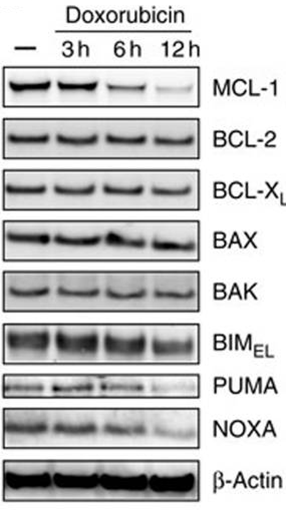
|
28714472 |
| Growth inhibition assay | Cell viability Cell viability |
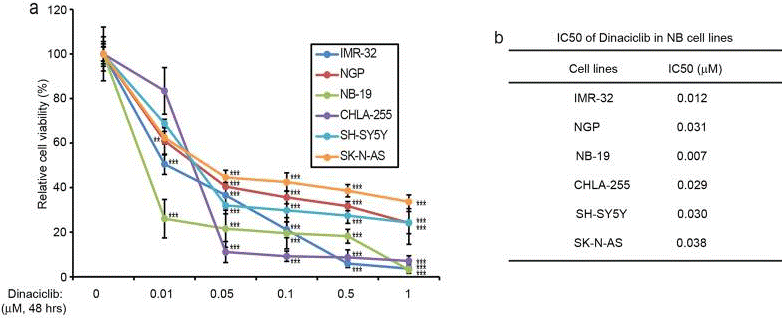
|
27378523 |
| Immunofluorescence | cyclin B1 / α-tubulin / Aurora A OCT4 |
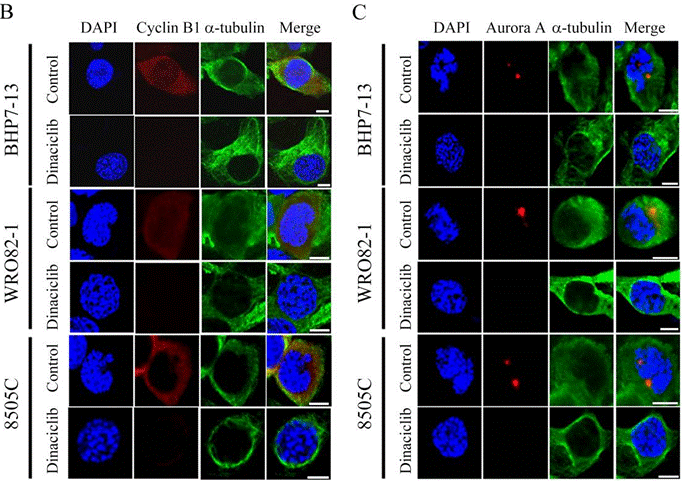
|
28207834 |
Información del ensayo clínico (Clinical Trial Information)
(datos de https://clinicaltrials.gov, actualizado el 2026-08-03)
| Número NCT | Reclutamiento | Condiciones | Patrocinador/Colaboradores | Fecha de inicio | Fases |
|---|---|---|---|---|---|
| NCT01434316 | ACTIVE_NOT_RECRUITING | Advanced Malignant Solid Neoplasm |
National Cancer Institute (NCI) |
2011-11-11 | PHASE1 |
| NCT03484520 | TERMINATED | Cancer - Acute Myeloid Leukemia |
AbbVie |
2018-07-23 | PHASE1 |
| NCT01676753 | COMPLETED | Advanced or Metastatic Breast Cancer; Triple Negative Breast Cancer |
Jo Chien |
2016-12-28 | PHASE1 |
| NCT02684617 | TERMINATED | rrCLL; rrMM; rrDLBCL |
Merck Sharp & Dohme LLC |
2016-03-29 | PHASE1 |
| NCT03484520 | Terminated | Cancer - Acute Myeloid Leukemia |
AbbVie|Merck Sharp & Dohme LLC |
2018-07-23 | Phase 1 |
| NCT01711528 | COMPLETED | Recurrent Plasma Cell Myeloma |
National Cancer Institute (NCI) |
2012-12-19 | PHASE1 |
Preguntas frecuentes (Frequently Asked Questions)
Pregunta 1:
I want to know how to reconstitute it for in vivo studies?
Respuesta:
It can be dissolved in 2% DMSO/30% PEG 300/ddH2O at 10 mg/ml as a clear solution for injection. And this compound in 15% Captisol at 8 mg/ml is a suspension for oral administration.

Los productos son solo para uso de investigación. No para uso humano. No vendemos a pacientes.
©Copyright 2013 Selleck Chemicals. Todos los derechos reservados.