
solo para uso en investigación
VX-809 (Lumacaftor) CFTR Modulador
Cat. No.: S1565

Estructura química
Peso molecular: 452.41
Control de calidad (Quality Control)
| Dianas relacionadas | CRM1 CD markers AChR Calcium Channel Sodium Channel Potassium Channel GABA Receptor TRP Channel ATPase GluR |
|---|---|
| Otros CFTR Inhibidores | Tezacaftor (VX-661) VX-445 (Elexacaftor) Vanzacaftor (VX-121) CFTRinh-172 GLPG1837 Galicaftor (ABBV-2222) GlyH-101 FDL169 IOWH032 PPQ-102 |
Cultivo celular, tratamiento y concentración de trabajo
(Cell Culture, Treatment & Working Concentration)
| Líneas celulares | Tipo de ensayo | Concentración | Tiempo de incubación | Formulación | Descripción de la actividad | PMID |
|---|---|---|---|---|---|---|
| CFBE41o | Corrector assay | 24 hrs | Corrector activity at CFTR F508-del mutant (unknown origin) expressed in human CFBE41o cells harboring HS-YFP preincubated for 24 hrs followed by forskolin/genistein stimulation for 30 mins by fluorescence assay, EC50 = 2.5704 μM. | 29272749 | ||
| FRT | Corrector assay | 25 mins | Corrector activity at human CFTR F508 deletion mutant expressed in FRT cells incubated for 25 mins with forskolin by YFP-based fluorescence analysis relative to control, EC50 = 2.6 μM. | 26561003 | ||
| TC32 | qHTS assay | qHTS of pediatric cancer cell lines to identify multiple opportunities for drug repurposing: Primary screen for TC32 cells | 29435139 | |||
| U-2 OS | qHTS assay | qHTS of pediatric cancer cell lines to identify multiple opportunities for drug repurposing: Primary screen for U-2 OS cells | 29435139 | |||
| A673 | qHTS assay | qHTS of pediatric cancer cell lines to identify multiple opportunities for drug repurposing: Primary screen for A673 cells | 29435139 | |||
| DAOY | qHTS assay | qHTS of pediatric cancer cell lines to identify multiple opportunities for drug repurposing: Primary screen for DAOY cells | 29435139 | |||
| Saos-2 | qHTS assay | qHTS of pediatric cancer cell lines to identify multiple opportunities for drug repurposing: Primary screen for Saos-2 cells | 29435139 | |||
| BT-37 | qHTS assay | qHTS of pediatric cancer cell lines to identify multiple opportunities for drug repurposing: Primary screen for BT-37 cells | 29435139 | |||
| RD | qHTS assay | qHTS of pediatric cancer cell lines to identify multiple opportunities for drug repurposing: Primary screen for RD cells | 29435139 | |||
| SK-N-SH | qHTS assay | qHTS of pediatric cancer cell lines to identify multiple opportunities for drug repurposing: Primary screen for SK-N-SH cells | 29435139 | |||
| BT-12 | qHTS assay | qHTS of pediatric cancer cell lines to identify multiple opportunities for drug repurposing: Primary screen for BT-12 cells | 29435139 | |||
| MG 63 (6-TG R) | qHTS assay | qHTS of pediatric cancer cell lines to identify multiple opportunities for drug repurposing: Primary screen for MG 63 (6-TG R) cells | 29435139 | |||
| NB1643 | qHTS assay | qHTS of pediatric cancer cell lines to identify multiple opportunities for drug repurposing: Primary screen for NB1643 cells | 29435139 | |||
| BT-12 | qHTS assay | qHTS of pediatric cancer cell lines to identify multiple opportunities for drug repurposing: Confirmatory screen for BT-12 cells | 29435139 | |||
| OHS-50 | qHTS assay | qHTS of pediatric cancer cell lines to identify multiple opportunities for drug repurposing: Primary screen for OHS-50 cells | 29435139 | |||
| fibroblast cells | qHTS assay | qHTS of pediatric cancer cell lines to identify multiple opportunities for drug repurposing: Primary screen for control Hh wild type fibroblast cells | 29435139 | |||
| Rh41 | qHTS assay | qHTS of pediatric cancer cell lines to identify multiple opportunities for drug repurposing: Primary screen for Rh41 cells | 29435139 | |||
| Rh30 | qHTS assay | qHTS of pediatric cancer cell lines to identify multiple opportunities for drug repurposing: Confirmatory screen for Rh30 cells | 29435139 | |||
| U-2 OS | qHTS assay | qHTS of pediatric cancer cell lines to identify multiple opportunities for drug repurposing: Confirmatory screen for U-2 OS cells | 29435139 | |||
| Rh41 | qHTS assay | qHTS of pediatric cancer cell lines to identify multiple opportunities for drug repurposing: Confirmatory screen for Rh41 cells | 29435139 | |||
| RD | qHTS assay | qHTS of pediatric cancer cell lines to identify multiple opportunities for drug repurposing: Confirmatory screen for RD cells | 29435139 | |||
| SJ-GBM2 | qHTS assay | qHTS of pediatric cancer cell lines to identify multiple opportunities for drug repurposing: Primary screen for SJ-GBM2 cells | 29435139 | |||
| SK-N-MC | qHTS assay | qHTS of pediatric cancer cell lines to identify multiple opportunities for drug repurposing: Primary screen for SK-N-MC cells | 29435139 | |||
| NB-EBc1 | qHTS assay | qHTS of pediatric cancer cell lines to identify multiple opportunities for drug repurposing: Primary screen for NB-EBc1 cells | 29435139 | |||
| LAN-5 | qHTS assay | qHTS of pediatric cancer cell lines to identify multiple opportunities for drug repurposing: Primary screen for LAN-5 cells | 29435139 | |||
| Rh18 | qHTS assay | qHTS of pediatric cancer cell lines to identify multiple opportunities for drug repurposing: Primary screen for Rh18 cells | 29435139 | |||
| CFBE41o | Corrector assay | 1 uM | 24 hrs | Corrector activity at CFTR F508-del mutant (unknown origin) expressed in human CFBE41o cells harboring HS-YFP assessed as increase in matured protein levels at cell surface at 1 uM after 24 hrs by electrophoretic mobility assay | 29272749 | |
| HBE | Corrector assay | Corrector activity at CFTR F508del/F508del mutant in primary HBE cells assessed as increase in chloride ion current across apical membrane measured 18 to 24 hrs post compound treatment on basolateral side of cells in presence of channel potentiator GLPG18 | 29251932 | |||
| CFBE41o | Corrector assay | Corrector activity at CFTR F508del mutant (unknown origin) expressed in human CFBE41o cells assessed as increase in fully glycosylated protein by western blot analysis | 26041577 | |||
| CFBE41o | Corrector assay | 1 uM | 24 hrs | Corrector activity at CFTR F508del mutant (unknown origin) expressed in human CFBE41o cells assessed as increase in size of cAMP-dependent current at 1 uM after 24 hrs measured at +100 mV by whole cell patch clamp assay | 26041577 | |
| Haga clic para ver más datos experimentales de líneas celulares | ||||||
Información química, almacenamiento y estabilidad (Chemical Information, Storage & Stability)
| Peso molecular | 452.41 | Fórmula | C24H18F2N2O5 |
Almacenamiento (Desde la fecha de recepción) | |
|---|---|---|---|---|---|
| Nº CAS | 936727-05-8 | Descargar SDF | Almacenamiento de soluciones madre |
|
|
| Sinónimos | VRT 826809 | Smiles | CC1=C(N=C(C=C1)NC(=O)C2(CC2)C3=CC4=C(C=C3)OC(O4)(F)F)C5=CC(=CC=C5)C(=O)O | ||
Solubilidad (Solubility)
|
In vitro |
DMSO
: 90 mg/mL
(198.93 mM)
Ethanol : 13 mg/mL Water : Insoluble |
Calculadora de Molaridad
|
In vivo |
|||||
Calculadora de formulación in vivo (Solución clara)
Paso 1: Introduzca la información a continuación (Recomendado: Un animal adicional para tener en cuenta la pérdida durante el experimento)
Paso 2: Introduzca la formulación in vivo (Esto es solo la calculadora, no la formulación. Por favor, contáctenos primero si no hay una formulación in vivo en la sección de Solubilidad.)
Resultados del cálculo:
Concentración de trabajo: mg/ml;
Método para preparar el líquido maestro de DMSO: mg fármaco predissuelto en μL DMSO ( Concentración del líquido maestro mg/mL, Por favor, contáctenos primero si la concentración excede la solubilidad del DMSO del lote del fármaco. )
Método para preparar la formulación in vivo: Tomar μL DMSO líquido maestro, luego añadirμL PEG300, mezclar y clarificar, luego añadirμL Tween 80, mezclar y clarificar, luego añadir μL ddH2O, mezclar y clarificar.
Método para preparar la formulación in vivo: Tomar μL DMSO líquido maestro, luego añadir μL Aceite de maíz, mezclar y clarificar.
Nota: 1. Por favor, asegúrese de que el líquido esté claro antes de añadir el siguiente disolvente.
2. Asegúrese de añadir el (los) disolvente(s) en orden. Debe asegurarse de que la solución obtenida, en la adición anterior, sea una solución clara antes de proceder a añadir el siguiente disolvente. Se pueden utilizar métodos físicos como el vórtice, el ultrasonido o el baño de agua caliente para ayudar a la disolución.
Mecanismo de acción (Mechanism of Action)
| Características |
Higher specificity and efficacy relative to other CFTR defect drugs.
|
|---|---|
| Targets/IC50/Ki |
F508del-CFTR
(Fisher rat thyroid cells) 0.1 μM(EC50)
|
| In vitro |
Lumacaftor (VX-809) acts at the level of the ER to allow a fraction of the F508del-CFTR to adopt a properly folded form, to exit the ER and mobilize to the cell surface for normal functioning. In Fischer rat thyroid (FRT) cells expressing F508del-CFTR, this compound treatment significantly improves F508del-CFTR maturation by 7.1 fold with an EC50 of 0.1 μM, and enhances F508del-CFTR-mediated chloride transport by approximately 5 fold with EC50 of 0.5 μM, while VRT-768 has higher EC50 values of 7.9 μM and 16 μM, respectively. In HEK-293 cells expressing F508del-CFTR, it (3 μM) increases F508del-CFTR exit from the ER by 6 fold, reaching levels comparable to 34% of CFTR. In primary human bronchial epithelial (HBE) cells with F508del-CFTR mutation, the agent increases CFTR maturation and enhances chloride secretion with EC50 of 350 nM and 81 nM, respectively, more efficacious than Corr-4a and VRT-325. F508del-CFTR corrected by it exhibits single-channel open probability of 0.39 similar to normal CFTR of 0.40. Unlike VX-770, it is not a CFTR potentiator, as acute addition has no effect on F508del-CFTR function. In contrast to VRT-325 and Corr-4a, it does not improve the processing of the normal or mutant forms of hERG or P-gp, as well as other disease-causing mislocalized proteins, including α1-antitrypsin Z mutant (E342K-α1-AT) or N370S-β-glucosidase, suggesting that it is specific for CFTR. It in combination with VRT-325 or Corr-4a has additive effect on CFTR-mediated chloride transport in cultured F508del-HBE. |
| Ensayo de quinasa |
maduración del F508del-CFTR
|
|
Las células FRT que expresan de forma estable F508del-CFTR se tratan con concentraciones crecientes de Lumacaftor (VX-809) durante 48 horas. Después de la incubación, las células se recolectan en solución D-PBS fría (sin calcio ni magnesio) y se centrifugan a 1.000 × g a 4 °C. Los pellets celulares se lisan en 1% de Nonidet P-40, 0,5% de desoxicolato de sodio, 200 mM de NaCl, 10 mM de Tris, pH 7,8, y 1 mM de EDTA más una mezcla de inhibidores de proteasas (1:250) durante 30 minutos en hielo. Los lisados se centrifugan durante 10 minutos a 10.000 × g a 4 °C para sedimentar los núcleos y el material insoluble. Aproximadamente 12 μg de proteína total se calientan en tampón de Laemmli con 5% de β-mercaptoetanol a 37 °C durante 5 minutos y se cargan en un gel de Tris-acetato del 3% al 8%. El gel se transfiere a nitrocelulosa y se procesa para Western blotting utilizando un anticuerpo monoclonal CFTR o policlonal contra GAPDH. Las membranas se revelan mediante quimioluminiscencia mejorada. La cuantificación de las cantidades relativas de las bandas C y GAPDH se realiza utilizando el análisis NIH ImageJ de las películas escaneadas.
|
|
| In vivo |
Lumacaftor (VX-809; VRT 826809) is a CFTR modulator that corrects the folding and trafficking of CFTR protein. |
Referencias |
Aplicaciones (Applications)
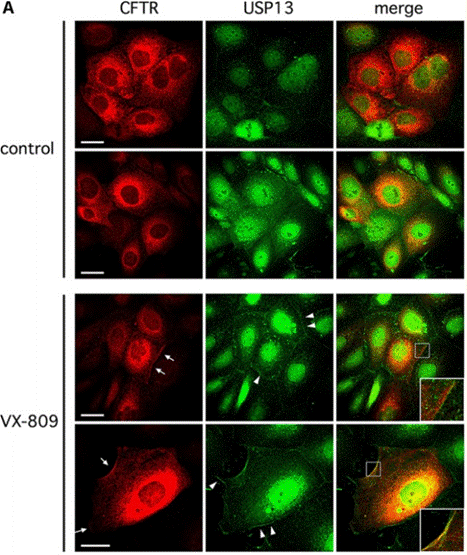
| Métodos | Biomarcadores | Imágenes | PMID |
|---|---|---|---|
| Immunofluorescence | CFTR / USP13 Cell surface kAE1 / kAE1 |
|
30618756 |
Información del ensayo clínico (Clinical Trial Information)
(datos de https://clinicaltrials.gov, actualizado el 2026-07-17)
| Número NCT | Reclutamiento | Condiciones | Patrocinador/Colaboradores | Fecha de inicio | Fases |
|---|---|---|---|---|---|
| NCT07695090 | RECRUITING | Heart Failure With Reduced Ejection Fraction |
Qanatpharma AG |
2026-07 | PHASE2 |
| NCT04581408 | COMPLETED | Long QT Syndrome |
Istituto Auxologico Italiano |
2021-06-15 | PHASE2 |
| NCT05968612 | COMPLETED | Healthy Volunteer |
Qanatpharma Canada LTD |
2023-11-17 | PHASE1 |
| NCT04235140 | COMPLETED | Cystic Fibrosis |
Vertex Pharmaceuticals Incorporated |
2020-02-24 | PHASE3 |
| NCT03601637 | COMPLETED | Cystic Fibrosis |
Vertex Pharmaceuticals Incorporated |
2018-09-07 | PHASE3 |
| NCT03625466 | COMPLETED | Cystic Fibrosis |
Vertex Pharmaceuticals Incorporated |
2018-08-10 | PHASE2 |

Los productos son solo para uso de investigación. No para uso humano. No vendemos a pacientes.
©Copyright 2013 Selleck Chemicals. Todos los derechos reservados.