
solo para uso en investigación
Abexinostat (PCI-24781) HDAC Inhibidor
Cat. No.: S1090
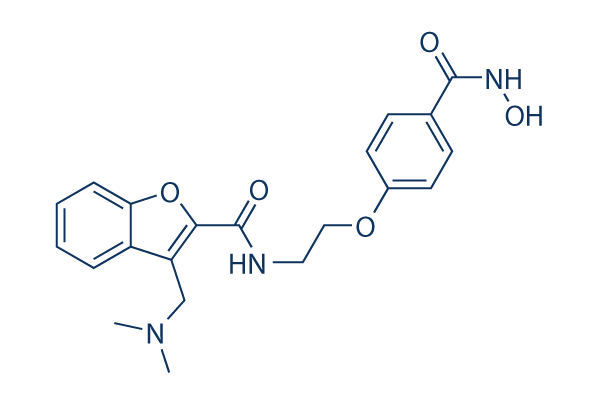
Estructura química
Peso molecular: 397.42
Control de calidad (Quality Control)
Cultivo celular, tratamiento y concentración de trabajo
(Cell Culture, Treatment & Working Concentration)
| Líneas celulares | Tipo de ensayo | Concentración | Tiempo de incubación | Formulación | Descripción de la actividad | PMID |
|---|---|---|---|---|---|---|
| HeLa | Function assay | 2 hrs | Inhibition of dye-labeled tracer binding to HDAC10 (unknown origin) transfected in human HeLa cells measured after 2 hrs by nano-luciferase reporter gene-based BRET assay, IC50=0.007943μM | 30964290 | ||
| TC32 | qHTS assay | qHTS of pediatric cancer cell lines to identify multiple opportunities for drug repurposing: Primary screen for TC32 cells | 29435139 | |||
| DAOY | qHTS assay | qHTS of pediatric cancer cell lines to identify multiple opportunities for drug repurposing: Primary screen for DAOY cells | 29435139 | |||
| SJ-GBM2 | qHTS assay | qHTS of pediatric cancer cell lines to identify multiple opportunities for drug repurposing: Primary screen for SJ-GBM2 cells | 29435139 | |||
| A673 | qHTS assay | qHTS of pediatric cancer cell lines to identify multiple opportunities for drug repurposing: Primary screen for A673 cells | 29435139 | |||
| SK-N-MC | qHTS assay | qHTS of pediatric cancer cell lines to identify multiple opportunities for drug repurposing: Primary screen for SK-N-MC cells | 29435139 | |||
| BT-37 | qHTS assay | qHTS of pediatric cancer cell lines to identify multiple opportunities for drug repurposing: Primary screen for BT-37 cells | 29435139 | |||
| NB-EBc1 | qHTS assay | qHTS of pediatric cancer cell lines to identify multiple opportunities for drug repurposing: Primary screen for NB-EBc1 cells | 29435139 | |||
| U-2 OS | qHTS assay | qHTS of pediatric cancer cell lines to identify multiple opportunities for drug repurposing: Primary screen for U-2 OS cells | 29435139 | |||
| Saos-2 | qHTS assay | qHTS of pediatric cancer cell lines to identify multiple opportunities for drug repurposing: Primary screen for Saos-2 cells | 29435139 | |||
| SK-N-SH | qHTS assay | qHTS of pediatric cancer cell lines to identify multiple opportunities for drug repurposing: Primary screen for SK-N-SH cells | 29435139 | |||
| NB1643 | qHTS assay | qHTS of pediatric cancer cell lines to identify multiple opportunities for drug repurposing: Primary screen for NB1643 cells | 29435139 | |||
| LAN-5 | qHTS assay | qHTS of pediatric cancer cell lines to identify multiple opportunities for drug repurposing: Primary screen for LAN-5 cells | 29435139 | |||
| BT-12 | qHTS assay | qHTS of pediatric cancer cell lines to identify multiple opportunities for drug repurposing: Primary screen for BT-12 cells | 29435139 | |||
| Rh18 | qHTS assay | qHTS of pediatric cancer cell lines to identify multiple opportunities for drug repurposing: Primary screen for Rh18 cells | 29435139 | |||
| OHS-50 | qHTS assay | qHTS of pediatric cancer cell lines to identify multiple opportunities for drug repurposing: Primary screen for OHS-50 cells | 29435139 | |||
| RD | qHTS assay | qHTS of pediatric cancer cell lines to identify multiple opportunities for drug repurposing: Primary screen for RD cells | 29435139 | |||
| MG 63 (6-TG R) | qHTS assay | qHTS of pediatric cancer cell lines to identify multiple opportunities for drug repurposing: Primary screen for MG 63 (6-TG R) cells | 29435139 | |||
| Rh30 | qHTS assay | qHTS of pediatric cancer cell lines to identify multiple opportunities for drug repurposing: Primary screen for Rh30 cells | 29435139 | |||
| Rh41 | qHTS assay | qHTS of pediatric cancer cell lines to identify multiple opportunities for drug repurposing: Primary screen for Rh41 cells | 29435139 | |||
| NB1643 | qHTS assay | qHTS of pediatric cancer cell lines to identify multiple opportunities for drug repurposing: Confirmatory screen for NB1643 cells | 29435139 | |||
| A673 | qHTS assay | qHTS of pediatric cancer cell lines to identify multiple opportunities for drug repurposing: Confirmatory screen for A673 cells) | 29435139 | |||
| SK-N-MC | qHTS assay | qHTS of pediatric cancer cell lines to identify multiple opportunities for drug repurposing: Confirmatory screen for SK-N-MC cells | 29435139 | |||
| BT-12 | qHTS assay | qHTS of pediatric cancer cell lines to identify multiple opportunities for drug repurposing: Confirmatory screen for BT-12 cells | 29435139 | |||
| LAN-5 | qHTS assay | qHTS of pediatric cancer cell lines to identify multiple opportunities for drug repurposing: Confirmatory screen for LAN-5 cells | 29435139 | |||
| DAOY | qHTS assay | qHTS of pediatric cancer cell lines to identify multiple opportunities for drug repurposing: Confirmatory screen for DAOY cells | 29435139 | |||
| NB-EBc1 | qHTS assay | qHTS of pediatric cancer cell lines to identify multiple opportunities for drug repurposing: Confirmatory screen for NB-EBc1 cells | 29435139 | |||
| SJ-GBM2 | qHTS assay | qHTS of pediatric cancer cell lines to identify multiple opportunities for drug repurposing: Confirmatory screen for SJ-GBM2 cells | 29435139 | |||
| BT-37 | qHTS assay | qHTS of pediatric cancer cell lines to identify multiple opportunities for drug repurposing: Confirmatory screen for BT-37 cells | 29435139 | |||
| TC32 | qHTS assay | qHTS of pediatric cancer cell lines to identify multiple opportunities for drug repurposing: Confirmatory screen for TC32 cells | 29435139 | |||
| MG 63 (6-TG R) | qHTS assay | qHTS of pediatric cancer cell lines to identify multiple opportunities for drug repurposing: Confirmatory screen for MG 63 (6-TG R) cells | 29435139 | |||
| U-2 OS | qHTS assay | qHTS of pediatric cancer cell lines to identify multiple opportunities for drug repurposing: Confirmatory screen for U-2 OS cells | 29435139 | |||
| Rh41 | qHTS assay | qHTS of pediatric cancer cell lines to identify multiple opportunities for drug repurposing: Confirmatory screen for Rh41 cells | 29435139 | |||
| RD | qHTS assay | qHTS of pediatric cancer cell lines to identify multiple opportunities for drug repurposing: Confirmatory screen for RD cells | 29435139 | |||
| Rh18 | qHTS assay | qHTS of pediatric cancer cell lines to identify multiple opportunities for drug repurposing: Confirmatory screen for Rh18 cells | 29435139 | |||
| Rh30 | qHTS assay | qHTS of pediatric cancer cell lines to identify multiple opportunities for drug repurposing: Confirmatory screen for Rh30 cells | 29435139 | |||
| Saos-2 | qHTS assay | qHTS of pediatric cancer cell lines to identify multiple opportunities for drug repurposing: Confirmatory screen for Saos-2 cells | 29435139 | |||
| OHS-50 | qHTS assay | qHTS of pediatric cancer cell lines to identify multiple opportunities for drug repurposing: Confirmatory screen for OHS-50 cells | 29435139 | |||
| SK-N-SH | qHTS assay | qHTS of pediatric cancer cell lines to identify multiple opportunities for drug repurposing: Confirmatory screen for SK-N-SH cells | 29435139 | |||
| Haga clic para ver más datos experimentales de líneas celulares | ||||||
Información química, almacenamiento y estabilidad (Chemical Information, Storage & Stability)
| Peso molecular | 397.42 | Fórmula | C21H23N3O5 |
Almacenamiento (Desde la fecha de recepción) | |
|---|---|---|---|---|---|
| Nº CAS | 783355-60-2 | Descargar SDF | Almacenamiento de soluciones madre |
|
|
| Sinónimos | CRA-024781 | Smiles | CN(C)CC1=C(OC2=CC=CC=C21)C(=O)NCCOC3=CC=C(C=C3)C(=O)NO | ||
Solubilidad (Solubility)
|
In vitro |
DMSO
: 80 mg/mL
(201.29 mM)
Water : Insoluble Ethanol : Insoluble |
Calculadora de Molaridad
|
In vivo |
|||||
Calculadora de formulación in vivo (Solución clara)
Paso 1: Introduzca la información a continuación (Recomendado: Un animal adicional para tener en cuenta la pérdida durante el experimento)
Paso 2: Introduzca la formulación in vivo (Esto es solo la calculadora, no la formulación. Por favor, contáctenos primero si no hay una formulación in vivo en la sección de Solubilidad.)
Resultados del cálculo:
Concentración de trabajo: mg/ml;
Método para preparar el líquido maestro de DMSO: mg fármaco predissuelto en μL DMSO ( Concentración del líquido maestro mg/mL, Por favor, contáctenos primero si la concentración excede la solubilidad del DMSO del lote del fármaco. )
Método para preparar la formulación in vivo: Tomar μL DMSO líquido maestro, luego añadirμL PEG300, mezclar y clarificar, luego añadirμL Tween 80, mezclar y clarificar, luego añadir μL ddH2O, mezclar y clarificar.
Método para preparar la formulación in vivo: Tomar μL DMSO líquido maestro, luego añadir μL Aceite de maíz, mezclar y clarificar.
Nota: 1. Por favor, asegúrese de que el líquido esté claro antes de añadir el siguiente disolvente.
2. Asegúrese de añadir el (los) disolvente(s) en orden. Debe asegurarse de que la solución obtenida, en la adición anterior, sea una solución clara antes de proceder a añadir el siguiente disolvente. Se pueden utilizar métodos físicos como el vórtice, el ultrasonido o el baño de agua caliente para ayudar a la disolución.
Mecanismo de acción (Mechanism of Action)
| Targets/IC50/Ki |
HDAC1
(Cell-free assay) 7 nM(Ki)
HDAC3/SMRT
8.2 nM(Ki)
HDAC6
17 nM(Ki)
HDAC2
(Cell-free assay) 19 nM(Ki)
HDAC10
24 nM
HDAC8
280 nM
|
|---|---|
| In vitro |
Abexinostat (PCI-24781) exhibits potent antitumor activity against a variety of tumor cell lines with GI50 ranging from 0.15 μM to 3.09 μM, and also has an antiproliferative effect on HUVEC endothelial cells with GI50 of 0.43 μM. Treatment with this compound causes dose-dependent accumulation of both acetylated histones and acetylated tubulin in HCT116 or DLD-1 cells, induces expression of p21, and leads to PARP cleavage and accumulation of the γH2AX. Inhibition of HDAC enzymes by PCI-24781 leads to a significant reduction in the transcription of genes specifically associated with HR, including RAD51. Consistent with inhibition of HR, it results in a decreased ability to perform homology directed repair of I-SceI-induced chromosome breaks in transfected CHO cells. It induces S phase depletion, G2 cell cycle arrest, and apoptosis in soft tissue sarcoma (STS) cells, and also causes Rad51 transcriptional repression in STS cells potentially mediated via enhanced E2F1 binding to the Rad51 proximal promoter. Additionally, this compound induces caspase and reactive oxygen species-dependent apoptosis through NF-κB mechanisms in Hodgkin lymphoma and non-Hodgkin lymphoma cell lines.
|
| Ensayo de quinasa |
Actividad HDAC
|
|
La actividad de HDAC se mide mediante un ensayo continuo acoplado a tripsina. Para la caracterización del inhibidor, las mediciones se realizan en un volumen de reacción de 100 μL utilizando placas de ensayo de 96 pocillos. Para cada isoenzima, la proteína HDAC en tampón de reacción [50 mM HEPES, 100 mM KCl, 0,001% Tween 20, 5% DMSO (pH 7,4), suplementado con albúmina sérica bovina a concentraciones de 0% (HDAC1), 0,01% (HDAC2, 3, 8 y 10), o 0,05% (HDAC6)] se mezcla con Abexinostat (PCI-24781) a varias concentraciones y se incuba durante 15 minutos. Se añade tripsina a una concentración final de 50 nM, y se añade acetil-Gly-Ala-(N-acetil-Lys)-AMC a una concentración final de 25 μM (HDAC1, 3 y 6), 50 μM (HDAC2 y 10), o 100 μM (HDAC8) para iniciar la reacción. Las reacciones de control negativo se realizan en ausencia de este compuesto en ocho réplicas. Las reacciones se monitorizan en un lector de placas de fluorescencia. Después de un tiempo de retardo de 30 minutos, la fluorescencia se mide durante un período de 30 minutos utilizando una longitud de onda de excitación de 355 nm y una longitud de onda de detección de 460 nm. El aumento de la fluorescencia con el tiempo se utiliza como medida de la velocidad de reacción. Las constantes de inhibición Ki(app) se obtienen utilizando el programa BatchKi.
|
|
| In vivo |
Abexinostat (PCI-24781) was administered at 200 mg/kg once daily every other day (q.o.d.), which significantly inhibited the growth of HCT116 and DLD-1 xenografts in mice by 69% and 59%, respectively. In the HCT116 model, administration of this compound at 20 mg/kg, 40 mg/kg, 80 mg/kg, or 160 mg/kg once daily for 4 consecutive days followed by 3 days without treatment each week (q.d. × 4 per week) caused inhibition of tumor growth by 48%, 57%, 82.2%, or 80.0%, respectively.
|
Referencias |
|
Información del ensayo clínico (Clinical Trial Information)
(datos de https://clinicaltrials.gov, actualizado el 2025-04-10)
| Número NCT | Reclutamiento | Condiciones | Patrocinador/Colaboradores | Fecha de inicio | Fases |
|---|---|---|---|---|---|
| NCT03600441 | ACTIVE_NOT_RECRUITING | Follicular Lymphoma |
Xynomic Pharmaceuticals, Inc. |
2018-08-27 | PHASE2 |
| NCT05698524 | RECRUITING | Recurrent High Grade Glioma; Anaplastic Astrocytoma; Anaplastic Oligodendroglioma; Glioblastoma; Gliosarcoma |
University of Nebraska |
2023-06-26 | PHASE1 |
| NCT03592472 | RECRUITING | Renal Cell Carcinoma |
Xynomic Pharmaceuticals, Inc. |
2018-07-17 | PHASE3 |
| NCT03936153 | RECRUITING | Diffuse Large B-cell Lymphoma (DLBCL) |
Xynomic Pharmaceuticals, Inc. |
2020-01-20 | PHASE2 |
| NCT04498520 | WITHDRAWN | Anatomic Stage III Breast Cancer AJCC v8; Anatomic Stage IIIA Breast Cancer AJCC v8; Anatomic Stage IIIB Breast Cancer AJCC v8; Anatomic Stage IIIC Breast Cancer AJCC v8; Anatomic Stage IV Breast Cancer AJCC v8; Hormone Receptor Positive Breast Carcinoma; Locally Advanced Breast Carcinoma; Metastatic Breast Carcinoma; Metastatic Endometrioid Adenocarcinoma; Metastatic Fallopian Tube Carcinoma; Metastatic HER2 Negative Breast Carcinoma; Metastatic Malignant Solid Neoplasm; Metastatic Ovarian Carcinoma; Metastatic Primary Peritoneal Carcinoma; Prognostic Stage III Breast Cancer AJCC v8; Prognostic Stage IIIA Breast Cancer AJCC v8; Prognostic Stage IIIB Breast Cancer AJCC v8; Prognostic Stage IIIC Breast Cancer AJCC v8; Prognostic Stage IV Breast Cancer AJCC v8; Recurrent Fallopian Tube Carcinoma; Recurrent Ovarian Carcinoma; Recurrent Primary Peritoneal Carcinoma; Refractory Breast Carcinoma; Stage IV Fallopian Tube Cancer AJCC v8; Stage IV Ovarian Cancer AJCC v8; Stage IV Primary Peritoneal Cancer AJCC v8; Stage IV Uterine Corpus Cancer AJCC v8; Stage IVA Fallopian Tube Cancer AJCC v8; Stage IVA Ovarian Cancer AJCC v8; Stage IVA Primary Peritoneal Cancer AJCC v8; Stage IVA Uterine Corpus Cancer AJCC v8; Stage IVB Fallopian Tube Cancer AJCC v8; Stage IVB Ovarian Cancer AJCC v8; Stage IVB Primary Peritoneal Cancer AJCC v8; Stage IVB Uterine Corpus Cancer AJCC v8 |
Pamela Munster |
2021-03-31 | PHASE1 |
| NCT03939182 | COMPLETED | Diffuse Large B-cell Lymphoma; Mantle Cell Lymphoma |
Memorial Sloan Kettering Cancer Center |
2019-05-29 | PHASE1 |

Los productos son solo para uso de investigación. No para uso humano. No vendemos a pacientes.
©Copyright 2013 Selleck Chemicals. Todos los derechos reservados.