
solo para uso en investigación
Nystatin Antibiotics for Mammalian Cell Culture Inhibidor
Cat. No.: S1934
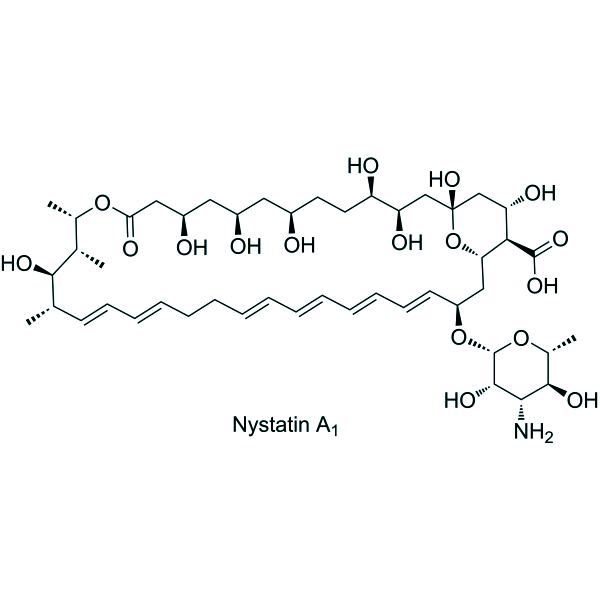
Estructura química
Peso molecular: 926.09
Control de calidad (Quality Control)
- Antibiotic Titer ≥ 4400 u/mg
- Citado en Nature Medicine por su calidad de primer nivel
- COA
- Hoja de datos
- SDS
| Dianas relacionadas | Integrase Bacterial Antibiotics Anti-infection Fungal Antiviral COVID-19 Parasite Reverse Transcriptase HIV |
|---|---|
| Otros Antibiotics for Mammalian Cell Culture Inhibidores | Tylosin tartrate |
Información química, almacenamiento y estabilidad (Chemical Information, Storage & Stability)
| Peso molecular | 926.09 | Fórmula | C47H75NO17 |
Almacenamiento (Desde la fecha de recepción) | |
|---|---|---|---|---|---|
| Nº CAS | 1400-61-9 | Descargar SDF | Almacenamiento de soluciones madre |
|
|
| Sinónimos | Fungicidin | Smiles | CC1C=CC=CCCC=CC=CC=CC=CC(CC2C(C(CC(O2)(CC(C(CCC(CC(CC(CC(=O)OC(C(C1OC3CC(C(C(O3)C)O)O)C)C)O)O)O)O)O)O)O)C(=O)O)OC4C(C(C(C(O4)C)O)N)O | ||
Calculadora de Molaridad
|
In vivo |
|||||
Calculadora de formulación in vivo (Solución clara)
Paso 1: Introduzca la información a continuación (Recomendado: Un animal adicional para tener en cuenta la pérdida durante el experimento)
Paso 2: Introduzca la formulación in vivo (Esto es solo la calculadora, no la formulación. Por favor, contáctenos primero si no hay una formulación in vivo en la sección de Solubilidad.)
Resultados del cálculo:
Concentración de trabajo: mg/ml;
Método para preparar el líquido maestro de DMSO: mg fármaco predissuelto en μL DMSO ( Concentración del líquido maestro mg/mL, Por favor, contáctenos primero si la concentración excede la solubilidad del DMSO del lote del fármaco. )
Método para preparar la formulación in vivo: Tomar μL DMSO líquido maestro, luego añadirμL PEG300, mezclar y clarificar, luego añadirμL Tween 80, mezclar y clarificar, luego añadir μL ddH2O, mezclar y clarificar.
Método para preparar la formulación in vivo: Tomar μL DMSO líquido maestro, luego añadir μL Aceite de maíz, mezclar y clarificar.
Nota: 1. Por favor, asegúrese de que el líquido esté claro antes de añadir el siguiente disolvente.
2. Asegúrese de añadir el (los) disolvente(s) en orden. Debe asegurarse de que la solución obtenida, en la adición anterior, sea una solución clara antes de proceder a añadir el siguiente disolvente. Se pueden utilizar métodos físicos como el vórtice, el ultrasonido o el baño de agua caliente para ayudar a la disolución.
Mecanismo de acción (Mechanism of Action)
| In vitro |
Nystatin results in a significant reduction in buccal epithelial cell adhesion of all six Candida species. This compound is an antibiotic that increases the permeability of plasma membranes to small monovalent ions, including chloridion. It increases apical chloridion permeability to the point where transepithelial chloridion transport is limited by transport across the basolateral membrane of tracheal epithelial cells, which reflects primarily the activity of the cotransporter. This chemical (400 units/ml) increases the basal level of transepithelial 36Cl flux approximately 1.5-fold and eliminates UTP stimulation of this flux. This treatment also abolishes UTP stimulation of saturable, basolateral [3H]bumetanide binding, a measure of functioning Na-K-Cl cotransporters in these cells; isoproterenol stimulation of binding is only mildly inhibited by nystatin treatment. It significantly enhances endostatin uptake by endothelial cells through switching endostatin internalization predominantly to the clathrin-mediated pathway. This compound-enhanced internalization of endostatin also increases its inhibitory effects on endothelial cell tube formation and migration. |
|---|---|
| In vivo |
Nystatin combined with endostatin selectively enhances endostatin uptake and biodistribution in tumor blood vessels and tumor tissues but not in normal tissues of tumor-bearing mice, ultimately resulting in elevated antiangiogenic and antitumor efficacies of endostatin in vivo. Liposomal this compound, at doses as low as 2 mg/kg of body weight/day, protects neutropenic mice against Aspergillus-induced death in a statistically significant manner at the 50-day time point compared to either the no-treatment, the saline, or the empty-liposome group. |
Referencias |
|
Información del ensayo clínico (Clinical Trial Information)
(datos de https://clinicaltrials.gov, actualizado el 2026-09-03)
| Número NCT | Reclutamiento | Condiciones | Patrocinador/Colaboradores | Fecha de inicio | Fases |
|---|---|---|---|---|---|
| NCT03178149 | RECRUITING | Age-Related Macular Degeneration |
Astellas Institute for Regenerative Medicine |
2018-07-13 | PHASE1 |
| NCT06616168 | ACTIVE_NOT_RECRUITING | Bacterial Vaginosis |
Danylo Halytsky Lviv National Medical University |
2023-09-01 | PHASE1 |
| NCT04550546 | COMPLETED | Dental Caries |
University of Rochester |
2021-05-15 | PHASE1 |
| NCT03862079 | WITHDRAWN | Graft-versus-host Disease Prevention |
M.D. Anderson Cancer Center |
2020-06-01 | PHASE2 |
| NCT04837664 | UNKNOWN | Candida Albicans Infection; Cigarette Smoking |
King Saud University |
2018-07-03 | PHASE3 |
| NCT03237533 | UNKNOWN | Oral Lichen Planus |
University of Faisalabad |
2017-06-01 | EARLY_PHASE1 |

Los productos son solo para uso de investigación. No para uso humano. No vendemos a pacientes.
©Copyright 2013 Selleck Chemicals. Todos los derechos reservados.