
solo para uso en investigación
Meropenem Antibiotics Químico
Cat. No.: S1381
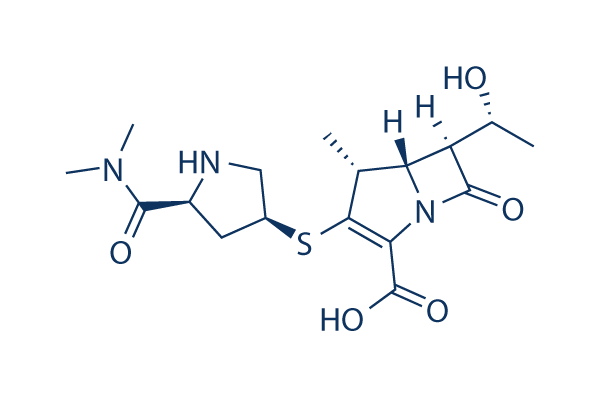
Estructura química
Peso molecular: 383.46
Control de calidad (Quality Control)
| Dianas relacionadas | Integrase Bacterial Anti-infection Fungal Antiviral COVID-19 Parasite Reverse Transcriptase HIV HCV Protease |
|---|---|
| Otros Antibiotics Inhibidores | Puromycin G418 Sulfate (Geneticin) Nanchangmycin Sitafloxacin Hydrate Nadifloxacin Spiramycin Trovafloxacin Mesylate G-418 Thiamphenicol Kitasamycin |
Información química, almacenamiento y estabilidad (Chemical Information, Storage & Stability)
| Peso molecular | 383.46 | Fórmula | C17H25N3O5S |
Almacenamiento (Desde la fecha de recepción) | |
|---|---|---|---|---|---|
| Nº CAS | 96036-03-2 | Descargar SDF | Almacenamiento de soluciones madre |
|
|
| Sinónimos | SM 7338 | Smiles | CC1C2C(C(=O)N2C(=C1SC3CC(NC3)C(=O)N(C)C)C(=O)O)C(C)O | ||
Solubilidad (Solubility)
|
In vitro |
Water : 77 mg/mL
DMSO
: Insoluble
Ethanol : Insoluble |
Calculadora de Molaridad
|
In vivo |
|||||
Calculadora de formulación in vivo (Solución clara)
Paso 1: Introduzca la información a continuación (Recomendado: Un animal adicional para tener en cuenta la pérdida durante el experimento)
Paso 2: Introduzca la formulación in vivo (Esto es solo la calculadora, no la formulación. Por favor, contáctenos primero si no hay una formulación in vivo en la sección de Solubilidad.)
Resultados del cálculo:
Concentración de trabajo: mg/ml;
Método para preparar el líquido maestro de DMSO: mg fármaco predissuelto en μL DMSO ( Concentración del líquido maestro mg/mL, Por favor, contáctenos primero si la concentración excede la solubilidad del DMSO del lote del fármaco. )
Método para preparar la formulación in vivo: Tomar μL DMSO líquido maestro, luego añadirμL PEG300, mezclar y clarificar, luego añadirμL Tween 80, mezclar y clarificar, luego añadir μL ddH2O, mezclar y clarificar.
Método para preparar la formulación in vivo: Tomar μL DMSO líquido maestro, luego añadir μL Aceite de maíz, mezclar y clarificar.
Nota: 1. Por favor, asegúrese de que el líquido esté claro antes de añadir el siguiente disolvente.
2. Asegúrese de añadir el (los) disolvente(s) en orden. Debe asegurarse de que la solución obtenida, en la adición anterior, sea una solución clara antes de proceder a añadir el siguiente disolvente. Se pueden utilizar métodos físicos como el vórtice, el ultrasonido o el baño de agua caliente para ayudar a la disolución.
Mecanismo de acción (Mechanism of Action)
| In vitro |
Meropenem has an antibacterial spectrum which is broadly similar to that of imipenem but, whilst slightly less active against staphylococci and enterococci, it is more active against Pseudomonas aeruginosa, all Enterobacteriaceae and Haemophilus influenzae. This compound is two- to four-fold more active than imipenem against Gram-negative organisms and its spectrum of antimicrobial activity is wider than those of all other drugs tested. Its MICs are not significantly influenced by high inocula and the drug is generally bactericidal. It demonstrates antagonism with several other beta-lactams against strains producing Type I cephalosporinases. This antibiotic binds most strongly to penicillin-binding protein 2 of Escherichia coli and Pseudomonas aeruginosa, and to penicillin-binding proteins 1 of Staphylococcus aureus. This chemical is a new carbapenem antibiotic which differs chemically from imipenem/cilastatin by having a 1-beta-methyl substitution, providing it with excellent intrinsic stability to human renal dehydropeptidase-I. It has one identified metabolite, a beta-lactam ring-opened form which is devoid of microbiological activity.
|
|---|---|
| In vivo |
Meropenem significantly increases the plamsa total clearance of valproate to about 1.5 times the control (6.09 mL/min/kg vs. 4.28 mL/min/kg) in rabbits. This compound significantly increases the urinary excretion of valproate- glucuronide in rabbits.
|
Referencias |
|
Información del ensayo clínico (Clinical Trial Information)
(datos de https://clinicaltrials.gov, actualizado el 2026-08-12)
| Número NCT | Reclutamiento | Condiciones | Patrocinador/Colaboradores | Fecha de inicio | Fases |
|---|---|---|---|---|---|
| NCT07759453 | NOT_YET_RECRUITING | Liver Transplant; Carbapenem-resistant Enterobacterales; CRE Colonization |
IRCCS Azienda Ospedaliero-Universitaria di Bologna |
2026-10-01 | PHASE3 |
| NCT07004049 | RECRUITING | Bloodstream Infection; Ventilator Associated Bacterial Pneumonia; Hospital Acquired Bacterial Pneumonia; Carbapenem Resistant Bacterial Infection; Multidrug Resistance |
National University of Singapore |
2025-04-21 | PHASE4 |
| NCT06184659 | RECRUITING | Sepsis; Septic Shock |
Scandinavian Critical Care Trials Group |
2025-06-26 | PHASE4 |
| NCT07556107 | RECRUITING | Infection; Acute Kidney Injury; Sepsis |
Bassett Healthcare |
2026-08-17 | PHASE4 |
| NCT07327619 | RECRUITING | Hospital-acquired Bacterial Pneumonia and Ventilator-associated Bacterial Pneumonia |
Qilu Pharmaceutical Co., Ltd. |
2026-01-22 | PHASE3 |
| NCT07484633 | NOT_YET_RECRUITING | Infection; Sepsis; NICU; PICU; Beta Lactams |
Semmelweis University |
2026-04 | PHASE4 |

Los productos son solo para uso de investigación. No para uso humano. No vendemos a pacientes.
©Copyright 2013 Selleck Chemicals. Todos los derechos reservados.