
solo para uso en investigación
GSK690693 inhibidor pan-Akt
Cat. No.: S1113
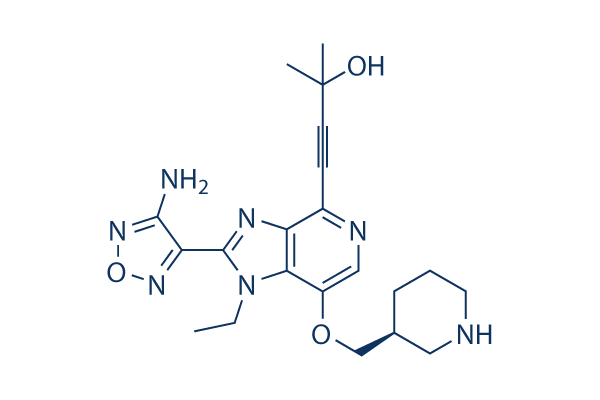
Estructura química
Peso molecular: 425.48
Control de calidad (Quality Control)
| Dianas relacionadas | PI3K mTOR GSK-3 ATM/ATR DNA-PK AMPK PDPK1 PTEN PI4K PP2A |
|---|---|
| Otros Akt Inhibidores | SC79 AZD5363 (Capivasertib) MK-2206 Dihydrochloride Ipatasertib (GDC-0068) Perifosine Triciribine (API-2) Afuresertib (GSK2110183) CCT128930 A-674563 HCl AKTi-1/2 (AKT Inhibitor VIII) |
Cultivo celular, tratamiento y concentración de trabajo
(Cell Culture, Treatment & Working Concentration)
| Líneas celulares | Tipo de ensayo | Concentración | Tiempo de incubación | Formulación | Descripción de la actividad | PMID |
|---|---|---|---|---|---|---|
| LNCaP | Proliferation assay | Antiproliferative activity against human LNCaP cells, IC50=20 nM | 18800763 | |||
| BT474 | Proliferation assay | Antiproliferative activity against human BT474 cells, IC50=50 nM | 18800763 | |||
| Sf9 | Function assay | Inhibition of human recombinant ROCK1 expressed in Sf9 cells, IC50=0.89 μM | 18800763 | |||
| NCI-H460 | Growth inhibition assay | 72 h | Growth inhibition of human NCI-H460 cells after 72 hrs by coulter counter method, IC50=5.4 μM | 24900862 | ||
| PC3 | Proliferation assay | 72 h | Antiproliferative activity against human PC3 cells after 72 hrs by MTT assay, IC50=15.5 μM | 24308997 | ||
| HFF | Cytotoxic assay | Cytotoxicity against HFF cells, IC50=16.3 μM | 18800763 | |||
| LNCAP | Antiproliferative assay | Antiproliferative activity against human LNCAP cells, IC50 = 0.021 μM. | 19179070 | |||
| BT474 | Antiproliferative assay | Antiproliferative activity against human BT474 cells, IC50 = 0.069 μM. | 19179070 | |||
| BT474 | Function assay | Inhibition of GSK3-beta phosphorylation in human BT474 cells, IC50 = 0.138 μM. | 19179070 | |||
| JVM2 | Antiproliferative assay | 72 hrs | Antiproliferative activity against human JVM2 cells after 72 hrs by CellTiter Glo assay, IC50 = 1.6 μM. | 28704757 | ||
| JeKo1 | Antiproliferative assay | 72 hrs | Antiproliferative activity against human JeKo1 cells after 72 hrs by CellTiter Glo assay, IC50 = 3 μM. | 28704757 | ||
| Z138 | Antiproliferative assay | 72 hrs | Antiproliferative activity against human Z138 cells after 72 hrs by CellTiter Glo assay, IC50 = 3.1 μM. | 28704757 | ||
| SP49 | Antiproliferative assay | 72 hrs | Antiproliferative activity against human SP49 cells after 72 hrs by CellTiter Glo assay, IC50 = 4.8 μM. | 28704757 | ||
| Maver1 | Antiproliferative assay | 72 hrs | Antiproliferative activity against human Maver1 cells after 72 hrs by CellTiter Glo assay, IC50 = 5.1 μM. | 28704757 | ||
| C6 | Function assay | 24 hrs | Inhibition of Akt in rat C6 cells after 24 hrs by ELISA, IC50 = 6.97 μM. | 29966916 | ||
| C6 | Cytotoxicity assay | 24 hrs | Cytotoxicity against rat C6 cells assessed as decrease in cell viability after 24 hrs by MTT assay, IC50 = 14.5 μM. | 29966916 | ||
| A549 | Function assay | 24 hrs | Inhibition of Akt in human A549 cells after 24 hrs by ELISA, IC50 = 17.33 μM. | 29966916 | ||
| Mino | Antiproliferative assay | 72 hrs | Antiproliferative activity against human Mino cells after 72 hrs by CellTiter Glo assay, IC50 = 20.8 μM. | 28704757 | ||
| A673 | qHTS assay | qHTS of pediatric cancer cell lines to identify multiple opportunities for drug repurposing: Primary screen for A673 cells | 29435139 | |||
| RD | qHTS assay | qHTS of pediatric cancer cell lines to identify multiple opportunities for drug repurposing: Primary screen for RD cells | 29435139 | |||
| NB1643 | qHTS assay | qHTS of pediatric cancer cell lines to identify multiple opportunities for drug repurposing: Primary screen for NB1643 cells | 29435139 | |||
| SJ-GBM2 | qHTS assay | qHTS of pediatric cancer cell lines to identify multiple opportunities for drug repurposing: Primary screen for SJ-GBM2 cells | 29435139 | |||
| SK-N-MC | qHTS assay | qHTS of pediatric cancer cell lines to identify multiple opportunities for drug repurposing: Primary screen for SK-N-MC cells | 29435139 | |||
| NB-EBc1 | qHTS assay | qHTS of pediatric cancer cell lines to identify multiple opportunities for drug repurposing: Primary screen for NB-EBc1 cells | 29435139 | |||
| LAN-5 | qHTS assay | qHTS of pediatric cancer cell lines to identify multiple opportunities for drug repurposing: Primary screen for LAN-5 cells | 29435139 | |||
| MCL | Antiproliferative assay | 24 hrs | Antiproliferative activity against primary human MCL cells up to 60 uM after 24 hrs by CellTiter Glo assay | 28704757 | ||
| Haga clic para ver más datos experimentales de líneas celulares | ||||||
Información química, almacenamiento y estabilidad (Chemical Information, Storage & Stability)
| Peso molecular | 425.48 | Fórmula | C21H27N7O3 |
Almacenamiento (Desde la fecha de recepción) | |
|---|---|---|---|---|---|
| Nº CAS | 937174-76-0 | Descargar SDF | Almacenamiento de soluciones madre |
|
|
| Sinónimos | N/A | Smiles | CCN1C2=C(C(=NC=C2OCC3CCCNC3)C#CC(C)(C)O)N=C1C4=NON=C4N | ||
Solubilidad (Solubility)
|
In vitro |
DMSO
: 21 mg/mL
(49.35 mM)
Water : Insoluble Ethanol : Insoluble |
Calculadora de Molaridad
|
In vivo |
|||||
Calculadora de formulación in vivo (Solución clara)
Paso 1: Introduzca la información a continuación (Recomendado: Un animal adicional para tener en cuenta la pérdida durante el experimento)
Paso 2: Introduzca la formulación in vivo (Esto es solo la calculadora, no la formulación. Por favor, contáctenos primero si no hay una formulación in vivo en la sección de Solubilidad.)
Resultados del cálculo:
Concentración de trabajo: mg/ml;
Método para preparar el líquido maestro de DMSO: mg fármaco predissuelto en μL DMSO ( Concentración del líquido maestro mg/mL, Por favor, contáctenos primero si la concentración excede la solubilidad del DMSO del lote del fármaco. )
Método para preparar la formulación in vivo: Tomar μL DMSO líquido maestro, luego añadirμL PEG300, mezclar y clarificar, luego añadirμL Tween 80, mezclar y clarificar, luego añadir μL ddH2O, mezclar y clarificar.
Método para preparar la formulación in vivo: Tomar μL DMSO líquido maestro, luego añadir μL Aceite de maíz, mezclar y clarificar.
Nota: 1. Por favor, asegúrese de que el líquido esté claro antes de añadir el siguiente disolvente.
2. Asegúrese de añadir el (los) disolvente(s) en orden. Debe asegurarse de que la solución obtenida, en la adición anterior, sea una solución clara antes de proceder a añadir el siguiente disolvente. Se pueden utilizar métodos físicos como el vórtice, el ultrasonido o el baño de agua caliente para ayudar a la disolución.
Mecanismo de acción (Mechanism of Action)
| Targets/IC50/Ki |
ULK1
STING
AMPK
Akt1
(Cell-free assay) 2 nM
PKCη
(Cell-free assay) 2 nM
PKCθ
(Cell-free assay) 2 nM
PrkX
(Cell-free assay) 5 nM
Akt3
(Cell-free assay) 9 nM
Akt2
(Cell-free assay) 13 nM
PKCδ
(Cell-free assay) 14 nM
PKCβ
(Cell-free assay) 19 nM
PKCε
(Cell-free assay) 21 nM
PKA
(Cell-free assay) 24 nM
PKG1β
(Cell-free assay) 33 nM
|
|---|---|
| In vitro |
GSK690693 is very selective for the Akt isoforms versus the majority of kinases in other families. However, this compound is less selective for members of the AGC kinase family including PKA, PrkX, and PKC isozymes with IC50 of 24 nM, 5 nM, and 2-21 nM, respectively. It also potently inhibits AMPK and DAPK3 from the CAMK family with IC50 of 50 nM and 81 nM, respectively, and PAK4, 5, and 6 from the STE family with IC50 of 10 nM, 52 nM, and 6 nM, respectively. This chemical inhibits the phosphorylation of GSK3β in tumor cells with IC50 ranging from 43 nM to 150 nM. Its treatment leads to a dose-dependent increase in the nuclear accumulation of the transcription factor FOXO3A. This compound potently inhibits the proliferation of T47D, ZR-75-1, BT474, HCC1954, MDA-MB-453, and LNCaP cells with IC50 of 72 nM, 79 nM, 86 nM, 119 nM, 975 nM, and 147 nM, respectively. Its treatment induces apoptosis at concentrations >100 nM in both LNCaP and BT474 cells. Consistent with the role of AKT in cell survival, it induces apoptosis in sensitive ALL cell lines. |
| Ensayo de quinasa |
Ensayos de quinasa in vitro
|
|
Akt1, 2 o 3 de longitud completa con etiqueta His se expresan y purifican de baculovirus. La activación se lleva a cabo con PDK1 purificada para fosforilar Thr308 y MK2 purificada para fosforilar Ser473. Para medir con mayor precisión la inhibición de Akt dependiente del tiempo, las enzimas Akt activadas se incuban con GSK690693 a varias concentraciones a temperatura ambiente durante 30 minutos antes de que la reacción se inicie con la adición de sustrato. La reacción final contiene 5 nM a 15 nM de enzimas Akt1, 2 y 3; 2 μM de ATP; 0,15 μCi/μL [γ-33P]ATP; 1 μM de péptido (Biotin-aminohexanoicacid-ARKR-ERAYSFGHHA-amida); 10 mM de MgCl2; 25 mM de MOPS (pH 7,5); 1 mM de DTT; 1 mM de CHAPS; y 50 mM de KCl. Las reacciones se incuban a temperatura ambiente durante 45 minutos, seguidas de la terminación con perlas Leadseeker en PBS que contiene EDTA (concentración final, 2 mg/mL de perlas y 75 mM de EDTA). Luego se sellan las placas, se dejan asentar las perlas durante al menos 5 horas y la formación del producto se cuantifica usando un generador de imágenes Viewlux.
|
|
| In vivo |
A single administration of GSK690693 inhibits GSK3β phosphorylation in human breast carcinoma (BT474) xenografts in a dose- and time-dependent manner. Similarly, this compound induces a reduction in phosphorylation of the Akt substrates, PRAS40, and FKHR/FKHRL1. It also results in an acute increase in blood glucose, returning to baseline 8 to 10 hours after drug administration. Administration of this chemical induces reductions in phosphorylated Akt substrates in vivo, and potently inhibits the growth of human SKOV-3 ovarian, LNCaP prostate, and BT474 and HCC-1954 breast carcinoma xenografts, with maximal inhibition of 58% to 75% at the dose of 30 mg/kg/day. This compound exhibits efficacy irrespective of the mechanism of Akt activation involved. It is most effective in delaying tumor progression in Lck-MyrAkt2 mice expressing a membrane-bound, constitutively active form of Akt. |
Referencias |
|
Aplicaciones (Applications)
| Métodos | Biomarcadores | Imágenes | PMID |
|---|---|---|---|
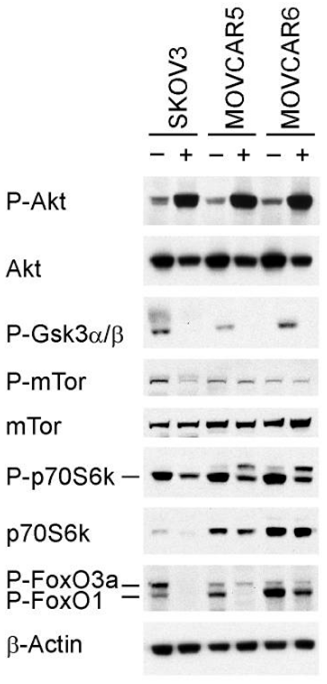
| Western blot | p-Akt / Akt / p-GSK3 / p-mTOR / mTOR / p-p70S6K / p-FoxO3a / p-FoxO1 pPRAS40 / PRAS40 / pBAD / BAD |
|
20075391 |
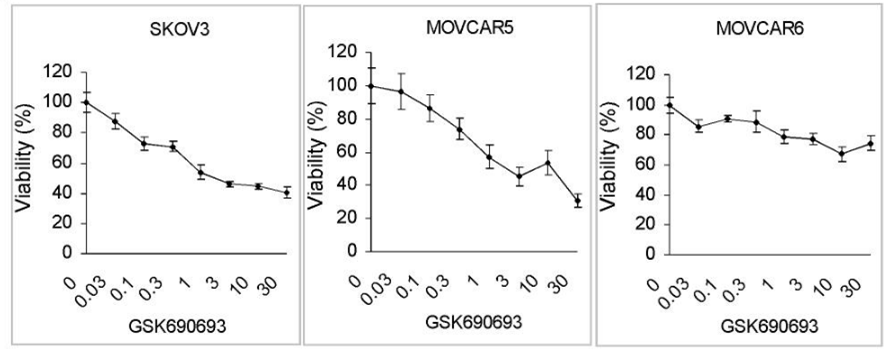
| Growth inhibition assay | Cell viability |
|
20075391 |
Información del ensayo clínico (Clinical Trial Information)
(datos de https://clinicaltrials.gov, actualizado el 2015-04-17)
| Número NCT | Reclutamiento | Condiciones | Patrocinador/Colaboradores | Fecha de inicio | Fases |
|---|---|---|---|---|---|
| NCT00666081 | WITHDRAWN | Cancer |
GlaxoSmithKline |
2008-04 | PHASE1 |
| NCT00493818 | TERMINATED | Cancer |
GlaxoSmithKline |
2007-04 | PHASE1 |
| NCT00666081 | Withdrawn | Cancer |
GlaxoSmithKline |
2008-04 | Phase 1 |
| NCT00493818 | Terminated | Cancer |
GlaxoSmithKline |
2007-04 | Phase 1 |
Preguntas frecuentes (Frequently Asked Questions)
Pregunta 1:
Why did pAKT increase after treatment with it?
Respuesta:
It actually inhibits AKT, but does not necessarily decrease p-Akt level. Treatment with this compound caused AKT hyper phosphorylation which has already been reported in some papers. (For example, http://www.bloodjournal.org/content/113/8/1723.short?sso-checked=true). To test the inhibition of AKT activity, you might have to look at the level of AKT substrates.

Los productos son solo para uso de investigación. No para uso humano. No vendemos a pacientes.
©Copyright 2013 Selleck Chemicals. Todos los derechos reservados.