
solo para uso en investigación
Aprepitant Neurokinin Receptor Antagonista
Cat. No.: S1189
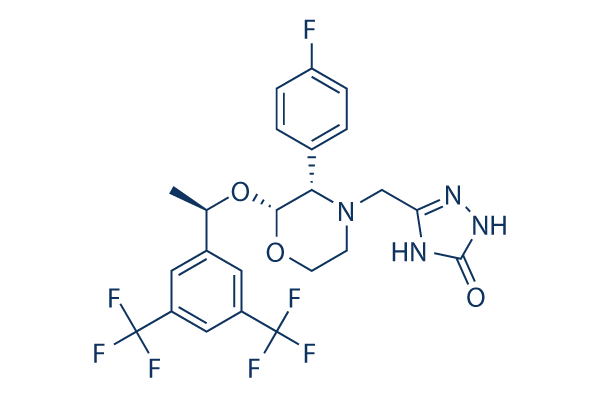
Estructura química
Peso molecular: 534.43
Control de calidad (Quality Control)
| Dianas relacionadas | Adrenergic Receptor AChR 5-HT Receptor COX Calcium Channel Histamine Receptor Dopamine Receptor GABA Receptor TRP Channel Cholinesterase (ChE) |
|---|---|
| Otros Neurokinin Receptor Inhibidores | L-732138 Fezolinetant Maropitant citrate Asparagus Extract Tradipitant Substance P Elinzanetant |
Cultivo celular, tratamiento y concentración de trabajo
(Cell Culture, Treatment & Working Concentration)
| Líneas celulares | Tipo de ensayo | Concentración | Tiempo de incubación | Formulación | Descripción de la actividad | PMID |
|---|---|---|---|---|---|---|
| CHO cells | Function assay | Displacement of [125I]SP from human NK1 receptor expressed in CHO cells, IC50=9e-05 μM | ||||
| HEK293 cell | Function assay | Displacement of [125I]-substance P from gerbil NK1 receptor expressed in HEK293 cell membranes incubated for 30 mins by liquid scintillation counting method, IC50=9e-05 μM | ||||
| HEK293 cell | Function assay | Noncompetitive inhibition of wild type human NK1 receptor expressed in HEK293 cells assessed as decrease in SP1-induced [3H]IP accumulation after 20 mins | ||||
| Haga clic para ver más datos experimentales de líneas celulares | ||||||
Información química, almacenamiento y estabilidad (Chemical Information, Storage & Stability)
| Peso molecular | 534.43 | Fórmula | C23H21F7N4O3 |
Almacenamiento (Desde la fecha de recepción) | |
|---|---|---|---|---|---|
| Nº CAS | 170729-80-3 | Descargar SDF | Almacenamiento de soluciones madre |
|
|
| Sinónimos | MK-0869, L-754030 | Smiles | CC(C1=CC(=CC(=C1)C(F)(F)F)C(F)(F)F)OC2C(N(CCO2)CC3=NNC(=O)N3)C4=CC=C(C=C4)F | ||
Solubilidad (Solubility)
|
In vitro |
DMSO
: 107 mg/mL
(200.21 mM)
Ethanol : 15 mg/mL Water : Insoluble |
Calculadora de Molaridad
|
In vivo |
|||||
Calculadora de formulación in vivo (Solución clara)
Paso 1: Introduzca la información a continuación (Recomendado: Un animal adicional para tener en cuenta la pérdida durante el experimento)
Paso 2: Introduzca la formulación in vivo (Esto es solo la calculadora, no la formulación. Por favor, contáctenos primero si no hay una formulación in vivo en la sección de Solubilidad.)
Resultados del cálculo:
Concentración de trabajo: mg/ml;
Método para preparar el líquido maestro de DMSO: mg fármaco predissuelto en μL DMSO ( Concentración del líquido maestro mg/mL, Por favor, contáctenos primero si la concentración excede la solubilidad del DMSO del lote del fármaco. )
Método para preparar la formulación in vivo: Tomar μL DMSO líquido maestro, luego añadirμL PEG300, mezclar y clarificar, luego añadirμL Tween 80, mezclar y clarificar, luego añadir μL ddH2O, mezclar y clarificar.
Método para preparar la formulación in vivo: Tomar μL DMSO líquido maestro, luego añadir μL Aceite de maíz, mezclar y clarificar.
Nota: 1. Por favor, asegúrese de que el líquido esté claro antes de añadir el siguiente disolvente.
2. Asegúrese de añadir el (los) disolvente(s) en orden. Debe asegurarse de que la solución obtenida, en la adición anterior, sea una solución clara antes de proceder a añadir el siguiente disolvente. Se pueden utilizar métodos físicos como el vórtice, el ultrasonido o el baño de agua caliente para ayudar a la disolución.
Mecanismo de acción (Mechanism of Action)
| Targets/IC50/Ki |
G-CSF
IL-6
IL-8
TNFα
Neurokinin-1 receptor
(Cell-free assay) 0.1 nM
|
|---|---|
| In vitro |
Aprepitant antagonizes the effects of substance P by binding to NK-1 receptors primarily in the CNS, but also in the periphery. This compound, at concentrations of 0.1 nM displaces 50% of substance P from hNK1 receptors transfected in CHO or COS cells. In radioligand binding assays, it is 3000-fold selective for the human cloned NK1 receptor versus the human cloned NK3 receptor and >50,000-fold selective over the human cloned NK2 receptor. In a range of assays at other human cloned G–protein coupled receptors, this chemical retains >50,000-fold selectivity for the human cloned NK1 receptor. It is inactive in human monoamine oxidase A and B assays and at human serotonin 5–HT1A, 5–HT2A, 5–HT2c, 5–HT3, 5–HT5, 5–HT6, and 5–HT7 receptors (IC50>3 μM). In the PANLABS panel of radioligand binding screens using native animal tissues, this compound inhibits [3H]substance P binding to native NK1 receptors in rat submaxillary gland; there are no significant interactions of it with any other native animal G–protein coupled receptors or ion channels examined in the PANLABS screen. It is inactive in monoamine uptake site (NE, 5–HT, DA) counterscreens using human and animal tissues (IC50> 3 μM) |
| In vivo |
Aprepitant crosses the blood–brain barrier and occupied NK-1 receptors in the brain. This compound has been shown to inhibit both acute and delayed emesis induced by cytotoxic chemotherapeutic such as cisplatin by blocking substance P. It (3 mg/kg i.v. or p.o.) inhibits the emetic response to cisplatin (10 mg/kg i.v.). The anti-emetic protection afforded by this chemical (0.1 mg/kg i.v.) is enhanced by combined treatment with either dexamethasone (20 mg/kg i.v.) or the 5–HT3 receptor antagonist ondansetron (0.1 mg/kg i.v.). In a model of acute and delayed emesis, ferrets are dosed with cisplatin (5 mg/kg i.p.) and the retching and vomiting response recorded for 72 h. Pretreatment with it (4–16 mg/kg p.o.) dose-dependently inhibits the emetic response to cisplatin. Once daily treatment with this compound (2 and 4 mg/kg p.o.) completely prevents retching and vomiting in all ferrets tested. Further when daily dosing began at 24 h after cisplatin injection, when the acute phase of emesis had already become established, it (4 mg/kg p.o. at 24 and 48 h after cisplatin) prevents retching and vomiting in three out of four ferrets. This chemical also plays a key part in transmission of pain impulses from the peripheral receptors to the CNS and is involved in various behavioural, neurochemical and cardiovascular responses to stress. |
Referencias |
|
Información del ensayo clínico (Clinical Trial Information)
(datos de https://clinicaltrials.gov, actualizado el 2023-05-03)
| Número NCT | Reclutamiento | Condiciones | Patrocinador/Colaboradores | Fecha de inicio | Fases |
|---|---|---|---|---|---|
| NCT05841849 | NOT_YET_RECRUITING | Breast Cancer; Chemotherapy-induced Nausea and Vomiting |
Second Affiliated Hospital, Zhejiang University, School of Medicine |
2023-07 | PHASE4 |
| NCT06740812 | NOT_YET_RECRUITING | Nausea and Vomiting; Nausea; Vomiting |
Montefiore Medical Center |
2026-12 | PHASE4 |
| NCT07662200 | NOT_YET_RECRUITING | Germ Cell Cancer |
Ottawa Hospital Research Institute |
2026-08 | EARLY_PHASE1 |
| NCT07639723 | NOT_YET_RECRUITING | PONV |
Endeavor Health |
2026-07 | PHASE4 |
| NCT06462287 | RECRUITING | Apnea, Obstructive |
University Hospital, Rouen |
2024-03-05 | PHASE2 |
| NCT07371728 | NOT_YET_RECRUITING | Otologic Disease |
Sir Mortimer B. Davis - Jewish General Hospital |
2026-06-01 | PHASE4 |

Los productos son solo para uso de investigación. No para uso humano. No vendemos a pacientes.
©Copyright 2013 Selleck Chemicals. Todos los derechos reservados.