
Bevacizumab (anti-VEGF)
Synoniemen: rhuMab VEGF
Bevacizumab (anti-VEGF, Avastin) is een gehumaniseerd anti-VEGF monoklonaal antilichaam dat bindt aan en alle humane VEGF-A-isoformen en bioactieve proteolytische fragmenten neutraliseert, MW:149 KD.
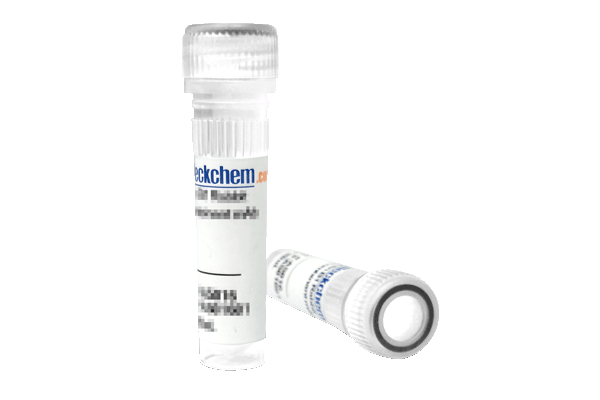
Klik om de isotypecontrole van te kopen
48 Citaties

17 Nobelprijswinnaars
hebben Selleck producten gebruikt
Shimon Sakaguchi
Nature Communications 2025;16, Article number:1325
David Baker
Dev Cell 2023;58(20):2163-2180.e9.
Michael Houghton
Cell Chem Biol 2020;27(7):780-792.e5
David Julius
Cell 2017;185-198.e16
Charles M. Rice
Cell 2018;172(3):423-438.e25
Kwaliteitscontrole
Specificiteit
| Naam | Citation | VEGFR1 | VEGFR2 | VEGFR3 | Overige |
|---|---|---|---|---|---|
| Foretinib | 94 | Met,Tie-2,RON | |||
| Cediranib (AZD2171) | 67 | c-Kit,PDGFRβ,FGFR1 | |||
| PD173074 | 124 | FGFR1 | |||
| Dovitinib (TKI-258) | 52 | FLT3,c-Kit,FGFR1 | |||
| Linifanib (ABT-869) | 33 | CSF-1R,FLT3,Kit | |||
| Vatalanib (PTK787) 2HCl | 53 | PDGFRβ,c-Kit,c-Fms | |||
| RAF265 (CHIR-265) | 24 | B-Raf | |||
| Motesanib Diphosphate (AMG-706) | 12 | Kit,RET,PDGFR | |||
| Brivanib (BMS-540215) | 10 | FGFR1 | |||
| MGCD-265 analog | 12 | Met,RON,Tie-2 | |||
| AEE788 (NVP-AEE788) | 13 | EGFR,HER2/ErbB2,c-Abl | |||
| ENMD-2076 | 9 | FLT3,RET,Aurora A | |||
| OSI-930 | 7 | CSF-1R,LCK,C-Raf | |||
| CYC116 | 10 | Aurora A,Aurora B,FLT3 | |||
| Ki8751 | 21 | c-Kit,PDGFRα | |||
| Telatinib | 5 | c-Kit,PDGFRα | |||
| KRN 633 | 6 | PDGFRα,c-Kit,BTK | |||
| SAR131675 | 34 | ||||
| Apatinib (YN968D1) mesylate | 26 | RET | |||
| BMS-794833 | 2 | Met | |||
| Brivanib Alaninate (BMS-582664) | 2 | FGFR1 | |||
| Golvatinib (E7050) | 8 | c-Met | |||
| Semaxanib (SU5416) | 21 | ||||
| ZM 323881 HCl | 20 | ||||
| ZM 306416 | 13 | Src,Abl | |||
| Sitravatinib (MGCD516) | 7 | DDR2,EPHA3,Axl | |||
| BFH772 | 0 | ||||
| BAW2881 (NVP-BAW2881) | 3 | C-Raf-1,B-RAFV599E,c-Abl | |||
| SU 5402 | 24 | FGFR1,PDGFRβ | |||
| Dovitinib (TKI258) Lactate monohydrate | 31 | FLT3,c-Kit,FGFR1 | |||
| LY2874455 | 15 | FGFR2,FGFR1,FGFR4 | |||
| SKLB1002 | 5 | ||||
| AZD2932 | 3 | PDGFRβ,Flt3,c-Kit |
2. "✔" duidt op een remmend effect, maar zonder specifieke waarde.
Werkingsmechanisme
| Beschrijving |
Bevacizumab (anti-VEGF, Avastin) is een gehumaniseerd anti-VEGF monoklonaal antilichaam dat bindt aan en alle humane VEGF-A-isoformen en bioactieve proteolytische fragmenten neutraliseert, MW:149 KD.
|
|---|---|
| Kenmerken |
Human IgG1
|
| Targets/IC50/Ki |
VEGFR2
VEGF-A
VEGF
|
| In vitro |
Het blokkeren van VEGF met bevacizumab vermindert het pro-angiogene effect van aangetaste fibroblasten in zowel de matrigel- als de directe co-cultuur Angiogenesis-modellen. |
| Celonderzoek |
Matrigel-gels werden gemaakt met behulp van low GF Matrigel (eiwitconcentratie > 9,5 mg/ml) in een 48-wells plaat. Het werd 's nachts bij 37 ℃ gegeld en vervolgens tweemaal gespoeld met PBS. Endotheelcellen (ECs) werden toegevoegd in 250 μl endotheelbasismedium zonder supplement en mochten 1 uur hechten. Een extra 250 μl van 48 uur geconditioneerd medium van niet-aangetaste of aangetaste fibroblasten of niet-geconditioneerd medium met of zonder 20 ng/ml VEGF en met of zonder 250 μl/ml bevacizumab in 5% FBS + 1% penicilline/streptomycine in DMEM werd toegevoegd, en EC's werden 14 uur geïncubeerd voordat ze werden gefixeerd en gekleurd voor CD31. De vorming van het ECs-netwerk werd ook gevolgd door live-cell imaging na 2, 4, 8, 16 en 24 uur. |
| In vivo |
De combinatietherapie van AAV9-LECT2-shRNA en bevacizumab verbetert de therapeutische effecten op leverfibrose aanzienlijk. |
| Dieronderzoek |
Dierlijke modellen: Mannelijke C57BL/6J muizen met een door CCl4 geïnduceerd fibrosemodel |
Referenties |
|
Productdetails
| CAS-nummer | 216974-75-3 |
|---|---|
| Isotype | Human IgG1 |
| Bron | CHO cells |
| Steriliteit | 0.2 μM filtered |
| Formulering | PBS buffer, pH 7.2 |
| Opslag | Store the undiluted solution at 4°C in the dark to avoid freeze-thaw cycles |
Vergelijking van klonen voor
*Literatuuranalyse van verschillende kloonproducten (voor dit doelwit) die op de markt verkrijgbaar zijn, toont aan dat de geselecteerde klonen van Selleck vaker worden toegepast. (gegevens tot september 2024)
Technische ondersteuning
Tel: +1-832-582-8158 Ext:3
Als u nog andere vragen heeft, kunt u een bericht achterlaten.
Veelgestelde vragen
Vraag 1:
How to store the antibody?
Antwoord:
Store the undiluted solution at 4 °C in the dark. Freezing antibodies can result in a loss of activity caused by the freezing/thawing process. Diluting antibodies to working concentrations and storing at 4°C for more than a day should be avoided. Additionally, make sure to keep the antibody sterile. Under these storage conditions, your antibodies should remain active for up to one year and oftentimes longer.

Producten zijn uitsluitend voor onderzoeksdoeleinden. Niet voor menselijk gebruik. Wij verkopen niet aan patiënten.
©Copyright 2013 Selleck Chemicals. Alle rechten voorbehouden.