
Données techniques
| Formule | C25H22N2O2 |
||||||||||||||
| Poids moléculaire | 382.45 | N° CAS | 890842-28-1 | ||||||||||||
| Solubilité (25°C)* | In vitro | DMSO | 76 mg/mL (198.71 mM) | ||||||||||||
| Water | Insoluble | ||||||||||||||
| Ethanol | Insoluble | ||||||||||||||
| In Vivo (Ajoutez les solvants au produit individuellement et dans lordre.) |
|
||||||||||||||
|
* <1 mg/ml signifie légèrement soluble ou insoluble. * Veuillez noter que Selleck teste la solubilité de tous les composés en interne, et la solubilité réelle peut différer légèrement des valeurs publiées. Ceci est normal et est dû à de légères variations dun lot à lautre. * Expédition à température ambiante (les tests de stabilité montrent que ce produit peut être expédié sans aucune mesure de refroidissement.) |
|||||||||||||||
Préparation des solutions mères
Activité biologique
| Description | GSK650394 est un inhibiteur de la sérum- et glucocorticoïde-régulée kinase-1 avec une IC50 de 62 nM et 103 nM pour SGK1 et SGK2, respectivement. | ||||
|---|---|---|---|---|---|
| Cibles |
|
||||
| In vitro | GSK650394 inhibe le transport épithélial médiatisé par SGK1 avec une CI50 de 0,6 μM dans l'essai SCC. Dans les cellules LNCaP, ce composé inhibe l'amélioration de la phosphorylation de Nedd4-2 médiatisée par les androgènes et la croissance cellulaire médiatisée par les androgènes. Ce produit chimique contrecarre la diminution de la neurogenèse induite par le Cortisol, les changements dans la signalisation Hedgehog et la translocation nucléaire de GR. [2] Il inhibe la réplication du virus de la grippe en altérant l'exportation des vRNP de la grippe dans le cytoplasme des cellules A549. |
Protocole (de référence)
| Test kinase :[1] |
|
|---|---|
| Test cellulaire :[1] |
|
Références
|
Validation du produit par le client
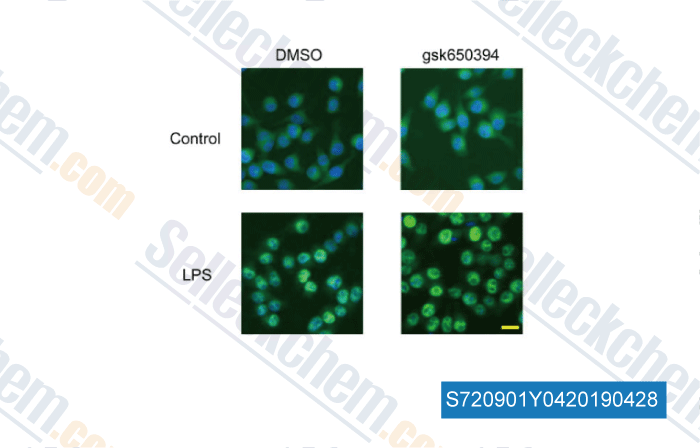
-
Données de [ , , Biochem Biophys Res Commun, 2016, 478(1):53-59 ]
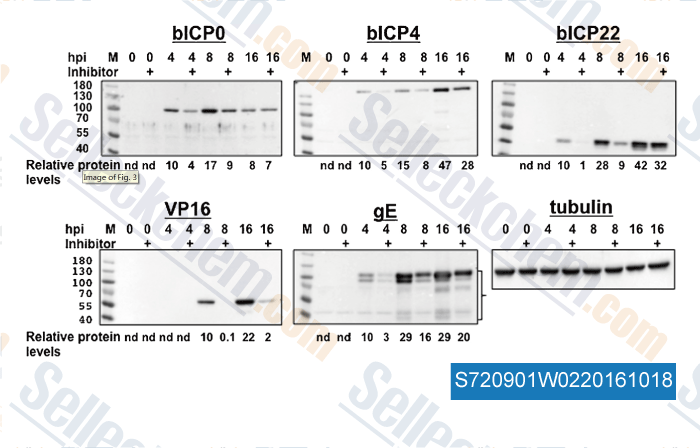
-
Données de [ , , Virus Res, 2016, 222:106-112. ]
De Selleck GSK650394 A été cité par 24 Publications
| Patient-derived enteroids provide a platform for the development of therapeutic approaches in microvillus inclusion disease [ J Clin Invest, 2023, 133(20)e169234] | PubMed: 37643022 |
| Bacterial DNA promoting inflammation via the Sgk1/Nedd4L/Syk pathway in mast cells contributes to antihistamine non-responsive CSU [ J Leukoc Biol, 2023, qiad025] | PubMed: 36857592 |
| Estrogen-sensitive activation of SGK1 induces M2 macrophages with anti-inflammatory properties and a Th2 response at the maternal-fetal interface [ Reprod Biol Endocrinol, 2023, 21(1):50] | PubMed: 37226177 |
| Inhibition of SGK1 potentiates the anticancer activity of PI3K inhibitor in NSCLC cells through modulation of mTORC1, p‑ERK and β‑catenin signaling [ Biomed Rep, 2023, 19(6):94] | PubMed: 37901878 |
| Therapy Development for Microvillus Inclusion Disease using Patient-derived Enteroids [ bioRxiv, 2023, 2023.01.28.526036] | PubMed: 36747680 |
| Activation of Serum/Glucocorticoid Regulated Kinase 1/Nuclear Factor-κB Pathway Are Correlated with Low Sensitivity to Bortezomib and Ixazomib in Resistant Multiple Myeloma Cells [ Biomedicines, 2021, 9(1)E33] | PubMed: 33406639 |
| Identification and Kinetic Characterization of Serum- and Glucocorticoid-Regulated Kinase Inhibitors Using a Fluorescence Polarization-Based Assay [ SLAS Discov, 2021, 24725552211002465] | PubMed: 33783250 |
| Crosstalk between Hedgehog pathway and the glucocorticoid receptor pathway as a basis for combination therapy in T-cell acute lymphoblastic leukemia [ Oncogene, 2020, 10.1038/s41388-020-01453-2] | PubMed: 32917954 |
| Convergent genomic and pharmacological evidence of PI3K/GSK3 signaling alterations in neurons from schizophrenia patients [ Neuropsychopharmacology, 2020, 10.1038/s41386-020-00924-0] | PubMed: 33288841 |
| Targeting histone K4 trimethylation for treatment of cognitive and synaptic deficits in mouse models of Alzheimer's disease [ Sci Adv, 2020, 6(50)eabc8096] | PubMed: 33298440 |
POLITIQUE DE RETOUR
La politique de retour inconditionnelle de Selleck Chemical garantit une expérience dachat en ligne fluide à nos clients. Si vous nêtes en aucun cas satisfait de votre achat, vous pouvez retourner tout article dans les 7 jours suivant sa réception. En cas de problèmes de qualité du produit, quil sagisse de problèmes liés au protocole ou au produit, vous pouvez retourner tout article dans les 365 jours suivant la date dachat initiale. Veuillez suivre les instructions ci-dessous lors du retour des produits.
EXPÉDITION ET STOCKAGE
Les produits Selleck sont transportés à température ambiante. Si vous recevez le produit à température ambiante, soyez assuré que le service dinspection de la qualité de Selleck a mené des expériences pour vérifier que le placement à température normale pendant un mois naffectera pas lactivité biologique des produits en poudre. Après réception, veuillez stocker le produit conformément aux exigences décrites dans la fiche technique. La plupart des produits Selleck sont stables dans les conditions recommandées.
NON DESTINÉ À UN USAGE HUMAIN, VÉTÉRINAIRE DIAGNOSTIQUE OU THÉRAPEUTIQUE.